
Making Money > Learn > Do You Pay Tax on Side Hustle Income? (US Guide)
Making Money · Side Hustles & Gig Work
Yes, side income is taxable in the US. Here is how it gets taxed depending on whether it counts as a W-2 job, a self-employed side business or a hobby, and how much to set aside.
The short answer to the side hustle taxes question is yes: money you earn outside your day job is taxable, whether it came by Venmo, cash or a client invoice. The IRS says so plainly in its gig economy tax center, and no form needs to show up in your mailbox for the income to count.
What changes is how it gets taxed. The same $10,000 can land on your return as wages from a part-time job, as profit from a small business you run, or as hobby income. There is no single “correct” bucket you get to pick; the facts of what you do decide it. This guide walks through all three so you know which rules apply to you.
Good News, You Don’t Have to Choose
Plenty of people have more than one kind of side income at once: a weekend retail shift on a W-2, freelance design billed on invoices, and the odd sale of handmade candles. Each stream follows its own rules, and they all sit on one Form 1040.
There’s also a shortcut if you have a day job. Instead of mailing quarterly payments for your freelance income, the IRS lets you raise the tax withheld from your paycheck by filing a new Form W-4 with your employer. That one change can cover the extra tax your side work creates.
At a Glance: How Side Hustle Taxes Work by Income Type
| What matters | W-2 part-time job | Self-employed side business | Hobby income |
|---|---|---|---|
| Tax withheld for you? | Yes, by your employer | No, you pay it yourself | No |
| 15.3% self-employment tax | No (you pay 7.65% FICA via payroll) | Yes, once net earnings hit $400 | No |
| Deduct your costs | Generally no | Yes, ordinary and necessary expenses | No |
| Main forms | W-2 | Schedule C, Schedule SE, 1099s | Schedule 1 (other income) |
| Quarterly payments | Rarely | Usually, if you’ll owe $1,000+ | Sometimes, if you’ll owe $1,000+ |
| 20% QBI deduction | No | Often yes | No |
| Losses offset other income | Not applicable | Generally yes | No |
Side Hustle Taxes, Criterion by Criterion
Withholding
A W-2 side job is the easy case: your employer withholds income tax and payroll tax from every check. A self-employed side business has no one doing that, and neither does hobby income. That gap is why so many first-year side hustlers get a surprise bill in April.
Most of the real work in side hustle taxes is filling that gap yourself. Track what comes in, estimate what you’ll owe, and pay before the IRS asks. The sections below show how each piece fits.
Self-Employment Tax
If your side work counts as a business, you owe self-employment tax once net earnings reach $400 for the year. It’s 15.3%: 12.4% for Social Security plus 2.9% for Medicare, because you’re both the worker and the employer.
For 2026, the Social Security part stops at $184,500 of combined earnings, including your day-job wages. You also get to deduct half of your self-employment tax when you work out your income tax. W-2 workers pay only their 7.65% half, and hobby income skips this tax completely.
Deductions
A business reports income and expenses on Schedule C, so you’re taxed on profit, not on gross receipts. Software, supplies, a share of your phone bill and business driving can all reduce what you owe.
Driving is a big one for delivery and rideshare work. The IRS set the 2026 standard mileage rate at 72.5 cents per business mile, then raised it to 76 cents for miles driven from July 1. Hobby expenses, by contrast, aren’t deductible at all.
Forms and 1099s
Clients and platforms may send you a Form 1099-NEC for freelance work or a Form 1099-K for payments run through apps and marketplaces. Business owners then add Schedule SE to calculate the 15.3% tax. Hobby income goes on Schedule 1 as other income, with no business forms attached.
Quarterly Payments
The US runs on pay-as-you-go. If you expect to owe $1,000 or more after withholding, the IRS generally wants estimated tax paid in four installments. Each one covers both income tax and self-employment tax.
You avoid an underpayment penalty if you pay at least 90% of this year’s tax or 100% of last year’s (110% if your income tops $150,000), whichever is smaller. The four 2026 deadlines don’t line up with calendar quarters, which trips people up.
Losses and the QBI Break
A real business that loses money in a year can generally use that loss to reduce your other taxable income. A hobby can’t. Profitable businesses may also take the qualified business income deduction, worth up to 20% of profit, which the 2025 One Big Beautiful Bill Act made permanent.
The 2026 1099 Rule Changes, and What They Don’t Change
The One Big Beautiful Bill Act, signed in July 2025, raised the reporting threshold for Forms 1099-NEC and 1099-MISC from $600 to $2,000 for payments made in 2026, with inflation adjustments starting in 2027. It also restored the 1099-K trigger for payment apps to $20,000 and more than 200 transactions.
That means fewer forms in your mailbox, not lower side hustle taxes. A client who pays you $1,800 no longer has to send a 1099, but you still report that $1,800. Keep your own income log by payment method so you’re not relying on forms that may never arrive.
What the Data Says About Side Income
Bankrate’s Side Hustle Survey, fielded in June 2025, found 27% of US adults had a side hustle. The median side hustler earned $200 a month, while the average was $885.
Run the median through the rules above and the tax angle gets real. $200 a month is $2,400 a year, well past the $400 line, so a self-employed earner at that level would owe roughly $340 in self-employment tax alone before income tax. Small side income still adds up to a filing obligation.
Those figures cover only the federal side of side hustle taxes. Most states charge their own income tax on the same profit, and some cities do too, so check your state’s revenue department site before you settle on a set-aside percentage.
A Halal-Aware Look at Side Hustle Taxes
Paying tax isn’t a riba issue in itself, but the way you handle it can drift into one. IRS underpayment penalties are calculated like interest, so paying quarterly on time is also the cleanest way to avoid interest-style charges.
Don’t pay a tax bill with a credit card you’ll carry a balance on, and keep your tax set-aside in a non-interest or profit-sharing account if that matters to you. If you open a SEP IRA to cut your bill, pick Shariah-screened funds inside it. Remember that taxes and zakat are separate: paying one doesn’t settle the other.
Pros and Cons by Income Type
None of these is a menu you order from, since your activity decides the category. Still, knowing the strengths of each helps you plan side hustle taxes and set up your work sensibly.
Where a W-2 Side Job Wins
- Taxes handled for you. Withholding comes out of each check, so April holds no surprises.
- Lower payroll tax. You pay 7.65% rather than 15.3%, since the employer covers the other half.
- The catch. You can’t deduct the costs of doing the work, and your hours aren’t your own.
Where a Self-Employed Side Business Wins
- Taxed on profit. Real business expenses come off the top before any tax is figured.
- Extra breaks. The 20% QBI deduction and self-employed retirement plans can shrink the bill.
- The catch. You owe the full 15.3% and must manage quarterly payments yourself.
Where Hobby Treatment Wins
- No self-employment tax. Only regular income tax applies.
- Simple paperwork. One line on Schedule 1, no Schedule C.
- The catch. Zero deductions, so a hobby with real costs can be taxed on money you never kept. The IRS weighs factors like profit motive and businesslike records to tell a hobby from a business, so you can’t simply declare one.
Which Rules Apply to You
Use your real situation, not a preference, to work out which side hustle taxes rules you face. If more than one line below fits, more than one set of rules applies.
- You get a paycheck from a second employer: W-2 rules. Check that your total withholding still covers both jobs.
- You freelance, drive, deliver or sell regularly to make money: self-employed business. Plan for the 15.3% and quarterly payments.
- You sell crafts a few times a year for fun, with no profit plan: likely a hobby. Report the income, but expect no write-offs.
- You have a day job plus freelance income: consider raising W-4 withholding instead of mailing quarterlies.
5 Tools That Make Side Hustle Taxes Easier
- Keeper scans linked bank and card accounts to flag likely write-offs, and offers filing.
- Found is business banking for the self-employed that can auto-save a share of each deposit for taxes.
- Everlance tracks business mileage and expenses for drivers and freelancers.
- IRS Direct Pay lets you pay estimated tax from a bank account for free, with no registration.
- EFTPS is the IRS payment system to use if you want to schedule payments ahead and keep a login.
The Bottom Line
These rules feel complicated mostly because nobody explains side hustle taxes before the first bill arrives. Once you know which bucket your income falls into, the rules are predictable: report everything, deduct real business costs, and pay as you go.
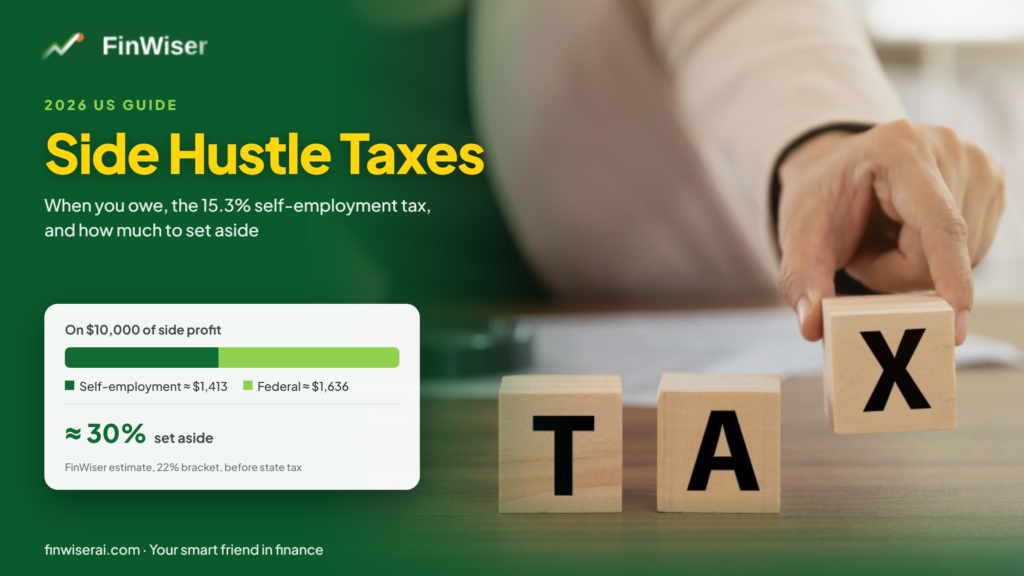
Start small this week. Open a separate tax savings account, move 30% of your last payout into it, and put the next quarterly deadline in your calendar. If your situation gets more complex, such as several states, big losses or high income, a credentialed tax preparer is worth the fee.
Key Takeaways
- Side hustle taxes apply to all side income, with or without a 1099, including cash and app payments.
- Self-employed side work owes 15.3% self-employment tax on top of income tax once net earnings reach $400.
- New 2026 thresholds ($2,000 for 1099-NEC, $20,000 and 200+ transactions for 1099-K) mean fewer forms, not less tax.
- Set aside about 30% of side profit and pay quarterly, or raise your W-4 withholding, to avoid penalties.
- Taxes aren’t riba, but late-payment penalties and card-funded tax bills work like interest, so plan ahead.
About the author
Sundas Tahir
Founder & CEO, FinWiser
Sundas Tahir founded FinWiser to make money decisions clearer. With close to eight years in finance and fintech, she has worked hands-on with financial accounts, payment flows and disputes, the day-to-day mechanics of how money actually moves. She writes about investing, banking and money tools with a halal-aware lens. Nothing here is personal financial advice. Think of FinWiser as the smart friend who reads the fine print so you don’t have to.
Further Reading From Top Finance Publishers
These outlets have covered the same question from different angles. Each link was checked before publishing.
- NerdWallet: Freelancer Taxes: A Guide for Filing With a Side Hustle (covers 1099s, Schedule C and retirement plans)
- GOBankingRates: What a ‘Small’ Side Gig Can Do to Your Tax Bill (CPA views on small side income)
- Kiplinger: When Are Estimated Tax Payments Due in 2026? (quarterly dates and how to pay)
- Bankrate: Self-Employment Tax: What It Is, How to Pay It (walks through the 15.3% math)