
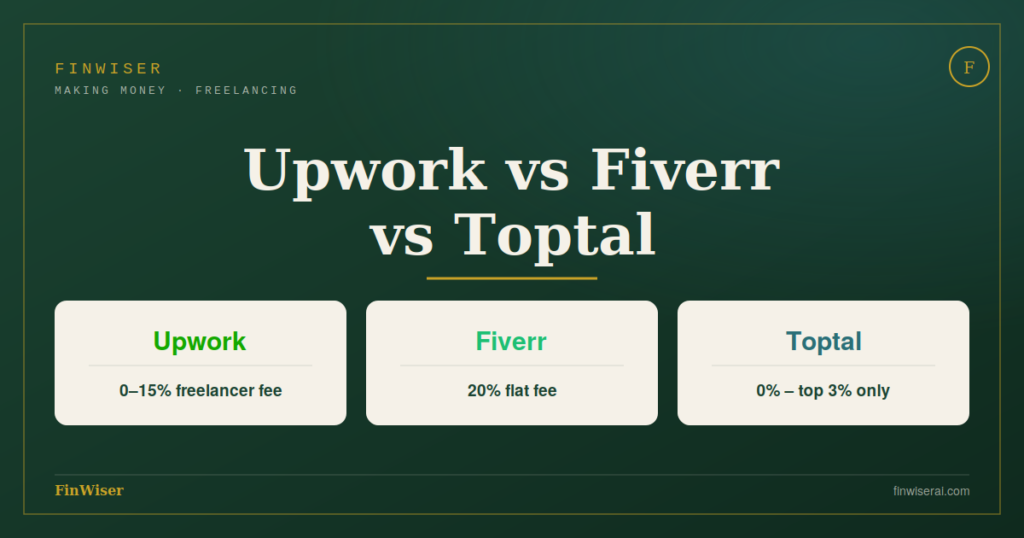
Three very different freelance marketplaces, one plain-language breakdown of which one actually fits how you want to work.
- Good News, You Don’t Have to Choose
- Upwork vs Fiverr vs Toptal at a Glance
- Breaking Down Every Criterion
- What Is the Gig Economy, and Where Do These Fit?
- The Real Numbers Behind Platform Fees
- A Halal-Conscious Look at Platform Fees
- Where Each Platform Wins
- Platforms to Watch Beyond the Big Three
- Which One Is Right for You
- Key Takeaways
If you’ve spent any time researching how to start freelancing, you’ve probably landed on the same question dozens of other beginners ask: Upwork vs Fiverr vs Toptal — which one should you actually join first? There isn’t one universally “correct” answer here. The right platform depends on what you’re selling, how much proof of work you already have, and how much competition you’re willing to wade through.
This guide walks through Upwork vs Fiverr vs Toptal side by side, using the same criteria for each, so you can see where they genuinely differ instead of relying on marketing copy.
Good News, You Don’t Have to Choose
You don’t have to pick a single winner and commit forever. A common approach among freelancers is to run one platform for volume and quick wins and a second for higher-value, ongoing relationships — for example, a Fiverr gig for fast-turnaround work alongside an Upwork profile for longer contracts. Just keep your pricing, portfolio, and profile consistent across both so clients see the same professional wherever they find you.
Upwork vs Fiverr vs Toptal at a Glance
Here’s the short version before we go criterion by criterion. Every option below is judged on the same eight points, so you can scan straight across.
| Criterion | Upwork | Fiverr | Toptal |
|---|---|---|---|
| Model | Bid on posted jobs | Buyers purchase pre-set “gigs” | Vetted, invite-only matching |
| Freelancer fee | Tiered, roughly 0–15% of earnings | Flat 20% on every order | 0% — the client absorbs the margin |
| Getting approved | Profile review, usually within 48 hours | Instant sign-up, no approval wait | Multi-stage screening; only the top 3% pass |
| Best for | Custom, ongoing contract work | Clearly scoped, fixed-price deliverables | Senior specialists in tech, design, and finance |
| Typical project size | Small to mid-size, hourly or fixed | Small, often one-off | Mid to large, often long-term engagements |
| Competition level | High — 15–40 proposals per job is common | High volume of sellers per category | Low, because most applicants are rejected upfront |
| Payment protection | Escrow and milestone-based payouts | Order-based, funds held until delivery | Contract-based, managed by Toptal |
| Beginner-friendliness | Moderate — you compete on proposals | High — easiest to start earning fast | Low — built for experienced professionals |
Breaking Down Every Criterion
The table above is a fast scan. Here’s what actually sits behind each row, criterion by criterion.
Fees: Upwork vs Fiverr vs Toptal Compared
Fees are usually the first thing beginners compare, since they come straight out of money already earned. Upwork uses a tiered structure trending toward roughly 10% for most freelancers, depending on how much you’ve billed a given client. Fiverr takes a flat 20% off every order, the steepest cut of the three. Toptal charges freelancers no commission at all; its margin sits on the client side instead.
Ease of Entry for Beginners
On ease of entry, Upwork vs Fiverr vs Toptal splits cleanly by design. Fiverr is the fastest way to start earning: publish a gig and you’re discoverable within a day, no proposals required. Upwork sits in the middle, with profile review typically clearing within 48 hours, but you’re still competing through written proposals. Toptal is the outlier, screening out most applicants so it’s rarely the first stop for someone with no track record yet.
Client Quality and Project Size
Toptal’s vetting cuts both ways: fewer freelancers get in, but clients on the other side are typically funding serious, well-scoped work. Upwork spans small tasks through long enterprise relationships, which is exactly why competition runs so high. Fiverr leans toward smaller, clearly defined deliverables where buyers know what they want before they click “order.”
Speed to First Payment
Fiverr’s upfront-escrow structure often means faster first payouts for new sellers. Upwork’s milestone and hourly billing cycles can take a bit longer, especially before you’ve built payment history. Toptal’s engagements are slower to start but longer once they do, given the scale of the work involved.
Competition and Visibility
This is where Upwork vs Fiverr vs Toptal diverges the most sharply. Upwork jobs routinely draw 15 to 40 proposals, so visibility depends heavily on your Job Success Score and how sharp your pitch is. Fiverr’s search-and-browse model means your gig has to out-rank thousands of similar listings on keywords and reviews. Toptal essentially removes open competition by filtering applicants before clients ever see a profile.
Payment Protection
All three build in some form of protection, but the mechanics differ. Upwork uses escrow for fixed-price work and a tracked Work Diary for hourly contracts. Fiverr holds buyer funds until an order is delivered and accepted. Toptal manages contracts and invoicing directly, removing most of the back-and-forth freelancers handle themselves on open marketplaces.
What Is the Gig Economy, and Where Do These Fit?
“Gig economy” describes work arranged as short-term contracts rather than traditional employment. Upwork and Fiverr are squarely gig-economy marketplaces, open to almost anyone, with the platform acting purely as matchmaker and payment processor. Toptal behaves more like a staffing agency wearing gig-economy clothing: still independent contract work, but heavy vetting makes it feel closer to recruitment than an open marketplace.
The Real Numbers Behind Platform Fees
It’s worth anchoring this in a real, checkable figure rather than rough estimates. According to NerdWallet, Upwork takes between 0% and 15% from freelancer earnings, applied to both hourly and fixed-price work. On a $500 fixed-price project at a 10% fee, that’s $50 gone before you ever see the money — a useful number to build into your pricing from day one, whichever platform you land on.
A Halal-Conscious Look at Platform Fees
A commission-based service fee — the model all three platforms use — is generally viewed as payment for a service rendered, not interest, so it doesn’t raise the same concerns as a lending product. Worth watching more closely: the “instant” or “early payout” add-ons some platforms upsell, which can function like a short-term cash advance with a fee attached. A halal-conscious freelancer is usually better off sticking to standard settlement timelines and direct bank transfer or PayPal withdrawal instead.
Where Each Platform Wins
Where Upwork Wins
- Long-term relationships. Repeat clients mean lower fees over time as you climb Upwork’s tiers.
- Range of work. From quick tasks to months-long contracts, all in one place.
- Track record building. Job Success Score becomes a real asset once you’ve delivered a few contracts.
Where Fiverr Wins
- Speed to first sale. No proposals, no waiting — just a published gig.
- Clear scope. Buyers know what they’re getting before they order, which cuts down on scope-creep arguments.
- Low setup friction. Ideal if you already have a tightly defined, repeatable service.
Where Toptal Wins
- Rate ceiling. Clients are pre-qualified for serious budgets, so pricing conversations start higher.
- Low competition. Once you’re in, you’re not fighting 30 other proposals for the same job.
- Credibility signal. Acceptance itself functions as a badge of expertise.
Platforms to Watch Beyond the Big Three
Upwork vs Fiverr vs Toptal isn’t the entire freelance landscape. A newer wave of platforms competes on fees rather than reach, and a couple are worth bookmarking:
Which One Is Right for You
Boiling Upwork vs Fiverr vs Toptal down to one recommendation depends entirely on where you’re starting from.
New to freelancing with no portfolio yet: start with Fiverr. The low barrier lets you build reviews fast, which later strengthens an Upwork profile.
Have a few years of client work already: Upwork is the better long-term home, since history and Job Success Score compound in your favor.
Senior specialist in tech, design, or finance: apply to Toptal. The screening is a real barrier, but client quality and rates reflect that filter.
Want to avoid commission fees entirely: look at Contra or Braintrust once your portfolio can stand on its own without a marketplace’s built-in traffic.
Key Takeaways
- Upwork vs Fiverr vs Toptal comes down to trade-offs, not a single winner — Upwork rewards longevity, Fiverr rewards speed, and Toptal rewards specialization.
- Fiverr’s flat 20% fee is the steepest of the three; Toptal charges freelancers nothing because the client covers the margin instead.
- Beginners with no track record generally find Fiverr the fastest path to a first paid project.
- Commission-based fees are a payment for service, not interest — the halal-conscious flag to watch is optional early-payout features, not the base fee model.
- You’re not locked into one platform; many freelancers run two in parallel with consistent pricing and portfolios across both.
For a deeper look at how Upwork’s fee tiers and Job Success Score actually work, NerdWallet’s guide on making money on Upwork is a solid next read. And if you’re mapping out your own income plan beyond freelance marketplaces, FinWiser covers the rest of that picture — budgeting irregular income, saving as a freelancer, and building toward bigger financial goals.