
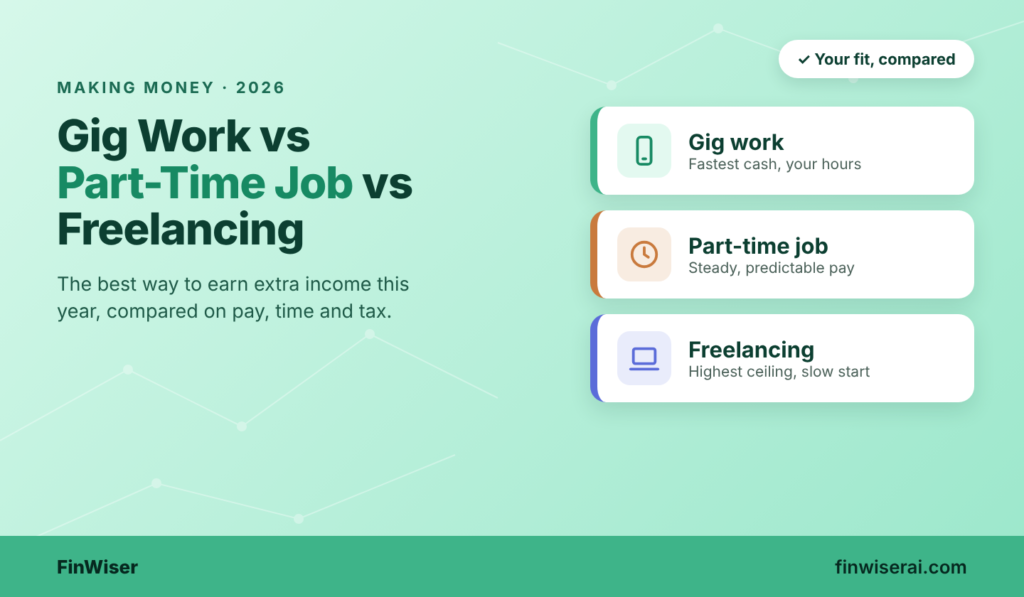
Finding the best side hustle 2026 can offer usually comes down to three roads: app-based gig work, a part-time job, or freelancing. All three put extra money in your account. They do it on different timelines, under different tax rules, and with very different ceilings.
There is no universally correct pick here. A delivery app that suits a student with a car can be the wrong call for a nurse on rotating shifts, and freelancing that pays off for a designer may stall for someone with no portfolio. This guide compares all three on the same criteria so you can match one to your actual life.
Choose by deadline, not by hype. If you need money inside two weeks, gig work or a part-time job gets you there. If you have a few months of runway and a skill people already pay for, freelancing usually has the higher ceiling. That one question settles most best side hustle 2026 debates.
One habit applies to every contractor: move a quarter to a third of each payout into a separate account for tax before you spend any of it.
Good News: You Don’t Have to Choose
These three options stack well. A common pairing is gig work for cash this month while you build a freelance client list in the background. Once the freelance income is steady, the app hours shrink.
Another mix is a part-time job as an income floor with freelance projects on top. The paycheck covers the fixed bills, and client work becomes the variable upside.
One caution before you combine anything with a main job. Read your employment contract for clauses on outside work or conflicts of interest, especially if you plan to freelance in the same industry.
At a Glance: Gig Work vs Part-Time Job vs Freelancing
Here is how the three contenders for best side hustle 2026 compare on the eight things that decide whether extra income is worth the effort.
| Criteria | Gig work | Part-time job | Freelancing |
|---|---|---|---|
| Your status | Independent contractor on an app | Employee on payroll | Independent contractor with your own clients |
| Time to first payout | Days after approval | After hiring plus one pay cycle | Weeks to months, until a client signs |
| Income predictability | Low. Swings with demand and tips | High. Set wage, set hours | Lumpy. Busy months and quiet ones |
| Earning ceiling | Limited by hours and local demand | Limited by wage times hours | Highest. You set the rate |
| Schedule control | Very high. Log on when you want | Low. The employer sets shifts | High, within client deadlines |
| Upfront costs | Vehicle, fuel, phone, insurance | Close to none | Laptop, software, platform fees |
| Tax handling | You pay self-employment tax yourself | Employer withholds for you | Self-employment tax plus quarterly estimates |
| Best for | Fast cash on your own hours | A steady, predictable top-up | Turning a skill into higher pay |
Best Side Hustle 2026: Criteria-by-Criteria Breakdown
The table gives the short version. The sections below explain where each option earns its rating and where the fine print bites.
Speed to First Payout
Gig work is the quickest. Apps such as DoorDash and Instacart approve most applicants after an identity and background check, and many offer daily or instant cash-out once you start completing orders.
A part-time job takes longer to begin because there is an application, an interview and onboarding. After that, the money arrives on a fixed pay cycle you can plan around.
Freelancing is the slowest start. On marketplaces such as Upwork and Fiverr, new profiles compete with sellers who already have reviews, so a first paid project can take weeks or months.
Earning Ceiling
Gig income is tied to hours on the road and to local demand. You can work more, yet the pay per order is set by the platform, and nobody negotiates with an algorithm.
Part-time pay is capped by the hourly wage multiplied by the shifts you are given. Raises exist, though they are slow and small compared with changing what you sell.
Freelancing has the highest ceiling of the three because you set the price. A specialist who moves from hourly billing to project pricing can raise income without adding hours, which is why many people call it the best side hustle 2026 pick for skilled workers.
Schedule Control
Gig work wins on flexibility. You open the app when you are free and close it when you are not, with no manager to ask.
A part-time job offers the least control. Shifts are assigned, swaps need approval, and the busiest shifts are often evenings and weekends.
Freelancers choose when to work, though client deadlines and time zones still shape the week. Freedom over hours is real, and so is the Sunday night revision request.
Taxes and Paperwork
This is where the three split most sharply. In a part-time job you are an employee, so your employer withholds tax and reports your pay on a Form W-2. You do almost nothing.
Gig workers and freelancers are treated as self-employed. The IRS sets self-employment tax at 15.3%, which covers Social Security and Medicare, and it applies once your net self-employment earnings reach $400 in a year.
Nobody withholds that for you, so you may also need to send estimated tax payments each quarter. The upside is that genuine business costs, such as mileage or software, reduce the income you are taxed on.
Costs You Carry
Delivery and rideshare look free to start, yet fuel, maintenance, insurance and wear on your car come out of your pocket. Any honest best side hustle 2026 comparison has to subtract them from the headline pay.
A part-time job costs you a commute and little else. The employer supplies the tools, the premises and the customers.
Freelancers pay for a laptop, software and the marketplace cut on each order. Fee schedules change, so check the current one on any platform before you set your rates.
Skills and Growth
Gig work pays you today and builds little you can sell tomorrow. Ratings rarely transfer between apps, and the work does not usually lead to a higher-paid role.
A part-time job can add references, training and sometimes a route into full-time work. Larger employers may extend benefits to part-time staff, which is worth asking about at interview.
Freelancing compounds. Each project adds to a portfolio, reviews and referrals, so month twelve can look very different from month one. That long tail is what makes it a strong best side hustle 2026 choice for patient earners.
5 Platforms to Know
These are real, live platforms where most people begin. None is an endorsement, and availability varies by country and city.
- DoorDash. Restaurant and store delivery by car, bike or scooter, with flexible log-on hours.
- Instacart. Grocery shopping and delivery, where larger orders tend to pay more.
- TaskRabbit. Local tasks such as furniture assembly, moving help and repairs, with rates you set yourself.
- Upwork. A freelance marketplace for longer client relationships in writing, design, finance and development.
- Fiverr. A marketplace where you list fixed-price services and buyers come to you.
Employee or Independent Contractor: The Label That Changes Everything
Underneath every best side hustle 2026 comparison sits one legal distinction. A part-time worker is an employee. A gig worker or freelancer is usually an independent contractor, which the IRS decides by looking at who controls the work, who carries the financial risk, and how the relationship is set up.
Employees get more than withheld tax. The employer pays half of Social Security and Medicare, and wage laws such as minimum wage and overtime apply. Unemployment insurance usually covers them too.
Contractors trade those protections for independence. There is no paid leave, no employer contribution and no guaranteed minimum for a slow week. Price your time with that gap in mind, because a contractor rate that matches an employee wage is actually a pay cut.
What the Numbers Say About Side Income
Expectations matter here, so start with real data. In Bankrate’s most recent Side Hustle Survey, 27% of U.S. adults said they had a side hustle, down from 36% a year earlier.
The income figures are more revealing. Side hustlers reported an average of $885 a month, while the median was only $200. Half of all side hustlers, in other words, earn $200 or less.
Only 14% clear $1,000 a month. So any article promising that the best side hustle 2026 will replace a salary within weeks is describing the exception. Plan around the median, and treat anything above it as a bonus.
The Halal-Aware View: Where Interest Sneaks In
All three paths pay you for labor or a service, which is sound in principle from a faith standpoint. The questions come from how you fund the work and what the work involves.
Interest, known as riba, tends to appear at the edges. Think of an interest-bearing car loan taken out to drive for an app, or a credit card balance carried to pay for freelance software. A halal-conscious reader would fund tools from savings and start smaller.
The nature of the work matters as well. Delivery drivers may be offered alcohol orders, freelancers may be approached by gambling or interest-based lending clients, and part-time employees have the least say over daily tasks.
Gig apps generally let you decline individual orders, and freelancers choose their clients, so both give you room to filter. Scholars differ on the details, so ask one you trust about your specific case.
Pros and Cons of Each Path
A quick scan of strengths and weaknesses helps narrow your best side hustle 2026 shortlist.
Where Gig Work Wins
- Fast money. You can be earning within days of approval.
- Total flexibility. Hours fit around classes, childcare or another job.
- No selling. The app supplies the customers.
Where Gig Work Falls Short
- Hidden costs. Fuel and vehicle wear reduce what you really earn.
- No safety net. A slow week or a deactivated account means no income.
Where a Part-Time Job Wins
- Predictable pay. You know the amount and the date in advance.
- Simple taxes. Withholding is handled for you.
- Legal protections. Wage laws and employer contributions apply.
Where a Part-Time Job Falls Short
- Fixed schedule. Shifts can clash with your main job or family time.
- Low ceiling. More income means more hours, with little room to raise your rate.
Where Freelancing Wins
- Highest upside. You control pricing and can raise it as demand grows.
- Portable reputation. A portfolio and client referrals follow you anywhere.
- Work from anywhere. Most projects need only a laptop and a connection.
Where Freelancing Falls Short
- Slow start. The first client is the hardest one to win.
- Uneven income. Late payers and quiet months are part of the deal.
Which Best Side Hustle 2026 Option Is Right for You
- You need money this month. Start with gig work, and keep a mileage log from day one.
- You want one bill covered reliably. A part-time job gives you a fixed number to budget around.
- You have a marketable skill and some patience. Freelancing is likely your strongest long-term option.
- You already work full-time and feel stretched. Pick the option with the fewest fixed commitments, usually gig work in short bursts.
- You are halal-conscious. Favor the route where you control which jobs you accept, and avoid borrowing at interest to get started.
If two answers fit, combine them. For many readers the best side hustle 2026 plan is quick cash from an app now and a freelance service built slowly alongside it.
Key Takeaways
- There is no single winner. Gig work is fastest, a part-time job is steadiest, and freelancing has the highest ceiling.
- Gig workers and freelancers pay 15.3% self-employment tax themselves, while part-time employees have tax withheld.
- The median side hustler earns about $200 a month, according to Bankrate, so set expectations by the median.
- Costs decide real earnings: vehicle expenses for gig work and platform fees for freelancing.
- Halal-conscious earners weighing the best side hustle 2026 options should check both the work itself and any interest-based borrowing used to fund it.
Keep Reading
For a wider look at how app-based work fits into the economy, NerdWallet explains the basics in The Gig Economy: Modern Term, Classic Concept.
More from FinWiser on Making Money