
Making Money > Learn > UGC Creator Side Hustle 2027: How Much Brands Pay
Making Money · Side Hustles
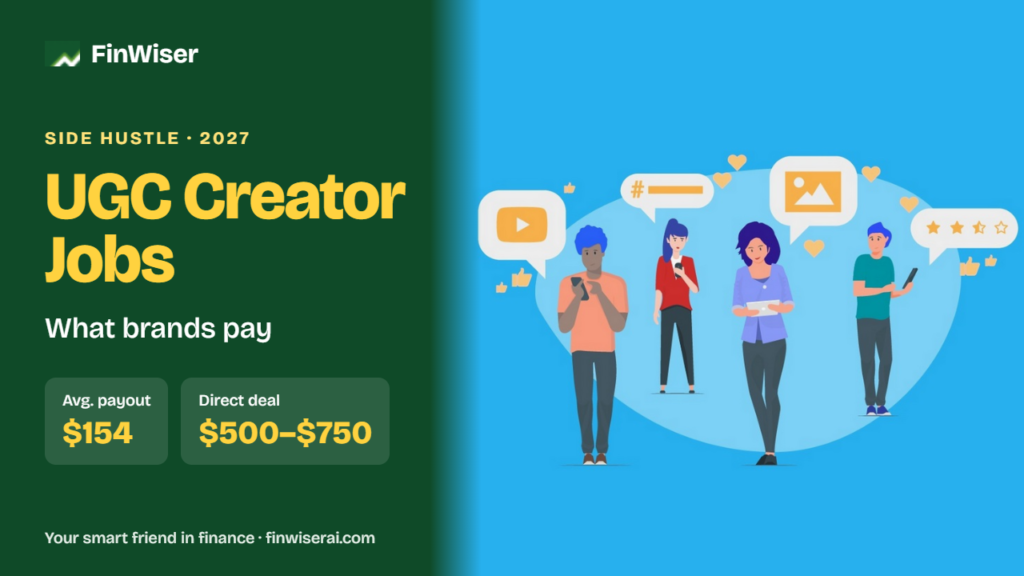
What brands really pay for UGC videos in 2027, and how marketplaces, managed platforms, direct deals and retainers compare.
Brands no longer need your followers. They need your phone, your face and about 30 seconds of honest-feeling video. That is the whole idea behind UGC creator jobs: you film short product videos, the brand runs them as ads or posts them on its own channels, and you get paid per piece.
UGC stands for user-generated content, meaning videos that look like a real customer made them, even when a brand paid for them. How much it pays depends less on talent than on the route you take to get hired. Marketplaces, managed platforms, direct brand deals and monthly retainers all pay differently, and none of them is the one correct choice. This guide compares the four using the latest market data, so you can price your work in 2027 with your eyes open.
🌱 Our Wisers Say
Never quote just the video. Quote the video, then the rights. If a brand wants to run your clip as a paid ad, that license is its own line on your invoice, not a favor. In our experience, the creators who skip this step are the ones who end up saying UGC creator jobs don’t pay.
Good News: You Don’t Have to Pick One Route
Most working creators mix routes. A common path looks like this: take a few marketplace or platform jobs to build a portfolio, use those clips to pitch brands directly, then turn your best client into a monthly retainer.
Each route feeds the next one. So read the comparison below as a menu, not a fork in the road.
How Much UGC Creator Jobs Pay in 2027: At a Glance
The figures come from 2026 marketplace reports, the latest full-year data available when this guide was written. Use them as starting benchmarks for 2027, not promises.
| Criteria | Marketplaces | Managed platforms | Direct brand deals | Retainers |
|---|---|---|---|---|
| Typical pay per video | ~$154 paid on average (Collabstr) | Set per brief; below the brand’s price | $500–$750 at intermediate level | Per-video rate minus a bundle discount |
| Who sets the price | You list it; brands negotiate | The platform | You | Agreed once, fixed monthly |
| Usage-rights upside | Negotiable add-on | Often bundled in | Highest: you price every license | Built into the contract |
| Payment protection | Escrow on some sites | Platform pays after approval | Your invoice, your risk | Contract plus monthly invoice |
| Time to first paid job | Fast | Fastest | Slowest | Comes after a trial |
| Income stability | Lumpy | Steady while approvals hold | Grows with referrals | Most predictable |
| Skills you need | Profile and portfolio | Following briefs exactly | Pitching, contracts, invoicing | Strategy and reporting |
Marketplace averages cluster under $215 per video. Direct deals pay far more, but only once you have a portfolio and clients who trust it.
The Breakdown, Criterion by Criterion
Here is how each route handles the seven things that decide what UGC creator jobs actually put in your pocket.
Typical Pay per Video
On Collabstr’s 2026 report, UGC packages were listed at an average of $180 but actually paid $154. Influee’s pricing guide puts most single videos between $150 and $212, with a median near $175.
Managed platforms keep a margin between what the brand pays and what you get. Billo advertises videos to brands from $99, so the creator’s share sits below that headline. Direct deals pay the most: Kelly Rocklein told CNBC Make It that creators with intermediate experience can charge $500 to $750 for a 20- to 60-second video. Retainers start from your per-video rate, minus a volume discount.
Who Sets the Price
On a marketplace you list packages and brands accept or haggle. On a managed platform, the platform sets the pay for each brief and you take it or skip it. With direct deals you set the number yourself, which is both the opportunity and the pressure. A retainer is negotiated once, then fixed every month.
Usage Rights and Add-Ons
Usage rights are the permission you grant for how, where and for how long a brand can use your video. Running it as a paid ad usually adds 30% to 50% for a short license, and whitelisting (the brand runs ads through your own account handle) is often priced around 30% of the base fee per month, according to hoo.be’s 2026 rate guide.
Marketplaces let you sell these as add-ons. Managed platforms often fold them into their own license, so read the terms before you accept. Direct deals give you the most room to price each right, and retainers should name the rights term in writing.
Payment Protection
Some marketplaces, Collabstr among them, hold the brand’s payment in escrow (a neutral third party holds the money until the work is approved). Managed platforms pay you once the brand signs off.
Direct deals carry the most risk, because you chase your own invoices. A simple fix with new clients is asking for half upfront. Retainers sit in between: a signed contract and a fixed monthly invoice date.
Time to First Paid Job
Marketplaces and managed platforms are fastest, because brands post open briefs you can apply to today. Direct deals are slowest. Rocklein told CNBC Make It that someone without an industry background should expect it to take longer, perhaps around three months, to find success. Retainers usually come after a brand has tested you on a few one-off videos.
Income Stability
Marketplace income is lumpy: a busy month, then a quiet one. Managed platforms can feel steady while your approval rate stays high. Direct work grows steadier as referrals build. Retainers are the most predictable, but one big client is also one big point of failure.
Skills You Need
Marketplaces reward a clean profile and a tight portfolio. Managed platforms reward following a brief to the letter. Direct deals add sales skills: pitching, contracts and invoicing. Retainers ask for strategy, like testing hooks and reporting on which videos actually sold.
UGC Creator vs. Influencer: Why Followers Don’t Set Your Rate
An influencer gets paid to share sponsored content with their own followers. A UGC creator usually delivers an asset the brand uses on its own channels, as Backstage explains. Your audience size barely matters.
That shows up in the numbers. Collabstr’s average UGC price of $180 sits right next to TikTok sponsorships at $182 and not far below Instagram at $214, even though the UGC creator brings no audience at all. With UGC creator jobs, your rate rests on production quality and the rights you license, not reach.
What the Data Says About UGC Pay
Collabstr’s 2026 report analyzed more than 21,000 collaborations and over 200,000 creators. Its key UGC finding: the average listed package was $180, but brands actually paid $154. That works out to about 14% below the asking price, by our math.
Demand is clearly growing. UGC rose from 15% to 35% of the platform’s campaigns in a single year, while the average UGC campaign cost slipped 5.7%, from $209 to $197. Over 40% of UGC campaigns came from companies spending under $5,000, so most buyers are small brands watching every dollar.
Supply is growing even faster. Collabstr’s previous report found that 66% of creators offered UGC, up from 26% the year before, and average UGC rates fell 44%. For anyone weighing UGC creator jobs in 2027, the message is simple: generic videos compete on price, so pick a niche. Across all collaboration types on Collabstr, Education averaged $307 and Entrepreneur & Business $295, against $210 for Beauty.
Taxes and a Halal-Aware Lens
Your Tax Bill Comes Before Your Profit
In the US, UGC fees are self-employment income. You generally owe self-employment tax of 15.3% (12.4% Social Security plus 2.9% Medicare) once net earnings reach $400, on top of income tax. Because no employer withholds it, you pay through estimated tax payments during the year.
In the UK, HMRC gives one £1,000 tax-free allowance across all your side hustles combined. Our full side hustle taxes guide walks through both systems.
A Halal-Aware Note on UGC Income
The good news first: getting paid to film a video is a fee for work, a plain service contract. There is no interest in the pay itself, so no riba (the Islamic prohibition on interest). Where riba can creep into UGC creator jobs is around the edges:
- Late-payment interest clauses. Some brand contracts add a percentage on overdue invoices. A flat, fixed late fee is a different discussion; ask a scholar you trust.
- Getting paid early for a cut. Invoice advances and factoring services charge a percentage to pay you before the brand does. Read how that fee is structured.
- Where you park the money. Holding earnings in an interest-paying account undoes the clean income.
Brand fit matters too: alcohol, gambling apps and interest-based lenders all post UGC briefs. Direct deals give a halal-conscious creator the most control here. On managed platforms, check that you can decline briefs without penalty. Scholars differ on details, so treat this as a starting point, not a ruling.
Where to Find UGC Creator Jobs: 5 Platforms to Know
These five are real, live places where brands hire creators. None pays FinWiser anything for being listed.
- Collabstr. A marketplace where you list packages and brands hire you, with payment held until the job is done. It also publishes the yearly pricing report used throughout this guide.
- Billo. A managed platform that sells creator videos to brands from $99 and assigns the work to approved creators. Good for volume, with less control over price.
- Influee. A UGC platform connecting brands with creators. Its public rate guide is one of the clearer pay benchmarks around.
- JoinBrands. A creator marketplace that says it lists over 250,000 active brand campaigns across TikTok, Instagram and Amazon.
- Backstage. Best known for casting calls, it also runs a database of paid content creator gigs, useful if you are comfortable on camera.
Pros and Cons of Each Route
Where Marketplaces Win
- Visible pricing. You can see what similar creators charge before you set your own rate.
- Safer payment. Escrow-style payouts mean less chasing.
- Watch out. Brands negotiate down, which is why the average payout lands below the asking price.
Where Managed Platforms Win
- No pitching. Briefs come to you, so you spend your hours filming instead of selling.
- Fast start. Approval can turn into paid work quickly.
- Watch out. The platform sets the rate and often bundles the rights, which caps your upside.
Where Direct Brand Deals Win
- Highest pay. Rates of $500 or more per video are realistic once you have a strong portfolio.
- Full control. You choose the brands, the rights terms and the payment schedule.
- Watch out. You do the selling, the contracts and the collections yourself.
Where Retainers Win
- Predictable income. A fixed monthly fee makes budgeting far easier.
- Deeper work. You learn what sells for one brand and get paid for that insight.
- Watch out. Losing one retainer can wipe out a large share of your income overnight.
Which One Is Right for You
- Brand new with no portfolio. Start on a marketplace or managed platform and treat the first jobs as paid practice.
- A full-time job and five spare hours a week. Managed platforms fit best, since there’s no pitching.
- A portfolio and a clear niche. Pitch brands directly and price every usage right separately.
- One brand that keeps rebooking you. Offer a monthly retainer with a set number of videos.
- Halal-conscious and picky about brands. Lean toward direct UGC creator jobs, where you control who you work with and what the contract says.
Key Takeaways
- Most UGC creator jobs pay roughly $150 to $212 per video on marketplaces; Collabstr’s average payout was $154.
- Usage rights and whitelisting can roughly double a quote, so always price them on their own line.
- Direct brand deals pay the most, often $500 to $750 at intermediate level, but take the longest to land.
- Demand is rising, but creator supply is rising faster, so a niche protects your rate.
- UGC pay itself is interest-free service income; watch late-fee clauses, invoice advances and where you keep the money.
About the author
Sundas Tahir
Founder & CEO, FinWiser
Sundas Tahir founded FinWiser to make money decisions clearer. With close to eight years in finance and fintech, she has worked hands-on with financial accounts, payment flows and disputes, the day-to-day mechanics of how money actually moves. She writes about investing, banking and money tools with a halal-aware lens. Nothing here is personal financial advice. Think of FinWiser as the smart friend who reads the fine print so you don’t have to.
Further Reading From Top Finance Publishers
These outlets have covered the same question from different angles. Each link was checked before publishing.
- CNBC Make It: At 28, her side hustle brought in $142K a year (one UGC creator’s real numbers and rates)
- GOBankingRates: ‘Your Rich BFF’ Vivian Tu: 5 easy side hustles (includes creating content for brands)