
Investing › Learn › Micron vs SK Hynix vs Samsung: Which Memory Chip Stock Fits You in 2026?
Investing · Stock Comparison
Three companies make almost all of the world’s AI memory chips. Here is how their stocks compare on growth, profit, price, ease of buying and halal screens.
If you have followed the AI boom, you have probably noticed that the chips feeding data to AI processors have become one of the most profitable products on the planet. Three companies make nearly all of them, which is why Micron vs SK Hynix vs Samsung has become the memory-stock question of 2026. Micron is American, SK Hynix and Samsung are South Korean, and each one gives you a very different kind of investment.
This is not a contest with one correct winner. The right pick depends on whether you want a pure bet on AI memory, a cheaper valuation, a giant company that hands back lots of cash, or a stock that passes a halal screen. We will walk through the numbers so you can match the stock to your own goals.
Our Wisers Say
Treat memory chips like a seasonal business, not a forever trend. Memory prices have always swung between shortage and glut, and today’s record profits are the shortage half of that swing. Our rule of thumb for any Micron vs SK Hynix vs Samsung decision: size the position so that a 50% drop would not change your life plans. Memory stocks have fallen that far before.
Good News: You Don’t Have to Choose
If picking one feels like guessing, you can own all three through a single fund. The Roundhill Memory ETF (DRAM) launched in April 2026 as the first ETF built only around memory stocks, and Samsung, SK Hynix and Micron sit among its top holdings. FinWiser’s DRAM ETF review covers its costs and structure. It holds swaps and Treasury bills, so it will not pass a typical halal screen.
Halal-conscious investors have a partial version. The Shariah-screened SP Funds S&P World ETF (SPWO) counts Samsung and SK Hynix among its larger positions. It covers markets outside the US, so it does not hold Micron. Our SPUS vs HLAL comparison covers the US-focused Shariah funds, which screen Micron separately.
Micron vs SK Hynix vs Samsung at a Glance
Figures come from each company’s latest reported quarter. Won amounts are rounded, and Samsung’s third-quarter numbers are preliminary.
| Criteria | Micron | SK Hynix | Samsung |
|---|---|---|---|
| Where it trades | Nasdaq (MU) | Korea Exchange (000660); Nasdaq ADR (SKHY) since July 2026 | Korea Exchange (005930); London GDRs; US over-the-counter (SSNLF) |
| What you are buying | Pure memory maker | Pure memory maker | Memory plus phones, TVs, displays and contract chipmaking |
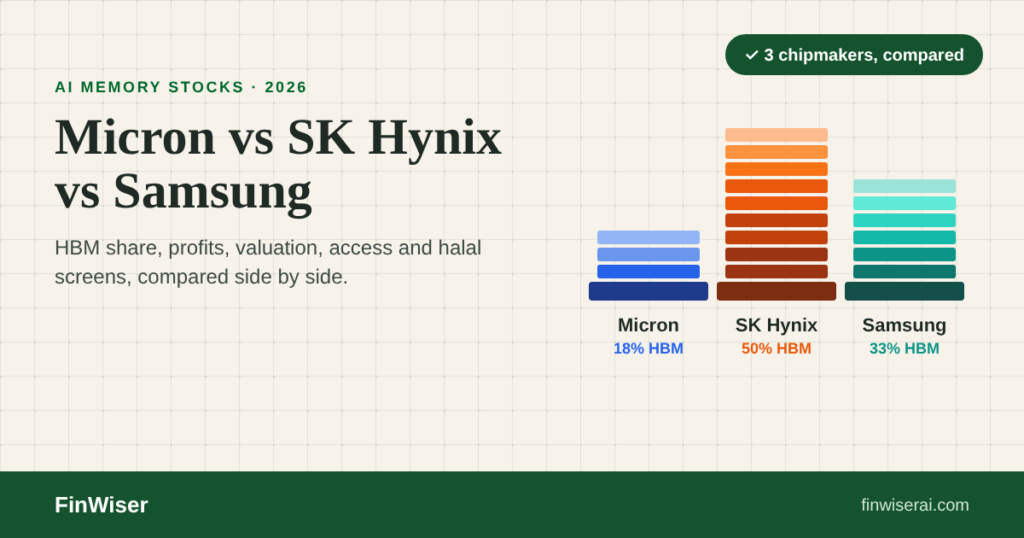
| HBM market share (Q2 2026) | 18% | 50% | 33% |
| Latest quarterly revenue | $54.2B (fiscal Q4, ended Sept 3) | ₩79.3T, roughly $52–55B (Q2) | ₩195T, roughly $145B, whole company (Q3, preliminary) |
| Latest operating margin | About 82% (non-GAAP) | 76% | 55% (whole company) |
| Forward P/E (mid-2026) | About 7x | About 5.8x | About 6–7x |
| Cash back to shareholders | Modest quarterly dividend | Tiny dividend plus a large buyback | Record plan of up to ₩110T for 2026 |
| Halal screen (Oct 2026) | Halal (Musaffa, Zoya) | Doubtful on Musaffa; screeners disagree | Halal (Musaffa) |
Micron vs SK Hynix vs Samsung, Criteria by Criteria
1. AI Memory Leadership (HBM)
High-bandwidth memory (HBM) is stacked memory that sits right next to an AI processor and feeds it data quickly. It is the product driving this boom. SK Hynix still leads with half of global HBM revenue in Q2 2026, according to Counterpoint Research. But Samsung jumped from 21% to 33% in a single quarter, while Micron slipped to 18%.
The next battle is HBM4, the newer generation going into Nvidia’s Vera Rubin systems. SK Hynix began mass shipments of HBM4 in its second quarter, and analysts credit Samsung’s HBM4 ramp for much of its record third quarter. Micron’s HBM output for 2026 is reported to be sold out, so its share is capped more by factory space than by demand.
2. Growth and Profits
All three are posting numbers that look almost unreal. Micron’s fiscal fourth-quarter revenue hit $54.2 billion, up from $11.3 billion a year earlier, and it guided to about $61.5 billion for the next quarter. SK Hynix’s second-quarter revenue rose 257% to ₩79.3 trillion, with a 76% operating margin.
Samsung’s preliminary third-quarter operating profit came in at ₩107.4 trillion, roughly $80 billion, with analysts estimating that memory produced most of it. SK Hynix reports its third quarter on October 27 and Samsung gives its full breakdown on October 29, so expect both stocks to move this month.
3. Valuation
Memory stocks look cheap on paper. An Investing.com analysis from July put SK Hynix at roughly 5.8 times expected earnings and Micron at about 7 times. Samsung’s Korean shares have traded in a similar 6–7x range. That measure is the forward P/E: price divided by next year’s expected profit.
There is a catch. A cyclical stock often looks cheapest right at the peak, because earnings are temporarily huge. A low multiple here can be a warning rather than a bargain if memory prices fall.
4. Business Focus and Risk
Micron and SK Hynix are close to pure memory plays, so their profits rise and fall with memory prices. Samsung is a conglomerate. Its phone division reportedly faced an operating loss last quarter as memory costs rose, which trims the upside but can cushion a downturn.
Each also carries its own extra risk. Close to a quarter of SK Hynix’s Q2 revenue came from China, where its factories depend on US export licenses, per its SEC filings. Chinese rival CXMT has grown to about 10% of the DRAM market, and all three are spending heavily on new factories that could cause oversupply later in the decade.
5. How Easy Is It to Buy?
Micron is the simplest. It trades on Nasdaq in US dollars like any American stock. SK Hynix became far easier in July 2026, when it listed American depositary receipts (ADRs) on Nasdaq under SKHY and raised $26.5 billion. Ten ADRs equal one Korean share.
Samsung is the hardest. It has no US exchange listing, and its investor relations page says non-US investors can trade its London GDRs while US residents cannot. Americans usually go through the Korean market or thinly traded OTC shares. Wherever you live, check whether your broker offers Korean or London market access first.
6. Cash Returned to Shareholders
If you like getting cash back, Samsung is the standout. Its board approved a 2026 shareholder-return plan of ₩90–110 trillion, including about ₩30 trillion in third-quarter cash dividends, according to Samsung’s newsroom.
SK Hynix pays only a token dividend but unveiled a $28.9 billion buyback in August. Micron pays a modest quarterly dividend and pours most of its cash into new factories.
Why Memory Is the Boom-and-Bust Corner of Chips
A chip designer like Nvidia sells something hard to copy. A memory maker sells something closer to a commodity, because one company’s DRAM chip can largely replace another’s. Prices are set by supply and demand across the whole market, which is why the Micron vs SK Hynix vs Samsung story always moves as a pack.
When demand outruns supply, prices soar and margins hit 70–80%. But new factories take years to build and tend to come online together, turning shortages into gluts. In 2022, Micron’s stock fell about 46% in nine months as memory prices slumped.
This cycle’s twist is long-term supply contracts. Micron has signed deals lasting five years or more, and Samsung says such agreements are growing. Whether they truly tame the cycle is the biggest open question in this whole debate.
Data Check: The HBM Shake-Up in One Number
Here is the statistic that matters most for Micron vs SK Hynix vs Samsung right now. In Q2 2025, SK Hynix held 64% of HBM revenue and Samsung held 15%. One year later, Counterpoint Research puts them at 50% and 33%, and it expects Samsung to keep gaining as HBM4 ramps up.
Why it matters: much of the bullish case for SK Hynix rests on HBM dominance. If that lead keeps shrinking, its valuation discount to Micron may be deserved rather than an opportunity, and Samsung could be the one that gets re-rated.
The Halal Angle
None of these companies sells anything prohibited, so the halal question comes down to finances: debt levels, cash held in interest-bearing accounts, and how much income comes from interest, or riba. Screeners using AAOIFI standards cap interest-bearing debt and deposits at 30% of market value and impermissible income at 5% of revenue.
For a halal-conscious reader, Micron vs SK Hynix vs Samsung looks a little different. Zoya rates Micron compliant, and Musaffa lists Samsung as halal but SK Hynix’s ADR as doubtful. Other screeners disagree on SK Hynix, so recheck before buying and purify the small interest-related share of any dividends.
5 Tools and Funds to Know
Whichever way you lean on Micron vs SK Hynix vs Samsung, these real, live tools make the research and buying easier:
- Roundhill Memory ETF (DRAM). All three companies in one fund. Not Shariah-screened.
- SP Funds SPWO. A Shariah-screened global fund holding Samsung and SK Hynix.
- Musaffa. A halal stock screener built on AAOIFI standards, updated as new financials arrive.
- Zoya. A halal screening app that also shows interest income for purification.
- SEC Investor Bulletin on ADRs. A plain guide to ADR fees and risks before you buy SKHY.
Where Each Stock Wins
Where Micron Wins
- Easiest to own. A regular US stock priced in dollars, with no foreign-market workarounds.
- Strong momentum. Its latest guidance points to yet another record quarter.
- Clean halal profile. Major screeners currently rate it compliant.
Watch out for:
- Smallest HBM share. At 18%, it is third in the most valuable product line.
- Priciest of the three. It trades at a premium to SK Hynix on expected earnings.
Where SK Hynix Wins
- HBM leader. Half of global HBM revenue and a deep relationship with Nvidia.
- Lowest multiple. The cheapest of the three on forward earnings.
- Now on Nasdaq. The ADR removed most of the access hassle for overseas investors.
Watch out for:
- Shrinking lead. Its HBM share fell 14 points in a year.
- China exposure and unclear halal status. Both deserve a check every quarter.
Where Samsung Wins
- Fastest gainer. Its HBM share is climbing as HBM4 shipments ramp.
- Biggest cash returns. A record payout plan for 2026.
- Diversified. Phones, displays and appliances mean it is not only a memory bet.
Watch out for:
- Hard to buy. No US listing, and London GDRs are closed to US residents.
- Mixed businesses. Weaker divisions can dilute a memory boom.
Micron vs SK Hynix vs Samsung: Which One Is Right for You?
You want simple and US-listed: Micron. No currency conversion headaches, no foreign exchange to navigate.
You want maximum AI-memory exposure at the lowest price tag: SK Hynix through SKHY, as long as you accept its China and share-loss risks.
You want cash returns and a steadier giant: Samsung, if your broker can reach Seoul or London.
Your portfolio is halal-first: Micron or Samsung on current screens, or SPWO for a screened basket.
You cannot decide: keep it small, split it, or use a fund instead of a single stock.
Key Takeaways
- In the Micron vs SK Hynix vs Samsung race, SK Hynix still leads HBM, but Samsung is closing the gap quickly.
- All three are earning record profits, and all three are cyclical, so today’s low P/E ratios can flip fast.
- Micron is the easiest to buy, SK Hynix is now on Nasdaq, and Samsung needs Korean or London market access.
- Halal screens currently favor Micron and Samsung; recheck SK Hynix every quarter.
- Keep any single memory stock to a size you could watch fall by half.
About the author
Sundas Tahir
Founder & CEO, FinWiser
Sundas Tahir founded FinWiser to make money decisions clearer. With close to eight years in finance and fintech, she has worked hands-on with financial accounts, payment flows and disputes, the day-to-day mechanics of how money actually moves. She writes about investing, banking and money tools with a halal-aware lens. Nothing here is personal financial advice. Think of FinWiser as the smart friend who reads the fine print so you don’t have to.
Further Reading From Top Finance Publishers
These outlets have covered the same question from different angles. Each link was checked before publishing.
- The Motley Fool: Better Buy: SK Hynix vs. Micron (makes the case for SK Hynix after its Nasdaq debut)
- Morningstar: A rival joins Micron in the $1 trillion club (includes a skeptical fund-manager view)
- Investing.com: SK Hynix vs. Micron deep dive (valuation and HBM share side by side)