
Two of those three names are actually the same fund — here’s what SPUS, HLAL, and a genuine third option actually do differently inside a halal portfolio.
ON THIS PAGE
If you’ve searched “SPUS vs HLAL vs Wahed FTSE USA Shariah ETF,” there’s something worth clearing up before we go any further: HLAL is the Wahed FTSE USA Shariah ETF. It’s one fund with a ticker and a full legal name, not two separate products. A lot of people search all three terms together without realizing they’ve named the same thing twice.
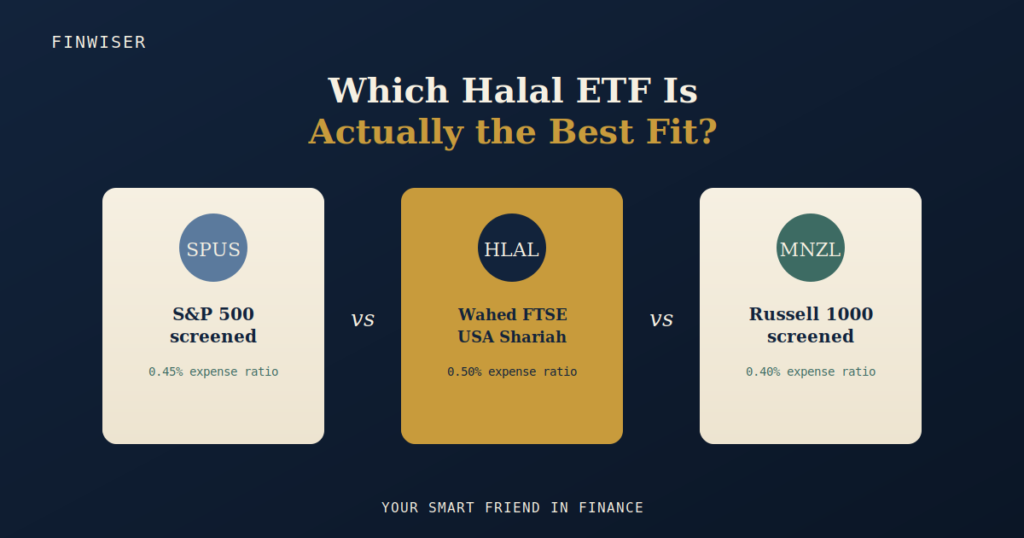
So a true SPUS vs HLAL vs Wahed FTSE USA Shariah ETF comparison is really a two-fund question — SPUS versus HLAL. But since most readers land here wanting a genuine three-way view, this guide adds a real third option: MNZL, the Manzil Russell Halal USA Broad Market ETF, a newer fund that takes a meaningfully different approach from both.
None of this is about finding one universally “correct” halal ETF. SPUS, HLAL, and MNZL all pass Shariah screening, but they screen from different starting universes, charge different fees, and suit different portfolios — which is exactly what this SPUS vs HLAL vs Wahed FTSE USA Shariah ETF breakdown walks through.
Good News: You Don’t Have to Pick Just One
Because SPUS, HLAL, and MNZL draw from different starting universes — the S&P 500, the broader FTSE USA index, and the Russell 1000, respectively — holding two of them isn’t redundant the way it might be with two conventional S&P 500 funds. A common combination: SPUS as a low-cost, large-cap core, paired with MNZL for exposure further down the market-cap ladder.
If you only want one fund, though, this SPUS vs HLAL vs Wahed FTSE USA Shariah ETF question really comes down to how much you value the lowest possible cost and the largest, most liquid fund (SPUS) versus a specific screening methodology or provider relationship you already trust (HLAL, MNZL).
SPUS vs HLAL vs Wahed FTSE USA Shariah ETF: At a Glance
| Criterion | SPUS | HLAL (Wahed FTSE USA Shariah ETF) | MNZL |
|---|---|---|---|
| Launched | December 2019 | July 2019 | November 2025 |
| Starting universe | S&P 500 | FTSE USA (broader, large + mid cap) | Russell 1000 |
| Expense ratio | 0.45% | 0.50% | 0.40% |
| Approx. holdings | ~200–230 stocks | ~180–210 stocks | ~440–460 stocks |
| Shariah screen | Ratings Intelligence Partners | Yasaar Ltd (IdealRatings) | AAOIFI + AFSC human-rights screen |
| Rebalance/turnover | Low (~5%) | Higher (~29%), quarterly review | Too new for a full-year figure |
| Best for | Lowest-cost, most liquid large-cap core | Slightly broader large/mid-cap tilt | Widest diversification, added ethical screen |
Criteria-by-Criteria: What Each Fund Actually Tracks
SPUS starts with the S&P 500 — the 500 largest U.S. public companies — and removes anything that fails Shariah screening: conventional banks and insurers, alcohol, gambling, weapons, adult entertainment, and companies whose debt-to-market-cap ratio runs too high. What’s left is a leaner, large-cap-only version of the index most people already recognize.
HLAL, the Wahed FTSE USA Shariah ETF, starts from a wider pool — the FTSE USA Index, which includes large- and mid-cap companies rather than stopping at the S&P 500’s cutoff. After screening, HLAL ends up with fewer total holdings than SPUS despite starting from a broader universe, largely because FTSE’s screening ratios are calculated slightly differently than S&P’s.
MNZL goes furthest upstream, starting from the Russell 1000 — roughly 1,000 of the largest U.S. companies — before applying both a standard AAOIFI-based Shariah screen and an additional human-rights screen developed with the American Friends Service Committee. That second layer is genuinely unique among the three and worth knowing about even if you don’t end up choosing MNZL.
Who Actually Certifies Each Fund as Shariah-Compliant
SPUS’s screening is handled by Ratings Intelligence Partners, an independent advisory firm applying an AAOIFI-inspired methodology. HLAL’s screening comes from Yasaar Ltd, a subsidiary of IdealRatings, which reviews the fund’s compliance at the end of every quarter. MNZL uses Russell’s IdealRatings-powered screens plus Manzil’s own AAOIFI-based process and the added AFSC filter.
None of the three screening bodies is more “official” than another — there’s no single global regulator for Shariah compliance, so different funds reasonably rely on different qualified advisory boards. If the specific certifying body matters to you or your local scholar, it’s worth checking each provider’s own disclosure page directly rather than taking any single comparison site’s word for it.
This is also the part of any SPUS vs HLAL vs Wahed FTSE USA Shariah ETF discussion that’s easiest to skip past, but it shouldn’t be. A fund’s ticker and marketing copy can say “Shariah-compliant” — the certifying board behind that label is what actually backs the claim.
Costs and Liquidity
MNZL currently carries the lowest expense ratio of the three at 0.40%, with SPUS close behind at 0.45% and HLAL slightly higher at 0.50%. On a $10,000 investment, that’s roughly a $10–$50 annual difference — not dramatic on its own, but it compounds over a long holding period.
Liquidity tells a different story. SPUS is the largest and most actively traded of the three, which typically means a tighter bid-ask spread and easier execution for large orders. HLAL trades a smaller volume, and MNZL, having launched in November 2025, is still building up trading history — a real consideration if you plan to trade actively rather than buy and hold.
None of the three charge a sales load or a front-end fee — the expense ratio is the whole ongoing cost picture for each fund. That makes the SPUS vs HLAL vs Wahed FTSE USA Shariah ETF cost comparison unusually clean compared with actively managed Islamic mutual funds, which often carry higher fees on top of a purchase or redemption charge.
Holdings and Sector Tilt
All three funds land in the same sector story: heavy technology weighting, because tech companies tend to carry less debt and fewer interest-based revenue streams than the banks and insurers that Shariah screening excludes wholesale. Apple, Microsoft, and Alphabet show up near the top of all three funds’ holdings lists.
The practical difference is concentration. SPUS and HLAL both sit around 40–45% technology exposure across roughly 200 holdings, so single-stock weight matters more. MNZL spreads the same general tilt across more than four times as many holdings, which softens the impact of any one company’s performance on the fund as a whole.
What “Purification” Actually Means
Since this comparison keeps circling back to screening, it’s worth explaining a related concept that trips people up: purification. Even a fully Shariah-compliant company can generate a small sliver of income from interest-bearing cash holdings or minor non-compliant business lines under the 5% threshold most screens allow.
Fund providers calculate that impermissible portion and publish a per-share purification figure, typically alongside quarterly distributions — Manzil, for example, does this explicitly for MNZL. The expectation is that a shareholder donates that specific amount to charity rather than treating the whole dividend as clean income. It’s a small mechanical step, but skipping it is one of the more common gaps in an otherwise halal-conscious portfolio.
The Numbers Behind Halal Investing’s Growth
This isn’t a niche corner of the market anymore. S&P Global’s own index research found that assets tracking Shariah-compliant indices in mutual funds and ETFs grew at an annualized rate of roughly 30% between 2017 and 2022, reaching close to $4.7 billion by September 2022 — and the category has kept expanding since, with new entrants like MNZL launching as recently as late 2025. That growth is exactly why a clear-eyed SPUS vs HLAL vs Wahed FTSE USA Shariah ETF comparison matters more each year, not less.
A Deeper Halal-Conscious Note
All three funds in this SPUS vs HLAL vs Wahed FTSE USA Shariah ETF comparison are structured as pass-through ownership of real underlying stocks, not synthetic swaps — an important distinction, since swap-based products can reintroduce the exact riba and gharar concerns Shariah screening is meant to remove.
“Shariah-compliant” as a label still isn’t a substitute for checking the fund yourself if you want full confidence. Screening methodologies genuinely differ between S&P, FTSE, and Russell’s respective Islamic indexes, and what one board approves, another might flag differently on a borderline holding.
SPUS vs HLAL vs Wahed FTSE USA Shariah ETF: Where Each Fund Wins
Where SPUS Wins
- Largest and most liquid. Bigger daily trading volume generally means tighter spreads and easier execution.
- Lower turnover. A roughly 5% turnover rate means fewer taxable rebalancing events for holders in taxable accounts.
- Familiar benchmark. Tracking a screened S&P 500 makes performance easier to compare against a fund most investors already understand.
Where HLAL (Wahed FTSE USA Shariah ETF) Wins
- Broader starting universe. Pulling from the FTSE USA Index rather than just the S&P 500 captures some mid-cap names SPUS never considers.
- Provider track record. Wahed has focused specifically on Islamic finance products since 2015, with a Shariah board reviewing the fund every quarter.
- Established history. A July 2019 launch gives HLAL a longer public track record than MNZL, if that matters to your comfort level.
Where MNZL Wins
- Lowest expense ratio. At 0.40%, MNZL undercuts both SPUS and HLAL on cost.
- Widest diversification. Roughly 440–460 holdings spreads concentration risk far more than either of the other two.
- Extra ethical screen. The added AFSC human-rights filter is a genuinely distinct feature no other major halal ETF currently offers.
SPUS vs HLAL vs Wahed FTSE USA Shariah ETF: Which One Is Right for You
If you want the simplest, lowest-friction halal core holding: SPUS’s size and liquidity make it the default starting point for most U.S. investors.
If you specifically want a Wahed-managed, Islamic-finance-focused provider: HLAL — remember, the Wahed FTSE USA Shariah ETF — is the only one of the three built by a dedicated Islamic fintech company.
If cost and diversification matter most, and you’re comfortable with a newer fund: MNZL’s lower fee and broader holdings list are worth the shorter track record.
If you’re still not sure: a reasonable default is starting with SPUS as a core position and revisiting a second fund like MNZL once you’ve got a full year of MNZL’s actual performance data to look at.
Key Takeaways
- In any SPUS vs HLAL vs Wahed FTSE USA Shariah ETF search, remember HLAL and the Wahed FTSE USA Shariah ETF are the same fund — the real comparison is SPUS versus HLAL, with MNZL as a genuine third option.
- SPUS is the largest, cheapest of the two original funds, and most liquid — a reasonable default core holding.
- HLAL draws from a broader FTSE USA universe and is run by an Islamic-finance-dedicated provider, Wahed.
- MNZL, launched in November 2025, undercuts both on fees and adds a distinct human-rights screening layer, but still lacks a full-year track record.
- All three hold real underlying stocks rather than synthetic swaps, and none of them eliminate the need for purification on the small non-compliant income slice each fund still generates.
For more on how Shariah-compliant index assets have grown industry-wide, S&P Global’s own commentary on the growth of Islamic index-based strategies is a useful primary-source read alongside this comparison. And if you’re building a full halal portfolio rather than a single fund, FinWiser’s full library of investing guides covers how ETFs like these fit alongside sukuk, savings, and zakat planning.