
If you’ve ever typed “compare savings accounts” or “compare personal loans” into Google, there’s a good chance you landed on Bankrate. It’s one of the oldest and most recognizable names in personal finance comparisons, founded back in 1976 and now used to research financial products by tens of millions of people a year. FinWiser takes a narrower, halal-aware approach instead, built for a reader who wants a faith-conscious flag on a product before it ever reaches a “compare” button.
This isn’t a case of one platform being objectively better than the other. If you’re trying to find the best financial comparison site for a specific situation — a faith-conscious first look at your options, or the broadest possible rate table across every product category — the right pick depends on what you’re actually comparing and why. This guide walks through how FinWiser and Bankrate genuinely differ, criterion by criterion, so you can decide for yourself.
Good News, You Don’t Have to Choose Just One
Looking for the single best financial comparison site to bookmark and never think about again? You don’t need to pick just one tool and stick with it forever. Plenty of financially savvy readers keep both bookmarked: Bankrate for a fast, broad rate check across almost any product category, and FinWiser for a second pass that flags whether a product is interest-based (riba) before it’s seriously considered.
Using more than one platform also acts as a built-in fact-check. If two sites agree on a rate range, you can move forward with more confidence. If they don’t, that disagreement is worth a closer look before you apply. Beyond these two, other reputable names worth bookmarking include NerdWallet, LendingTree, Credit Karma, SmartAsset, and Investopedia — each takes a slightly different angle on the same underlying problem.
FinWiser vs. Bankrate: Best Financial Comparison Site at a Glance
Here’s how the two platforms stack up across the criteria that actually matter when you’re deciding which one to open first.
| Criteria | FinWiser | Bankrate |
|---|---|---|
| Primary focus | Halal-aware personal finance education and comparisons across seven pillars | Broad personal finance comparisons: mortgages, CDs, credit cards, loans, insurance and more |
| Business model | Content-and-affiliate model, still building out partner coverage | Advertising-supported comparison service; compensated by placement and clicks |
| Halal / faith-conscious screening | Built into the taxonomy — every pillar has a halal-flagged subtopic | Not a design feature; interest-based products aren’t flagged as such |
| Editorial independence | Editorially independent; discloses founder’s stake where relevant, as above | States an editorial firewall from advertisers; compensation can still affect placement order |
| Rate & data verification | Manually researched guides, updated periodically rather than daily | Rate tables refreshed frequently, with reviews across a large number of banks |
| Tools & calculators | Educational guides and comparison tables; calculators still in development | Mature library of mortgage, loan and savings calculators |
| Company age & scale | Newer, smaller, independent publisher launched in 2026 | Nearly five decades old; one of the largest personal finance publishers in the U.S. |
| Best suited for | A faith-conscious reader who wants riba flagged upfront | Anyone who wants the widest possible rate table, fast |
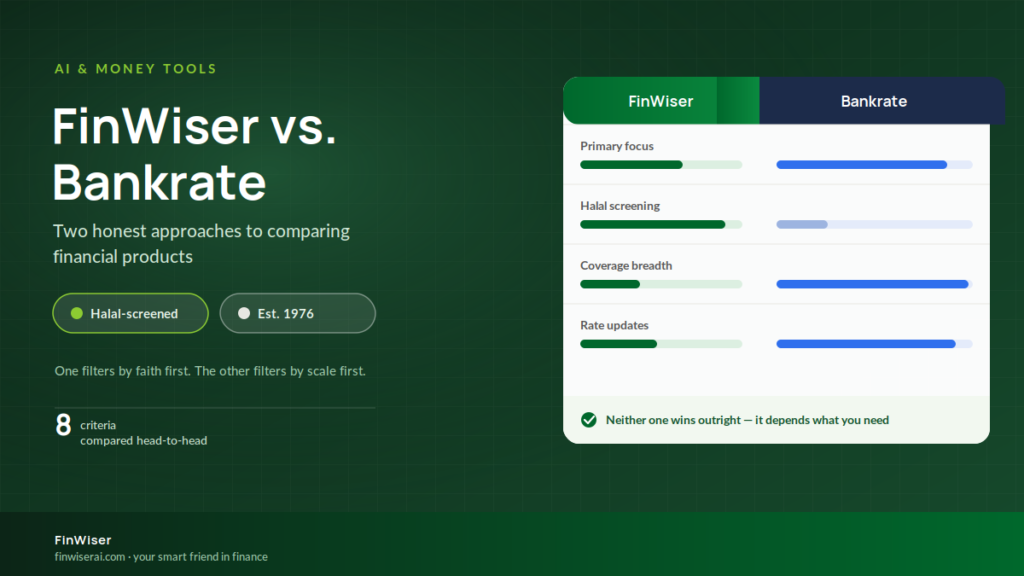
Where FinWiser and Bankrate sit on breadth of coverage versus halal-screening depth — the two variables that most decide which one to open first for a given search.
Comparing FinWiser and Bankrate, Criterion by Criterion
Primary Focus and Content Breadth
The criterion that decides the best financial comparison site for most searches is simply how many product categories a platform covers. Bankrate wins this outright: it spans mortgages, credit cards, CDs, savings accounts, personal loans, insurance, investing and retirement, all under one roof. FinWiser is deliberately narrower, organized around seven pillars — from personal financing to credit and debt — each with its own halal-flagged subtopic.
Business Model and How Each Platform Gets Paid
Bankrate is an advertising-supported comparison service. It states plainly that compensation from partners can influence how and where some products appear, though it maintains an editorial firewall between advertisers and its writers. FinWiser is still building out its own partner network and currently earns primarily through content and future affiliate placements, which is a smaller, less-tested model by comparison.
Faith-Conscious (Halal) Screening
This is where the two platforms diverge the most. Bankrate treats interest-based products as the default, since that’s how the conventional financial system works — a mortgage rate table is just a mortgage rate table. FinWiser instead builds a halal lens into the structure itself, so a reader can see at a glance whether a product involves riba before comparing anything else.
Editorial Independence and Transparency
Bankrate publishes a lengthy disclosure explaining that it’s compensated when readers click certain links or open accounts, and states that this compensation doesn’t affect its editorial recommendations. FinWiser is smaller and newer, so it hasn’t yet built the same scale of partner relationships — which also means there’s less compensation to disclose today, though that will change as the affiliate network grows.
Rate Verification and Update Frequency
For a time-sensitive product, update frequency alone can decide the best financial comparison site to check first. Bankrate says it reviews more than 100 banks and verifies annual percentage yields daily on many of its pages — a meaningful advantage for anyone comparing time-sensitive rates like CDs or savings accounts. FinWiser’s content is researched and fact-checked before publishing but isn’t refreshed on a daily cadence, so treat any specific rate mentioned there as a starting point rather than a live quote.
Tools, Calculators, and Extras
Decades of development have given Bankrate a mature set of mortgage, auto loan and retirement calculators. FinWiser’s strength right now is explanatory: plain-language guides that walk through APR, fees, and terms before you ever touch a calculator, which suits a reader who wants to understand a product before running the numbers.
Company Age, Scale, and Trust Signals
Longevity is one more input into which is the best financial comparison site for a cautious first-time borrower. Bankrate has been in continuous operation since 1976 and is used by tens of millions of people annually, which brings a long track record but also a large, established advertiser base. FinWiser is a young, independent publisher launched in 2026, still building its reputation and its provider relationships from a much smaller base.
Who Each Platform Is Actually Built For
Bankrate is built for a general audience that wants the broadest possible view of a market. FinWiser is built for a narrower, faith-conscious audience that wants that same market filtered through a halal lens from the start, even if that means fewer products are covered for now.
How the Best Financial Comparison Site Actually Makes Money
It’s worth understanding this before you trust any rate table, including ours. Comparison sites in personal finance generally earn through a mix of paid placement, referral fees when you click through to a provider, and compensation when an account is opened or an application is approved. None of that is secret — reputable sites disclose it — but it does mean the products at the top of a list aren’t necessarily the cheapest ones; they may simply be the providers paying the most for that spot.
That’s exactly why the criterion “editorial independence” above matters so much. A lender that advertises a lower headline rate but a higher APR after fees can still rank first on a site that hasn’t clearly separated paid placement from ranking by cost. Reading the actual APR, not just the advertised rate, is the single best habit to bring to any comparison site — including the best financial comparison site you eventually settle on.
What Shopping Around Actually Saves You
The reason comparison sites exist at all is that shopping around genuinely pays off. According to research from Freddie Mac, borrowers who collected rate quotes from multiple lenders saved an estimated $600 to $1,200 a year on their mortgage compared with accepting the first offer, with the gap widening further as rates rise. That’s not a one-time saving either — it compounds every year the loan is outstanding.
The takeaway isn’t “use exactly one comparison site.” It’s that the act of comparing at all, on any reasonably transparent platform, is worth real money. Which platform you use after that matters far less than the fact that you didn’t stop after the first quote.
Is FinWiser or Bankrate the Best Financial Comparison Site for a Halal-Conscious Reader?
For a halal-conscious reader specifically, this comparison isn’t close. Bankrate’s tables mix conventional, interest-bearing products with no attempt to flag riba, because that filter simply isn’t part of its design. FinWiser’s riba-free financing alternatives coverage and halal investing guides build that screen in from the start, even though its overall catalog of products is much smaller today.
In practice, a lot of readers use both: Bankrate to see the full range of what’s available, and FinWiser to sense-check whether a given option is even worth considering on faith grounds before going further.
Where FinWiser Wins
- Halal screening built in. Faith-conscious flags aren’t bolted on afterward — they’re part of how the site is organized from the ground up.
- Plain-language explanations. Jargon like APR or riba is explained the first time it appears, aimed at a reader who’s financially literate but not a finance professional.
- Smaller, more transparent advertiser base. With fewer partnerships in place today, there’s less room for paid placement to quietly shape what you see.
- Where it falls short. Fewer product categories, no live rate feeds yet, and a much shorter track record than an established publisher.
Where Bankrate Wins
- Breadth of coverage. Mortgages, CDs, credit cards, insurance, and more, all searchable from one platform.
- Daily rate verification. Reviewing more than 100 banks with frequent updates matters most for time-sensitive products like CDs and savings rates.
- Decades of tools and calculators. A mature library built up over nearly fifty years of operation.
- Where it falls short. No halal lens at all, and its scale means a much larger advertiser base whose compensation can influence placement.
Which Is the Best Financial Comparison Site for You?
- Want the widest possible rate table, fast: Bankrate’s breadth and daily updates are hard to beat for a general product search.
- Want riba flagged before you compare anything else: FinWiser’s halal-first structure does that work for you upfront.
- Researching a big, one-time decision like a mortgage: Start broad on Bankrate, then sense-check any interest-based option against FinWiser’s halal guides.
- New to personal finance jargon generally: FinWiser’s plain-language explanations may be the more comfortable starting point.
- Not sure yet: That’s fine — bookmark both and let the specific product you’re comparing decide which one you open first.
Key Takeaways
- Bankrate and FinWiser solve different problems: breadth versus a halal-first lens.
- There’s no single best financial comparison site for everyone — the right one depends on the product and the reader.
- Every comparison site, reputable or not, is compensated somehow — read the APR, not just the headline rate.
- Shopping around genuinely saves money: an estimated $600–$1,200 a year on a mortgage alone, according to Freddie Mac.
- Using more than one platform is a free way to fact-check the results you get from either one.
Whichever you land on today, treat it as a starting point rather than a verdict — the right pick for a mortgage this year may not be the right one for a credit card next year.
For a deeper look at how comparison sites influence financial marketing more broadly, The Financial Brand’s reporting on bank comparison sites is a solid next read.
More from FinWiser on AI Money Tool: