
Making Money > Learn > AI Side Hustles in 2027: What Still Pays and What’s Saturated
Making Money · Side Hustles
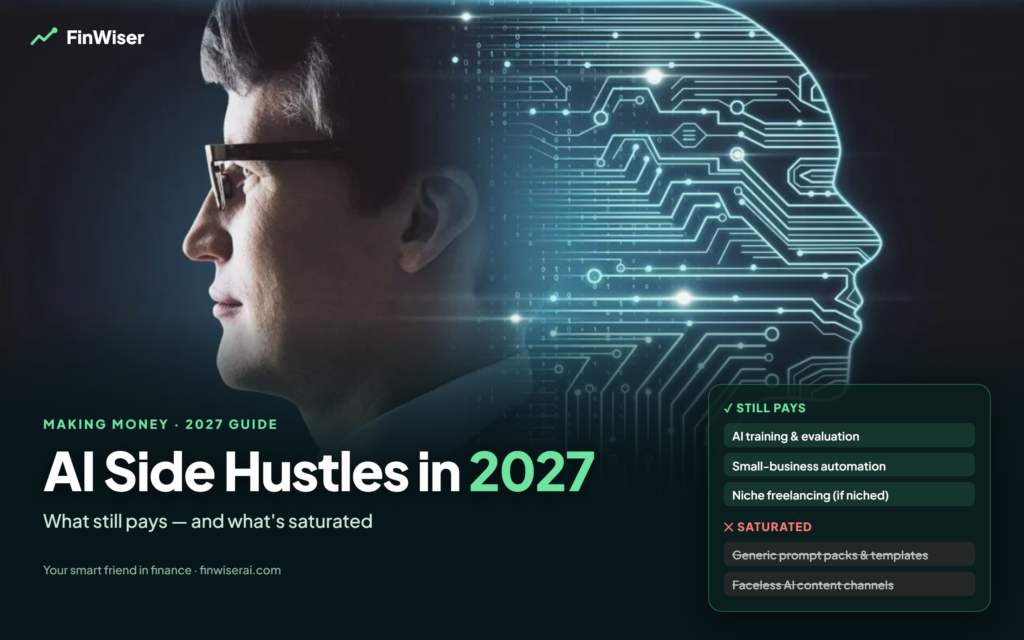
Five popular ways to earn extra money with AI, compared on pay, competition and staying power, so you can see which ones still reward your time in 2027 and which ones have filled up.
Disclosure: the author sells freelance business-plan and pitch-deck services on Upwork and Fiverr, one of the categories covered here. FinWiser earns nothing from any platform named in this article.
Every few months a new wave of “make money with AI” videos promises easy income. Some AI side hustles really do still pay in 2027. Others have been copied so many times that the only people reliably earning are the ones selling courses about them.
This isn’t a ranking with one “correct” winner. The right pick depends on your skills, how fast you need cash and how much client contact you can stomach. What we can do is compare the five most common options on the same criteria, so you can see where the real opportunity sits. We’ll also flag where the money touches interest, for readers who keep their finances halal.
🌱 Our Wisers Say
If the only thing standing between a beginner and your income is a good prompt, assume someone will undercut you within a year. Pay AI the role of a fast assistant, and charge for the part it can’t do: your judgment, your industry knowledge and your accountability to the client.
Good News: You Don’t Have to Choose Just One
These options stack well. Many people start with platform-based AI training work for quick, predictable hourly pay, then use what they learn to land a few freelance or automation clients. A digital product can come later, once you know exactly which problem your buyers will pay to solve.
The mistake is starting all five at once. Pick one earner and one longer-term builder, and give each a fair 90-day test.
At a Glance: AI Side Hustles Compared
Same seven criteria for every option. The pay ranges come from the sources linked later in this article; the competition and verdict rows are FinWiser’s editorial judgment.
| Criterion | AI training & evaluation | AI automation for small businesses | Niche AI-assisted freelancing | AI digital products | Faceless AI content channels |
|---|---|---|---|---|---|
| Typical pay | From about $12–$25/hr for generalists; far higher for credentialed experts | Per-project fees plus monthly retainers; varies widely | AI writing roles average roughly $24–$40/hr | Mostly occasional sales; a few niche sellers do well | Little to nothing until the channel monetizes |
| Startup cost | Free to join | Low (tool subscriptions) | Low | Low | Low to moderate |
| Time to first dollar | Days to weeks | A few weeks | A few weeks | Weeks to months | Months |
| Competition | Moderate | Low to moderate | High if generic, moderate if niche | Very high | Very high |
| Skill moat | Your domain expertise | Business-process knowledge | Industry knowledge plus editing | Weak | Weak unless you add storytelling |
| Income stability | Lumpy; projects pause | Good with retainers | Good with repeat clients | Unpredictable | Unpredictable |
| 2027 verdict | Still pays | Still pays | Pays if niched | Saturated | Saturated |
How AI Side Hustles Compare, Criterion by Criterion
Typical Pay
Structured AI training work is the easiest pay to verify. Mercor puts generalist evaluation tasks at roughly $12–$25 an hour and says credentialed experts can earn far more, while DataAnnotation advertises projects starting at $20 an hour. Writing-focused roles land in a similar band: GOBankingRates, citing ZipRecruiter, puts average AI prompt writers at about $24 an hour and AI content writers at about $40.
Automation consulting has no tidy hourly rate because you price the outcome, such as hours saved each week. Digital products and faceless channels can earn something, but the typical result is small and slow. That gap matters more than the headline numbers suggest, as the chart below shows.
Startup Cost
All five options are cheap to start, which is exactly why the low-skill ones fill up so quickly. AI training platforms charge nothing to join. Automation work usually needs a paid plan on a tool like n8n or Zapier, and content channels may need paid voice or video software.
Keep a simple rule: don’t spend more on tools in month one than you expect to earn in month three. Most AI tools offer free tiers that are plenty for building your first samples, and upgrading only after a client pays keeps the experiment self-funding.
Time to First Dollar
Among AI side hustles, AI training wins on speed: pass an assessment, get matched, start earning. Freelancing and automation typically take a few weeks because you need samples and a first client. Products and channels are “build first, earn later,” so they suit people who already have income covering the bills.
Competition and Saturation
Saturation follows a simple rule. When a hustle needs no money, no license and no specialist knowledge, everyone can copy it, and prices race toward zero. That is the story of generic prompt packs, template shops and faceless “top 10” video channels.
Buyers are also pushing back. In Menlo Ventures’ 2026 consumer survey, 36% of Americans said they’d be less likely to engage with content they knew was AI-generated, against 14% who’d be more interested. That’s a headwind for any model built on volume alone.
You can test saturation yourself in ten minutes. Search the marketplace where you’d sell, whether Upwork, Fiverr, Etsy or YouTube, and look at the first two pages. If dozens of near-identical listings compete mainly on price, the crowded ones reveal themselves fast. If you find a few busy sellers with strong reviews and clear specialization, demand exists and there’s room for someone with a sharper niche.
Skill Moat
A moat is whatever makes you hard to replace, and it’s the clearest dividing line between AI side hustles that last and those that fade. For AI training it’s your field: a nurse, accountant or lawyer qualifies for tiers a generalist can’t reach. For automation it’s understanding how a dental office or freight brokerage actually runs, which no prompt supplies.
Income Stability
Platform work is convenient but lumpy, since projects can end without warning. Freelance and automation clients on monthly retainers are the steadiest of the five. Product and channel income can swing wildly from one month to the next.
If you’re relying on side income for essentials, stability should outweigh upside. A $600 retainer that arrives every month is worth more to your budget than a product that made $1,500 once and $40 since.
Why “AI Skill” Alone Isn’t a Business Anymore
When AI side hustles first took off in 2023, simply knowing how to use ChatGPT was a selling point. By 2027 it’s table stakes, like knowing Excel. Menlo’s survey found 55% of AI users now pay for at least one AI product, so your clients often own the same tools you do.
That shifts what people pay for. They pay for outcomes they can’t get alone: a bookkeeping workflow that runs without errors, a pitch deck an investor takes seriously, a model evaluation only a doctor can do. AI shortens the work; your expertise is what sets the price.
This is also why the saturated options look so attractive from the outside. They’re the ones where AI does nearly all the work, which means the barrier to entry is almost zero. The same feature that makes them easy to start makes them nearly impossible to defend once thousands of others start too.
What the Data Says About Income From AI Side Hustles
The opportunity is real but thinner than social media suggests. Menlo Ventures’ 2026 State of Consumer AI report, based on a Morning Consult survey of 5,067 U.S. adults in July 2026, found 48% of AI users have earned money with AI, roughly 30% of all American adults.
The most common routes were content creation (22% of AI users) and freelancing (18%). Notice the tension: content creation is the most popular way to earn and also one of the most crowded. Popularity is a warning sign, not an invitation.
Context helps too. Bankrate found only 27% of U.S. adults had any side hustle in 2025, and 28% of side hustlers earned just $1–$50 a month. Plan for the median, not the viral screenshot. A realistic first-year goal for most people is a few hundred dollars a month, which can still cover a bill, fund an emergency savings habit or pay down debt faster.
A Halal-Aware Note
Most AI side hustles are service or trade income, which halal-conscious earners generally treat as permissible. The watch-outs sit around the edges, starting with riba (interest). Avoid financing tool subscriptions or equipment on interest-bearing credit, and don’t park payouts in interest-paying balances.
For content and product sellers, check what you promote. Affiliate links to interest-based loans or credit cards, or content in clearly impermissible niches, can taint otherwise clean income. AI training work is usually fine, though some may decline projects whose subject matter conflicts with their values.
Whatever your faith, set money aside for tax. U.S.-based earners owe self-employment tax of 15.3% once net earnings reach $400 a year.
Pros and Cons of AI Side Hustles
Where AI Training & Evaluation Wins
- Fastest start. No clients or portfolio needed; you complete assessments and pick up tasks.
- Rewards expertise. Specialist tiers pay well above generalist rates.
- The catch. Work can dry up between projects, and some onboarding is unpaid.
Where AI Automation Wins
- Value-based pricing. You charge for hours saved, not hours worked.
- Recurring revenue. Workflows need upkeep, which naturally becomes a retainer.
- The catch. You must sell to business owners and fix things when tools change.
Where Niche AI-Assisted Freelancing Wins
- Uses skills you already have. AI speeds up writing, design or analysis you can already do.
- Room to raise rates. A narrow niche lets you charge for judgment, not word count.
- The catch. Generic “AI writer” profiles compete on price with thousands of others.
Where AI Digital Products Win
- Build once, sell many times. No per-hour ceiling if a product finds its audience.
- The catch. Very low barriers mean marketplaces are flooded, and most listings sell rarely.
Where Faceless AI Content Channels Win
- Long-term asset. A channel with an audience can earn from ads and sponsors for years.
- The catch. Identical channels crowd every topic, and audiences increasingly skip obvious AI content.
Which One Is Right for You?
None of these AI side hustles is right for everyone. Match the option to your situation rather than to whatever is trending this month.
- You need money within a month. Start with AI training and evaluation work.
- You have professional expertise. Apply for specialist AI training tiers, then add niche freelancing in your field.
- You understand how small businesses run. Automation consulting has the best pay-to-competition ratio of the five.
- You already have an audience. A digital product can work, because distribution is the hard part you’ve already solved.
- You’re starting from zero with no niche. Skip products and faceless channels for now; they reward people who already have an edge.
5 Platforms to Know
- Mercor: matches professionals with AI training and expert evaluation projects.
- DataAnnotation: remote AI training tasks, with projects advertised from $20 an hour.
- n8n: workflow-automation tool many consultants build client automations on.
- Upwork: freelance marketplace for niche writing, design and automation clients.
- Gumroad: storefront for selling digital products once you have a validated niche.
Key Takeaways
- The AI side hustles that still pay in 2027 pair AI speed with expertise: AI training, small-business automation and niche freelancing.
- Generic prompt packs, template shops and faceless channels are saturated because anyone can copy them.
- Plan around median income, about $200 a month for U.S. side hustlers, not viral earnings claims.
- Halal-conscious earners should keep financing and payouts riba-free and vet affiliate links.
Further Reading From Top Finance Publishers
These outlets have covered the same question from different angles. Each link was checked before publishing.
- NerdWallet: 8 Side Gigs for People Pressed for Time (includes learning to monetize AI tools)
- Bankrate: Side Hustle Survey: Roughly One in Four Adults Have a Side Hustle
- The Motley Fool: How to Use AI to Make Money in 2026
- CNBC Make It: How AI Makes Some Side Hustles Easier and More Lucrative
- GOBankingRates: 4 Low-Effort AI Gigs That Can Make $1,000
- Forbes: How You Can Make Money With AI: Real Opportunities You Can Tap Into