
Investing > Learn > Best Uranium ETF in 2026: URA vs URNM vs Sprott Physical Uranium Trust
Investing · Index Funds & ETFs
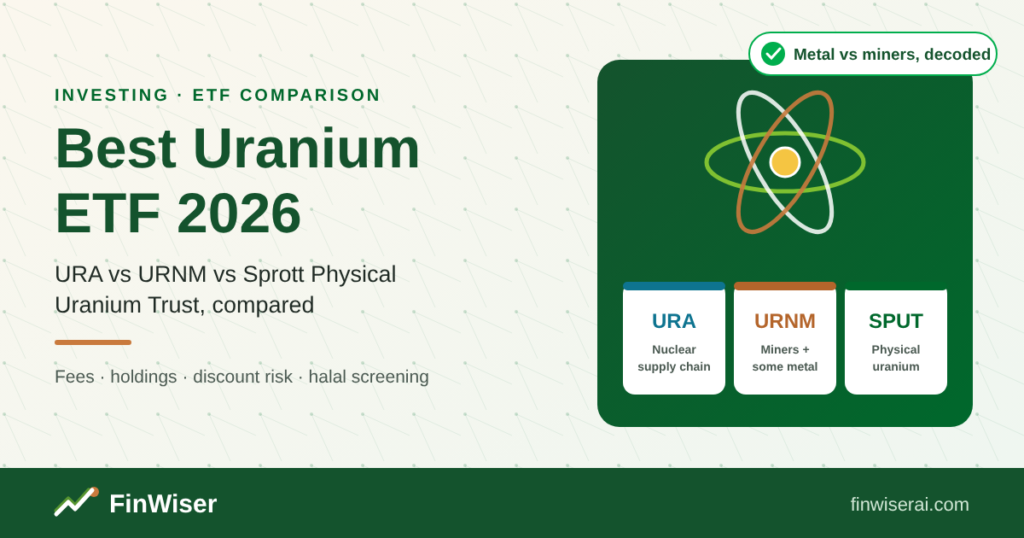
URA, URNM and the Sprott Physical Uranium Trust all ride the nuclear-power trade, but one owns a wide slice of the nuclear supply chain, one owns miners plus some metal, and one simply owns the metal.
Search for the best uranium ETF and you’ll keep landing on the same three names: the Global X Uranium ETF (URA), the Sprott Uranium Miners ETF (URNM) and the Sprott Physical Uranium Trust (SPUT). They get lumped together online, but they don’t own the same things, don’t cost the same, and don’t even share the same legal structure.
This isn’t a hunt for one universally “correct” pick. It’s a plain-language breakdown of what each fund actually holds, so you can match the vehicle to the bet you’re trying to make. Figures come from each provider’s own fund pages and filings, mostly as of mid-October 2026.
🌱 Our Wisers Say
Decide what you’re betting on before you pick a ticker. If your thesis is “the uranium price goes up,” a miners fund stacks a second layer of risk (management, permits, cost overruns) on top of the metal. If your thesis is “the nuclear buildout keeps going,” the metal alone may be too narrow. Either way, treat uranium as a small satellite next to a diversified core, never as the core itself.
Good News: You Don’t Have to Choose Just One
These funds already overlap. On October 16, 2026, the Sprott Physical Uranium Trust was URNM’s second-largest holding at 16.79% of the fund, and URA’s second-largest at 7.68%. Buying either ETF already hands you a slice of physical uranium.
That makes blending easy. If you can’t decide which is the best uranium ETF for you, a miners ETF plus a small trust position lets you set your own metal-versus-miners mix instead of accepting the ratio an index rulebook picked for you.
At a Glance: The Best Uranium ETF Options Side by Side
Same eight criteria, all three funds. One thing to know up front: SPUT is technically a closed-end trust, not an ETF, and that difference shows up in several rows.
| Criterion | Global X Uranium ETF (URA) | Sprott Uranium Miners ETF (URNM) | Sprott Physical Uranium Trust (SPUT) |
|---|---|---|---|
| Structure | U.S.-listed ETF | U.S.-listed ETF | Canadian closed-end trust |
| Where it trades | URA on NYSE Arca | URNM on NYSE Arca | U.U (US$) and U.UN (C$) on the TSX; SRUUF over the counter in the U.S. |
| Annual cost | 0.69% expense ratio | 0.75% expense ratio | 0.35% management fee; 0.71% total expense ratio (H1 2026) |
| Size | $5.00B net assets | $1.70B net assets | $7.04B net assets (June 30, 2026) |
| Holdings | 60 positions | 25 positions | One asset: about 81.7M lbs of U3O8 |
| Physical uranium share | About 7.7% (via its SPUT stake) | About 19.6% | About 98.3% |
| Payouts | Semi-annual distributions | Year-end distributions | Not an income vehicle |
| Halal angle | Screen 60 holdings | Screen 25 holdings | Simplest: one physical commodity |
Sources: Global X and Sprott ETFs fund pages (October 16, 2026; URNM physical share as of September 30); SPUT interim report (June 30, 2026) and Sprott’s trust page.
Breaking Down the Best Uranium ETF Choice, Criterion by Criterion
Structure and How You Buy It
URA and URNM are ordinary U.S. ETFs. New shares get created and redeemed as demand changes, which normally keeps the market price close to the fund’s net asset value (NAV, the per-share value of everything it holds). Any standard U.S. brokerage account can buy them.
SPUT is a closed-end fund set up as a Canadian trust, so its units aren’t redeemed on demand. They list on the Toronto Stock Exchange, and many U.S. brokers reach them through the over-the-counter ticker SRUUF.
Annual Cost
On fees alone, the gap is small. URA’s 0.69% expense ratio works out to $69 a year per $10,000 invested, and URNM’s 0.75% to $75. SPUT’s 0.35% management fee looks cheapest, but storage, administration and other costs pushed its total expense ratio to 0.71% for the first half of 2026.
SPUT also pays its manager a 1% commission whenever it buys uranium, which showed up as a separate 0.18% trading expense ratio in that period. When you weigh the best uranium ETF on cost, remember that a gap of a few hundredths of a percent is smaller than an ordinary day’s price move in this sector.
What You Actually Own
URA is the broadest. Its index covers miners, physical uranium trusts and companies making nuclear components or developing reactor technology, and Industrials made up about 29% of the fund at the end of September 2026. Its country mix is wide too, with Canada at 39%, the U.S. at 23% and South Korea at 14%.
URNM stays closer to the ground. Its index targets companies that devote at least half their assets to the uranium mining industry, including physical uranium holders and royalty owners. SPUT owns almost nothing except uranium oxide, stored with three custodians: Cameco, ConverDyn and Orano.
Concentration differs sharply as well. URA’s three biggest positions add up to about 37% of the fund, while URNM’s top three add up to about 51%. SPUT is a single asset by design.
How Closely Each Tracks the Uranium Price
SPUT is the closest you can get to owning the spot price (the price for immediate delivery) through a brokerage, minus fees and any gap between its unit price and NAV. Miners are a lever on that price instead.
Rising uranium can lift a miner’s profits faster than its revenue, but falling prices and permit delays cut just as deep. That’s why the best uranium ETF for a pure price view and the best one for growth upside are rarely the same fund.
Trading and Liquidity
Global X reported a 30-day median bid-ask spread of 0.03% for URA in mid-October, while Sprott reported 0.21% for URNM. In plain terms, URA costs less to get in and out of, which matters if you add to the position often.
SPUT’s catch is different: its price can drift well away from the value of its uranium, as the section below shows.
Taxes and Paperwork
For U.S. taxpayers, Sprott says all its physical trusts count as a passive foreign investment company (PFIC). Holders in taxable accounts generally need a timely Qualified Electing Fund election on IRS Form 8621, filed every year they own units, to keep capital-gains treatment. URA and URNM carry no such extra form. Outside the U.S., check your own country’s rules on foreign trusts.
Track Record
Over the year to September 30, 2026, URA’s NAV fell 12.58% and URNM’s fell 18.52%. Over five years, URA returned 15.61% a year against 8.01% for URNM. SPUT’s yearly NAV returns swing hard: up 86.3% in 2023, down 20.2% in 2024 and up 9.9% in 2025.
Treat those numbers as a volatility warning, not a forecast. Whichever fund you pick as your best uranium ETF, expect years that look like 2024.
Uranium ETF vs Nuclear Energy ETF: Not the Same Bet
A uranium fund and a nuclear energy fund sound interchangeable, but they aren’t. Broader nuclear funds, such as VanEck’s NLR, add utilities that run reactors, so their results lean more on power prices and regulators than on the fuel.
That breadth can soften the swings, but it dilutes the uranium story too. If you came looking for the best uranium ETF but your real thesis is “nuclear power keeps growing,” a wider nuclear fund may fit better than any of the three compared here.
Five Providers to Know
- Global X. Runs URA, the oldest fund here, launched in November 2010.
- Sprott. Manages both URNM and SPUT, which Sprott calls the world’s largest physical uranium fund on Morningstar’s measure.
- VanEck. Offers NLR, a wider nuclear-energy ETF that mixes miners with utilities.
- Yellow Cake plc. A London-listed company that buys and holds physical uranium; it was a 4.6% URNM holding in mid-October.
- Zoya. A halal investing app whose ETF screener filters a fund’s underlying holdings by Shariah status.
By the Numbers: SPUT’s Discount Swung Back to 13%
On October 16, 2026, SPUT’s U.S.-dollar units closed at $18.81 against a NAV of $21.61, a discount of about 13%, according to Sprott’s own trust page. That’s a sharp reversal: in the first half of 2026, the units traded at an average discount of only about 2.7%, down from roughly 8.0% a year earlier, per the trust’s interim report.
For comparison, URA and URNM traded within about 0.7% of their NAV that same day. The trust can only sell new units when the price covers at least 100% of NAV, so a deep discount stops it from raising money to buy more U3O8 (uranium concentrate, or “yellowcake”). A discount means buying uranium on sale, but selling at one leaves value on the table.
Can the Best Uranium ETF Be Halal?
Mining and nuclear power aren’t on the excluded-industry lists that mainstream Shariah screens use, such as alcohol, gambling or conventional lending. The real question is how each company is financed, so screens check interest-bearing debt, riba (interest) income and cash ratios holding by holding.
None of the three is Shariah-certified. For URA and URNM, that means running the holdings through a screener and setting aside any impure share of distributions for purification. Some methodologies also flag defense-related revenue, which can matter for the nuclear-component makers inside URA.
SPUT is simpler to assess because it owns a physical commodity outright rather than shares in indebted companies. It does keep a small cash balance, so ask a qualified scholar whether any income earned on that cash needs purifying.
Where Each Option Wins
No single fund is the best uranium ETF on every count. Here’s where each one earns its place, and what to watch.
Where Global X Uranium ETF (URA) Wins
- Broadest exposure. Miners, a trust stake and nuclear-component makers sit in one ticker.
- Lowest ETF fee. At 0.69%, it’s the cheaper of the two ETFs.
- Easiest to trade. A 0.03% median spread suits people who buy in regularly.
- Watch out for. Industrial and reactor-tech stocks that move on factors other than uranium.
Where Sprott Uranium Miners ETF (URNM) Wins
- Purer mining focus. Companies must be mostly about uranium to get in.
- Built-in metal. About a fifth of the fund sits in physical uranium holders.
- Concentrated upside. With half the fund in three names, a rally in the leaders shows up fast.
- Watch out for. The highest fee of the three and a wider trading spread.
Where Sprott Physical Uranium Trust (SPUT) Wins
- Closest to the metal. About 98% of its value is uranium oxide.
- No mining risk. No permits, cost overruns or management execution to worry about.
- Simplest halal screen. One physical commodity instead of dozens of balance sheets.
- Watch out for. TSX or over-the-counter access, PFIC paperwork and a discount that can widen fast.
Which Is the Best Uranium ETF for You?
Match the fund to the sentence that sounds most like you:
- “I want one simple ticker for the whole nuclear supply chain.” URA.
- “I think miners will outrun the metal.” URNM.
- “I want the uranium price itself, with the least company risk.” SPUT, if your broker can reach it.
- “I want a halal-aware starting point.” SPUT is the simplest to screen; screen URA or URNM holdings first if you prefer an ETF.
- “I honestly can’t decide.” A miners ETF already holds some SPUT. Start there and keep the position small.
Key Takeaways
- The best uranium ETF depends on your bet: the metal (SPUT), miners plus some metal (URNM), or the wider nuclear chain (URA).
- Fees sit close together, from 0.69% to 0.75%, so structure and holdings matter more than cost.
- SPUT isn’t an ETF. It’s a Toronto-listed closed-end trust that traded about 13% below NAV in mid-October 2026, and U.S. holders face PFIC filing.
- URNM already holds about 17% SPUT and URA about 8%, so you can blend without buying all three.
- For halal-conscious investors, SPUT is the simplest to screen; URA and URNM need holding-level screening and purification.
About the author
Sundas Tahir
Founder & CEO, FinWiser
Sundas Tahir founded FinWiser to make money decisions clearer. With close to eight years in finance and fintech, she has worked hands-on with financial accounts, payment flows and disputes, the day-to-day mechanics of how money actually moves. She writes about investing, banking and money tools with a halal-aware lens. Nothing here is personal financial advice. Think of FinWiser as the smart friend who reads the fine print so you don’t have to.
Further Reading From Top Finance Publishers
These outlets have covered the same question from different angles. Each link was checked before publishing.
- The Motley Fool: 3 Best Nuclear Energy ETFs for 2026 and How to Invest (covers URA, URNM and NLR side by side)
- U.S. News: Uranium Stocks, ETFs and Other Ways to Invest in the Nuclear Fuel (includes a section on physical uranium)
- Nasdaq: How to Invest in Uranium: 2026 Guide to Stocks, ETFs and More (supply-and-demand background from the Investing News Network)