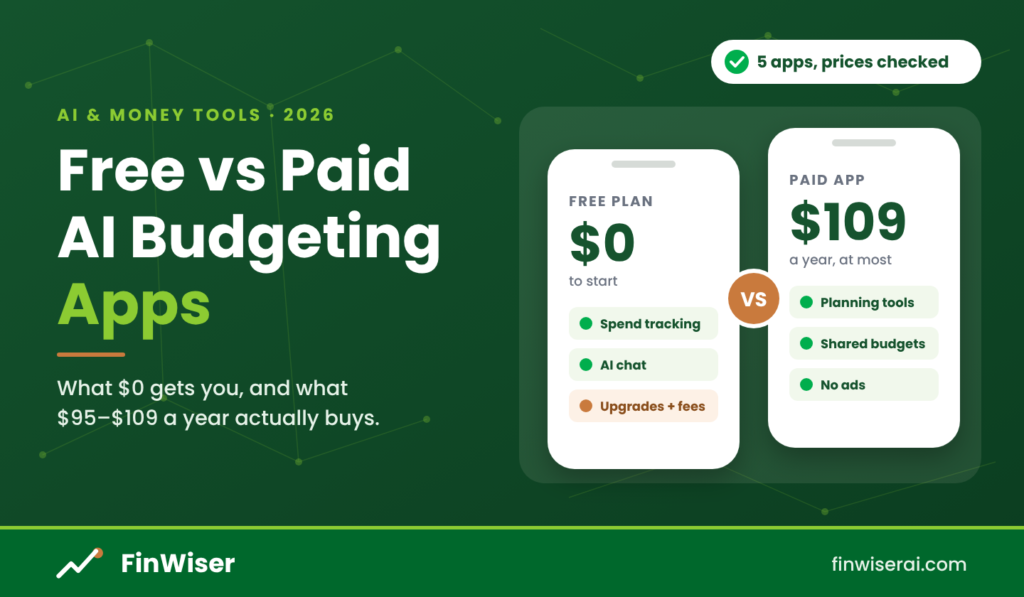
Free budgeting apps cost nothing up front and paid ones run about $95 to $109 a year. Here is what the extra money buys, and when it is not worth it.
Type “best budgeting app 2026” into any search bar and you get advice from two camps. One says never pay for something a free app already does. The other says a free app is free for a reason. Both are partly right.
This guide compares five real apps across that divide. Two have useful free plans: Rocket Money and Cleo. Three you pay for: YNAB, Monarch Money and Copilot Money. Every price below was checked against the provider’s own pricing page or NerdWallet’s June 2026 roundup.
One thing up front: there is no universally correct choice here. A $109 app that changes how you spend is cheap. A free app you open twice is expensive in a different way. The right pick depends on what you need the app to do.
Don’t pay for a budgeting app until you can name the feature you are missing. Run a free plan for 30 days first. If you upgrade, the subscription should save you at least what it costs, which is roughly $8 to $9 a month on an annual plan. If it can’t clear that bar by month three, cancel.
Good News: You Don’t Have to Choose Yet
Picking the best budgeting app 2026 has to offer is not a one-way door between free and paid. Every paid app in this comparison offers a trial, and the longest runs 34 days with no card required. That is enough time to run a paid app alongside a free one and see which you open more.
A sensible order: start on a free plan to see where your money goes. Then trial one paid app during a normal month, not a holiday month. Whichever one you check without being reminded is the one to keep.
Best Budgeting App 2026: Free vs Paid at a Glance
Prices are in US dollars and were verified in October 2026. Free plans can change without notice, so confirm on the provider’s site before you sign up.
| Criteria | Rocket Money Free plan |
Cleo Free plan |
YNAB Paid |
Monarch Money Paid |
Copilot Money Paid |
|---|---|---|---|---|---|
| Price | $0. Premium is about $6–$12 a month, and you pick the amount | $0. Paid tiers are $5.99, $8.99 or $14.99 a month | $14.99 a month or $109 a year | $14.99 a month or $99.99 a year | $13 a month or $95 a year |
| Free trial | 7 days of Premium | Free plan, no trial needed | 34 days, no card | 7 days | 1 month |
| AI features | Rowan, an AI assistant | AI chat is the whole product | Minimal. Method comes first | AI assistant and weekly recaps | AI sorts transactions and learns patterns |
| Devices | iOS, Android, web | iOS, Android | iOS, Android, web | iOS, Android, web | iPhone, iPad, Mac. Limited web app, no Android |
| Budget style | Tracking and subscription finder | Chat-based tracking | Zero-based, hands-on | Flexible or by category | Mostly automatic |
| How it earns | Premium upgrades, plus 35%–60% of bill savings it negotiates | Paid tiers and cash advance express fees | Subscriptions only | Subscriptions only, no ads | Subscriptions |
| Lending or interest add-ons | Savings account. Parent company sells mortgages and loans | Cash advances, interest-paying savings, credit-builder card | None found | None found | None found |
The chart shows why billing choice matters as much as app choice. If you trial a paid app and decide it is your best budgeting app 2026 pick, switch to annual billing straight away.
Free vs Paid, Criteria by Criteria
Price and Real First-Year Cost
The free plans from Rocket Money and Cleo cost $0. On annual billing, Copilot Money is $95, Monarch Money is $99.99 and YNAB is $109. That works out to between $7.92 and $9.08 a month.
Rocket Money Premium is unusual because you choose your own price. Its help center puts the range at $6 to $12 a month, with higher ranges on some platforms. Cleo’s paid tiers run from $5.99 to $14.99 a month. So an app that tops a “best budgeting app 2026” list for being free can cost more than the paid ones once you upgrade.
What the AI Actually Does
Nearly every app now says it uses AI, and the label covers very different things. Copilot Money uses it to sort transactions and learn your patterns. Monarch added an AI assistant that answers questions about your own numbers. Cleo is chat-first, and Rocket Money has an assistant called Rowan.
YNAB is the outlier. It leans on a method called zero-based budgeting, where every dollar is given a job before you spend it. Judged purely on AI features, YNAB looks weak. For changing habits, the manual work is the point of the method.
Bank Syncing and Devices
All five can connect to your bank through a data aggregator. That is a middleman company, such as Plaid, that pulls your transactions into the app. YNAB also lets you skip syncing and type transactions in by hand.
Devices matter more than people expect. Copilot Money is built for iPhone, iPad and Mac. It added a limited web app in December 2025 and has no Android app. Monarch and YNAB work on iOS, Android and the web, so check this before comparing anything else.
How the App Makes Money
This is the criterion most best budgeting app 2026 roundups skip, and it explains almost everything else. A paid app has one customer: you. YNAB says plainly that subscriptions are its only income. Monarch says it runs no ads and never sells financial data.
A free plan has to be funded another way. Rocket Money earns from Premium upgrades and from bill negotiation, where it keeps 35% to 60% of your first year’s savings. Cleo earns from paid tiers and from cash advances. Those are small advances on your next paycheck, with express fees for same-day transfers.
None of that is hidden or improper. It simply means a free plan is designed to move you toward something that pays. Know what that something is before you link your accounts.
Privacy and Data
Any app that syncs accounts holds sensitive data, paid or free. NerdWallet’s advice is to choose apps with bank-grade encryption and multi-factor authentication. That applies on both sides of any “best budgeting app 2026” comparison.
The difference is incentive. A subscription-funded app has less reason to market financial products to you. In March 2025 the FTC announced a $17 million settlement with Cleo over allegations about how it described cash advance amounts and handled cancellations. It is a reminder to read what a free plan is selling.
Effort and Budgeting Style
Free plans mostly look backward and show what you already spent. Paid apps add planning. YNAB has you assign income before you spend it, a digital take on envelope budgeting. Monarch offers a loose three-bucket view or detailed category limits.
More planning means more setup. NerdWallet notes that Monarch can overwhelm beginners and that YNAB suits hands-on users. If you want something close to automatic, Copilot Money or a free tracker fits better.
Free Tier vs Free Trial: A Difference Worth Knowing
These two terms get used as if they mean the same thing. A free tier is a permanent but limited version of the app, the “free” half of a freemium model. A free trial is the full app for a short time, after which you pay or leave.
Trials vary a lot. YNAB gives 34 days and takes no card when you sign up directly. Copilot Money gives one month. Monarch and Rocket Money Premium give seven days, which is too short to judge a budget across a full pay cycle.
Before you act on any best budgeting app 2026 ranking, check which of the two it is describing. Then set a calendar reminder two days before a trial ends.
The 1,900% Search Claim, Checked
You may have seen the claim that searches for personal finance apps are up 1,900% in 2026. We tried to trace that figure to a published source and could not find one. So we are not repeating it as fact, and you should be wary of any article that does so without a link.
Here is what can be checked. Rocket Money reports more than 10 million members on its own site. Of the nine apps in NerdWallet’s 2026 roundup, only two are entirely free. Interest is real, but the exact size of the surge is unproven.
The one statistic that speaks to value comes from YNAB. It says new users save $600 in their first two months and more than $6,000 in their first year. That figure is self-reported by a company selling a $109 subscription, so treat it as a best case. Even a tenth of it would cover the fee several times over.
Halal Check: Is the Best Budgeting App 2026 Interest-Free?
Tracking your spending involves no riba, the interest that Islamic finance prohibits. A flat subscription is a fee for a service. That makes YNAB, Monarch Money and Copilot Money the simplest fit for a halal-conscious reader.
Care is needed around the add-ons. Cleo’s paid tiers include cash advances with fees, a savings feature that pays interest and a credit-builder card. Rocket Money sits inside Rocket Companies, which sells mortgages and personal loans.
You can use either free plan for tracking alone and ignore the rest. If you would rather not be shown those offers at all, a subscription-only app removes the question. For a ruling on a specific feature, ask a scholar you trust.
Where Each Option Wins
No single pick is the best budgeting app 2026 offers for everyone. Here is the case for each side, and against it.
Where Free Apps Win
- No cost to start. You see where your money goes without committing a cent.
- Low effort. Rocket Money’s free plan links accounts, tracks spending and finds recurring subscriptions for you.
- Good enough for awareness. If the goal is to stop being surprised by your balance, a free plan does the job.
Where Free Apps Fall Short
- Features sit behind upgrades. Subscription cancellation, net worth tracking and unlimited budgets are Premium features at Rocket Money.
- Add-on fees can be steep. A 35% to 60% cut of negotiated bill savings is a real price.
- More product offers. The app needs you to buy something eventually.
Where Paid Apps Win
- Planning, not just tracking. YNAB and Monarch help you decide where money goes before it is spent.
- Household sharing. One YNAB subscription covers a group of up to six, and Monarch adds a household member at no extra cost.
- Cleaner incentives. There are no ads, and the business depends on you staying satisfied.
Where Paid Apps Fall Short
- A recurring bill. Expect $95 to $109 a year, or up to $179.88 if you pay monthly.
- Setup time. Building a first budget takes real effort before the app pays you back.
- Platform gaps. Copilot Money has no Android app, which rules it out for mixed-device households.
Which One Is Right for You? The Best Budgeting App 2026 by Reader Type
- You have never budgeted. Start with Rocket Money’s free plan for a month.
- You overspend and want structure. Try YNAB and use the full 34-day trial.
- You share money with a partner or track investments too. Monarch Money fits best.
- You live on Apple devices and want minimal effort. Copilot Money is built for you.
- You like asking questions in plain language. Use Cleo’s free plan and skip the advances.
- You avoid interest on principle. Choose YNAB, Monarch or Copilot, which are subscription-only.
Prefer no bank link at all? EveryDollar’s free version and Goodbudget’s free plan both work with manual entry, so nothing is synced.
Key Takeaways
- Free plans are funded by upgrades and add-on fees. Paid apps are funded by your subscription alone.
- On annual billing, paid apps cost $95 to $109 a year. Monthly billing pushes that as high as $179.88.
- “AI” means something different in each app, so check what it does before paying for it.
- Trial before you buy. YNAB’s 34 days is the longest window in this comparison.
- The best budgeting app 2026 has to offer is the one you still open in month three.
Keep Reading
For a wider list of apps with user ratings, see NerdWallet’s guide to the best budget apps for 2026.
More from FinWiser on AI & Money Tools