
Making Money > Learn > Payoneer vs Wise for Freelancers in Pakistan (2026)
Making Money · Freelancing
Payoneer helps you receive client money in Pakistan, while Wise mostly helps your client send it, so here is how the two really compare for Pakistani freelancers.
If you freelance from Lahore, Karachi or anywhere in between, the Payoneer vs Wise Pakistan question usually starts with a client asking, “Can I just pay you on Wise?” The honest answer is: sort of. These two platforms don’t do the same job for someone who lives in Pakistan, so comparing them like-for-like misses the point.
This isn’t a contest with one universally correct winner. Payoneer is built to help you receive money, while Wise, for Pakistan residents, mostly helps your client send it. Which one serves you better depends on who pays you, how often, and how much.
Our Wisers Say
Think of Payoneer as your inbox and Wise as your client’s outbox. Judge every route by one number only: the rupees that actually land in your bank from a $1,000 invoice. Headline fees that skip a step are marketing, not maths.
Good News: You Don’t Have to Choose
Most Pakistani freelancers who handle this well run both routes side by side. Marketplace earnings from Upwork or Fiverr flow into Payoneer, because that’s the payout rail those platforms support. Direct clients abroad who already use Wise can send rupees straight to your bank, and you never need a Wise login at all.
Neither route requires closing the other. The real skill is matching each client to the cheaper path, invoice by invoice.
Payoneer vs Wise Pakistan: At a Glance
| Criterion | Payoneer | Wise |
|---|---|---|
| Useful account for a Pakistan resident? | Yes, Pakistan is supported | Limited: no balance, no USD details |
| Your own USD account details | Yes, receiving accounts in USD, EUR, GBP | No, Pakistan is excluded |
| Upwork and Fiverr payouts | Built-in payout option | Not usable from Pakistan |
| Who pays the transfer fee | You, the freelancer | Your client, the sender |
| Receiving fee | Up to 1% on USD | None charged to you |
| Converting to PKR | Up to 3% on withdrawal | Mid-market rate, fee shown to sender |
| Annual fee | $29.95 if under $6,000 received in 12 months | None for you |
| Typical speed | A couple of business days | Usually same day |
Criterion by Criterion: How They Really Compare
Who Can Actually Use It
Payoneer accepts Pakistan-based freelancers and lets you link a local bank account for withdrawals. Wise is different. Its own help centre lists Pakistan among the addresses that can’t get USD account details, and Pakistan isn’t on Wise’s list of places where residents can hold money.
In practice, a Pakistan resident can’t use Wise as a wallet, and that’s the single biggest fact in any Payoneer vs Wise Pakistan comparison. You can still be paid through Wise; you simply sit on the receiving end of someone else’s transfer.
Setting Up and Verification
Payoneer needs a proper sign-up: your identity documents, your details, and a linked Pakistani bank account. Payoneer itself warns that account approvals can take 72 hours, so open it before your first invoice is due, not on payday.
The Wise route needs almost nothing from you. You share your full name and IBAN, exactly as your bank prints them, and the client handles everything else on their side.
Getting Paid by Upwork and Fiverr
Payoneer wins this one by default. Upwork lets you add Payoneer as a payment method, and Fiverr charges $1 for each withdrawal to Payoneer. Wise can’t stand in, because a Pakistan-based Wise account has no balance for a marketplace to pay into.
Getting Paid by Direct Clients
For a client in the US, UK or Europe, Payoneer gives you receiving account details that work like a local bank account in that country. The client pays as if paying a local supplier. You pay Payoneer’s receiving fee, which is a fixed fee or up to 1% when the currency isn’t your local one, and for a Pakistan account, dollars count as non-local.
Wise flips the bill, and this is the Payoneer vs Wise Pakistan difference many clients never notice. A client with a Wise account sends rupees straight to your personal account using your full name and IBAN, the 24-character code on your bank statement. Two catches from Wise’s PKR guide: it can’t pay Pakistani business accounts, and it rejects Meezan Bank and Allied Bank Express accounts.
A practical tip: when a new client mentions Wise, send them your details in one clean message. Include your name as it appears on your bank account, your IBAN, your bank’s name, and a line saying the payment should go to a personal account in PKR.
Fees and Exchange Rates
Payoneer’s public pricing page lists withdrawals in non-local currency at up to 3% of the amount. Pakistani users have reported being charged the full 3% since Payoneer revised its local fees, up from 2% before. On top of that, an annual account fee of $29.95 applies if you receive less than $6,000 in any 12 consecutive months.
Wise converts at the mid-market rate, the midpoint between the buy and sell price of a currency, without adding an exchange rate markup. Its fee sits in plain view as a separate line the sender sees before paying.
Here’s what that means on a real invoice, and it’s where the Payoneer vs Wise Pakistan gap is widest. A $1,000 payment into your Payoneer USD receiving account can lose up to $10 on arrival and up to $30 more on withdrawal, leaving around $960 before your bank’s own charges. Earn under $6,000 in a year and the annual fee takes a further $29.95, while the same invoice sent through Wise reaches you at the full converted amount.
Speed and Limits
Wise PKR transfers usually arrive the same day once Wise has received and converted the money, with a ceiling of 35 million rupees per transfer. Asaan accounts capped at 500,000 rupees can bounce the payment. Payoneer withdrawals typically take a couple of business days to reach a Pakistani bank.
Common Mistakes That Cost Pakistani Freelancers Money
- Giving a client the wrong account. Wise can’t pay business accounts or Meezan and Allied Express accounts, so share a regular personal account’s IBAN from the start.
- Forgetting the Payoneer threshold. If your Payoneer income dips below $6,000 over 12 months, the $29.95 fee comes straight out of your balance.
- Comparing only headline fees. The fair Payoneer vs Wise Pakistan test is rupees received per invoice, after every hop, not the fee printed on a pricing page.
- Skipping the paperwork. Download your PRCs as payments arrive instead of chasing your bank at tax time.
What Lands in Your Bank: PRCs, Tax and Dollar Accounts
Whichever route you use, the money that reaches your Pakistani bank is what the tax system sees. When foreign funds are credited and converted to rupees, your bank issues a Proceeds Realization Certificate (PRC), proof the money came from abroad. Since 2022, the State Bank has had banks issue these electronically as soon as funds land.
That certificate matters. Freelancers registered with the Pakistan Software Export Board pay a reduced 0.25% tax on remittances through banking channels, and can keep up to 50% of their income in a foreign currency account, according to Business Recorder.
One nuance for the Wise route: the rupees arrive from Wise’s local bank account inside Pakistan, which can look like a domestic transfer. In any Payoneer vs Wise Pakistan setup, ask your bank how it classifies these credits before relying on them for a PRC.
By the Numbers: Freelancers Earned $1.76 Billion
Pakistan’s freelancers earned a record $1.76 billion in foreign exchange in FY2025-26, up 78% from $984 million the year before, according to State Bank of Pakistan data reported by Profit. IT freelancers brought in more than $1.16 billion of that total.
At that scale, one percentage point is serious money: 1% of $1.76 billion is roughly $17.6 million a year. That’s why running the numbers on your own invoices beats picking whichever app your friend uses.
Is Payoneer or Wise Halal-Friendly?
Neither platform lends to you or pays you interest on its core receiving and transfer services, so the fees you pay are service charges, not riba (interest, which Islamic law prohibits). For everyday use, both pass that main test.
Two details still matter when you weigh Payoneer vs Wise Pakistan on halal grounds. Wise pays interest on balances in some countries, including US dollar balances, which doesn’t apply while you live in Pakistan but is worth switching off if you move abroad. Payoneer also offers a Working Capital Advance product, so read its terms carefully before treating it as halal financing.
Many scholars treat on-the-spot currency exchange at a rate agreed at the time as permissible. Both platforms convert this way, at the moment of transfer.
4 Payment Providers Pakistani Freelancers Should Know
Beyond the two big names, a couple of local fintechs are worth knowing about. Check each one’s current fees and requirements before you switch any client over.
- Payoneer. Receiving accounts in major currencies plus direct payouts from Upwork, Fiverr and other marketplaces.
- Wise. The route for clients abroad who want to send rupees straight to your personal bank account.
- SadaBiz by SadaPay. A Pakistani fintech product built for freelancers getting paid by clients worldwide.
- Elevate Pay. A startup that raised $5 million to offer US dollar accounts to freelancers in emerging markets like Pakistan.
Where Each One Wins
Here’s the short Payoneer vs Wise Pakistan scorecard, side by side.
Where Payoneer Wins
- Marketplace income. It plugs straight into Upwork and Fiverr, which Wise can’t do for a Pakistan resident.
- Your own foreign account details. Clients can pay you like a local supplier in the US, UK or Europe.
- Payment requests. You can send a client a payment link and track what has been paid.
- One dashboard. Several clients and platforms land in a single place before you withdraw.
Where Wise Wins
- Zero cost to you. The sender pays Wise’s fee, so the invoice amount reaches you in full.
- Fair conversion. Money converts at the mid-market rate with the fee shown separately.
- Speed. Rupee transfers usually land the same day.
- No annual fee trap. There’s no Pakistan-side account, so there’s no inactivity charge to dodge.
Which One Is Right for You? Payoneer vs Wise Pakistan by Situation
- Mostly Upwork or Fiverr. Payoneer is your default, since it’s the payout rail those platforms support.
- Direct clients who already use Wise. Ask them to send rupees to your IBAN through Wise, and you keep the full amount.
- A mix of both. Run Payoneer for marketplaces and Wise for direct clients, matching each invoice to the cheaper route.
- Earning under $6,000 a year through Payoneer. Budget for the $29.95 annual fee or steer direct clients toward Wise.
- Halal-conscious freelancers. Both work for everyday receiving; just skip interest features and read any financing terms.
Key Takeaways
- The Payoneer vs Wise Pakistan choice isn’t either/or: Payoneer receives your money, Wise lets clients send it to you.
- Pakistan residents can’t get Wise USD account details or hold a Wise balance.
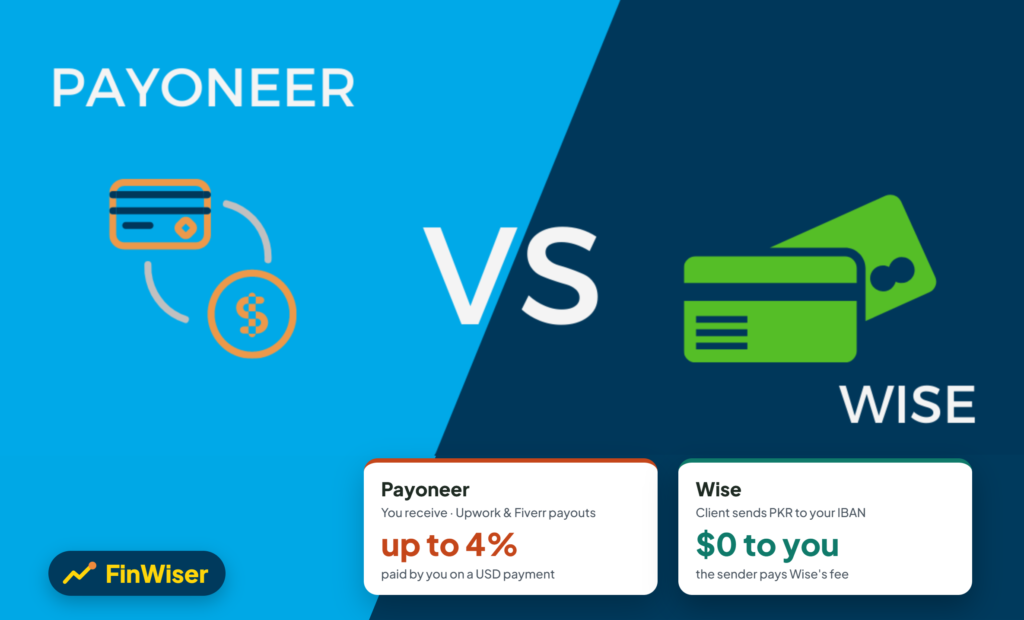
- Payoneer can cost up to 4% on a dollar payment, plus $29.95 a year if you receive under $6,000.
- Keep your PRCs, since they prove foreign income for the reduced freelancer tax rate.
About the author
Sundas Tahir
Founder & CEO, FinWiser
Sundas Tahir founded FinWiser to make money decisions clearer. With close to eight years in finance and fintech, she has worked hands-on with financial accounts, payment flows and disputes, the day-to-day mechanics of how money actually moves. She writes about investing, banking and money tools with a halal-aware lens. Nothing here is personal financial advice. Think of FinWiser as the smart friend who reads the fine print so you don’t have to.
Further Reading From Top Finance Publishers
These outlets have covered the same question from different angles. Each link was checked before publishing.
- NerdWallet: Wise Review 2026: Multicurrency Account (covers fees, interest features and limits)
- Forbes Advisor: Wise Review 2026: Money Transfer Fees and Features (includes worked fee examples)