
Investing > Learn > Halal Retirement Investing: Shariah 401(k) Options vs Self-Directed Halal IRA 2026
Investing & Stocks
A workplace 401(k) and a self-directed IRA can both keep your retirement savings free of interest, but they differ on matching, limits, fund choice, and control.
If you’re a Muslim saving for retirement in the U.S., the real question usually isn’t whether to invest. It’s where. A halal 401k and a self-directed halal IRA can both keep your savings clear of interest and prohibited industries, but they get there in very different ways.
This isn’t a contest with one universally correct winner. Your employer’s plan menu, whether you get a match, how much you save, and how hands-on you want to be all change the answer. So instead of crowning a champion, we’ll show you where each account is strong, where it falls short, and how to use them together.
One term to know before we start: riba, the Arabic word for interest, which Islamic law prohibits. Whether a retirement account is halal comes down to how much riba sits inside the funds you pick, not the account itself.
Our Wisers Say
Treat the account as a container and the funds as the contents. No 401(k) or IRA is haram by design, but the default fund your money lands in often is. Our rule of thumb: capture the full employer match first, fill a halal IRA second, then return to the 401(k) for anything beyond the IRA limit.
Good News: You Don’t Have to Choose
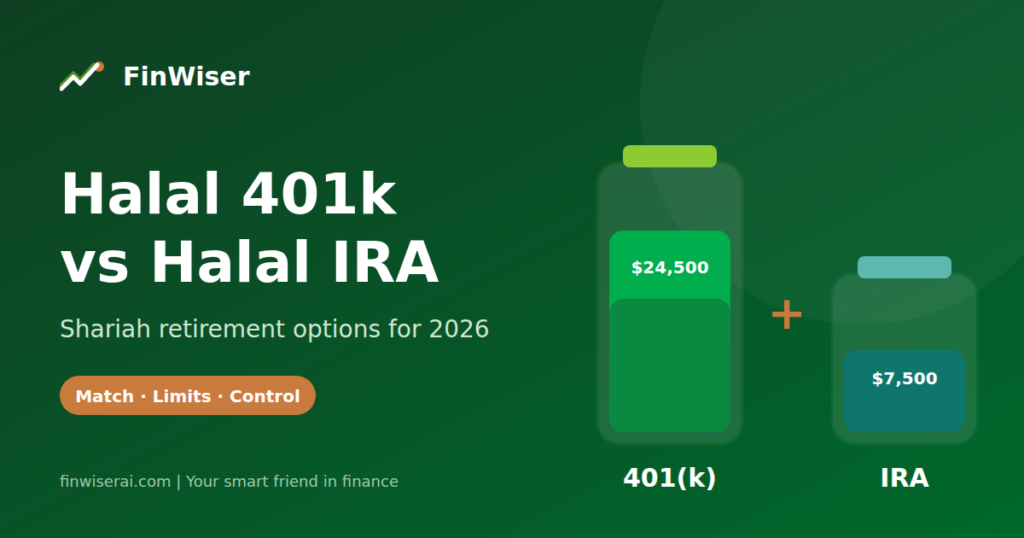
A halal 401k and an IRA are two separate buckets with two separate limits. For 2026, you can defer up to $24,500 into a 401(k) and, on top of that, put up to $7,500 into an IRA, according to the IRS. Contributing to one doesn’t shrink what you’re allowed to put in the other.
That turns “401(k) or IRA?” into a better question: in what order? Most savers who want a fully Shariah-compliant retirement end up running both, using the workplace plan for the match and the bigger ceiling, and the IRA for full control over what they own.
One caveat on taxes. At higher incomes, deducting traditional IRA contributions or contributing directly to a Roth IRA can be restricted. The contribution room still exists, but the tax treatment changes, so check the IRS income thresholds for your filing status.
At a Glance: Halal 401k vs Self-Directed Halal IRA
Here’s how the two accounts line up on the seven things that matter most to a halal-conscious saver.
| Criterion | Workplace 401(k), halal setup | Self-Directed Halal IRA |
|---|---|---|
| Investment choice | Limited to the plan menu, plus a brokerage window if offered | Almost any Shariah-screened fund, ETF, or stock your custodian carries |
| 2026 contribution limit | $24,500 ($32,500 at 50+; $35,750 at ages 60–63) | $7,500 ($8,600 at 50+) |
| Employer match | Yes, if your employer offers one | None |
| Fund costs | Set by the plan; some add admin fees | Set by you; for example SPUS at 0.45%, Amana Growth at 0.86% |
| Shariah oversight | Only if a screened fund is on the menu | You pick funds with their own Shariah boards |
| Riba exposure by default | High: default funds often hold bonds | Low if you hold only screened equity or sukuk |
| Control and portability | Tied to your employer until you leave | Yours; movable between custodians any time |
Criteria-by-Criteria Breakdown
The table gives you the shape of it. Below, we walk through each criterion so you can see where a halal 401k earns its place and where the IRA does the better job.
Investment Choice
A 401(k) only lets you buy what your employer’s plan puts on the menu. If nobody asked for a Shariah-screened fund, there probably isn’t one, and your only halal route may be a brokerage window. An IRA flips this: at most major brokerages you can buy screened ETFs and mutual funds directly.
A quick naming note. Strictly speaking, a self-directed IRA is one held by a custodian that allows alternative assets like real estate or private deals, and the SEC warns those carry extra fraud and fee risk. Most people searching for a self-directed halal IRA mean an ordinary brokerage IRA where they choose screened funds themselves, and that’s the version compared here.
Contribution Room
This is where a halal 401k pulls far ahead. The 2026 employee limit is more than three times the IRA’s, and savers aged 60 to 63 get a special catch-up that lifts their 401(k) total to $35,750. If you want to save 15% or more of a good salary, an IRA alone simply can’t hold it all.
Employer Match
A match is part of your pay. Scholars who have addressed 401(k) plans, including the AMJA fatwa committee, generally focus on what the money is invested in rather than treating the account or the match as the problem. An IRA has no equivalent, which is why the match comes first in almost every sensible plan.
Fund Costs
Inside a 401(k), your costs are whatever the plan negotiated, plus any recordkeeping fees your employer passes on. In an IRA you control the bill: the SPUS ETF carries a 0.45% expense ratio, while the actively managed Amana Growth Fund’s investor shares cost 0.86%. Halal funds tend to cost more than plain index funds, so compare the lineup in your halal 401k against IRA options before assuming either account is cheaper.
Shariah Oversight
A 401(k) plan itself isn’t screened; each fund on the menu either has Shariah oversight or it doesn’t. Dedicated halal funds do. Saturna says an unaffiliated board of Sharia advisers reviews the Amana portfolios, and SPUS follows AAOIFI guidelines, the standards most U.S. screeners reference.
In an IRA, you decide which board and methodology you trust instead of inheriting whatever your employer picked.
Riba Exposure by Default
This is the quiet risk in any workplace plan. Many plans drop new enrollees into a target-date fund, and those funds hold a growing share of bonds as you near retirement, which is interest-bearing debt that Shariah screens exclude. Unless you actively choose your funds, an account you assumed was compliant can drift out of compliance without you doing anything at all.
Control and Portability
Your 401(k) stays with the plan while you work there, and some plans limit how often you can change investments. Once you leave the job, you can move the balance into an IRA through a rollover, ideally a direct trustee-to-trustee transfer so nothing is withheld for taxes. An IRA is yours from day one and can move between custodians whenever you like.
Brokerage Windows: The Hidden Door in a Halal 401k
If your plan menu has no Shariah-screened fund, check your plan documents for a brokerage window, sometimes called a self-directed brokerage account. It lets you move part of your balance into a regular brokerage account inside the plan, where you can buy screened ETFs.
You keep the tax benefits and your match while opening up the halal fund universe. The trade-offs: some plans charge a separate fee for the window, cap how much of your balance can go into it, or set a minimum transfer, so read the fee disclosure first.
If your plan has neither a halal fund nor a window, you still have a move: ask. Employers can add funds when employees request them, and some providers build complete Sharia-compliant 401(k) plans for companies that want one.
The Number to Know: 26%
Only 26% of retirement plans offered a brokerage window in 2024, according to a Plan Sponsor Council of America survey cited by Capital Group. Among plans with 5,000 or more participants, the figure rises to 45%.
For a halal-conscious saver, that number tells the story in miniature. Roughly three in four plans give you no built-in route to screened ETFs, which is why the IRA ends up doing so much of the heavy lifting. It’s also why a halal 401k is often easier to build at a larger employer.
Halal-Aware Note: Bonds, Sukuk, and Purification
Even a well-built retirement account won’t be perfectly pure. Shariah screens tolerate small amounts of non-compliant income; ShariaPortfolio’s screen, for example, accepts companies earning under 5% from non-compliant sources. That’s why many investors practice purification, estimating that slice of their returns and giving it to charity.
The bigger gap is fixed income. Conventional bonds pay interest, so the halal stand-in is sukuk, asset-backed certificates that pay a share of profit or rent instead. If you want a steadier slice as retirement approaches, look for a sukuk fund rather than the plan’s bond or stable-value option.
Scholars differ on details, from acceptable debt ratios to how strictly to purify, so treat any screen as a starting point rather than a fatwa. When a question is genuinely yours to settle, a qualified scholar you trust is the right call.
Where Each Option Wins
Where a Halal 401k Wins
- Free money. The employer match is an instant return that no IRA can offer.
- A much bigger ceiling. More than three times the IRA’s annual room, before catch-ups, lets high savers shelter far more.
- Automatic discipline. Payroll deductions happen before the money ever reaches your checking account.
- Strong legal protection. Balances in employer plans covered by federal ERISA rules are generally shielded from creditors.
Where it falls short: the plan is only as good as its menu. With no screened fund and no window, full compliance may be out of reach, so you’ll need to watch where every contribution lands.
Where a Self-Directed Halal IRA Wins
- Total control. You choose the funds, the screening methodology, and the Shariah board behind them.
- Easy to keep clean. There’s no default fund quietly buying bonds on your behalf.
- Portable for life. It follows you across jobs, freelance years, and gaps in between.
- Flexible style. A managed halal robo-advisor and a do-it-yourself brokerage account both work.
Where it falls short: $7,500 a year won’t fund a full retirement on its own, and unlike a halal 401k there’s no match, so every dollar comes from you.
5 Providers to Know
- Amana Funds (Saturna Capital). One of the oldest halal mutual fund families in the U.S., with funds available in IRAs and on some employer plan menus.
- Wahed. A halal robo-advisor offering Traditional, Roth, and SEP IRAs, plus rollovers from old 401(k) plans into its managed portfolios.
- SP Funds (SPUS). An ETF tracking about 200 S&P 500 stocks that pass AAOIFI-based screens, including debt below 30% of market value. It’s a natural pick inside a 401(k) brokerage window or an IRA.
- ShariaPortfolio. Builds a turnkey halal 401k for employers, which makes it the name to mention if you’re lobbying HR.
- Zoya. A screening app covering more than 40,000 stocks, ETFs, and funds. It can filter a fund’s holdings by compliance status, which helps you check what’s really inside your current plan options.
Which One Is Right for You
- Your plan has a screened fund or a brokerage window. Use it. A plan with a proper fund choice can carry most of your savings, and an IRA becomes a bonus once you want more control.
- Your plan offers a match but nothing halal. Many halal-conscious savers still contribute enough to capture the match, choose the least-exposed option (usually a stock fund rather than a target-date or bond fund), and purify. Your main investing then happens in the IRA.
- You’re a freelancer or self-employed. There’s no employer plan to lean on, so a halal IRA, or a SEP IRA for bigger contributions, is your core tool.
- You just changed jobs. Roll the old plan directly into a halal IRA instead of leaving it in a default fund you never chose.
- You’re a high saver. Max out both, since the limits don’t overlap.
Key Takeaways
- The account isn’t the problem; the default funds inside it usually are.
- A halal 401k wins on the employer match and contribution room, while a self-directed halal IRA wins on control and portability.
- The 2026 limits are separate, at $24,500 for a 401(k) and $7,500 for an IRA, so most savers benefit from using both.
- Check your plan for a brokerage window, since only about a quarter of plans offer one.
- No screen is perfect, so plan to purify and choose sukuk over bonds when you want stability.
Sources and Further Reading
For a broader look at structuring a halal 401k or IRA around Islamic principles, see Forbes: Complying With Sharia Law in Retirement Account Investments. Contribution figures come from the IRS 2026 limits announcement.
This article is for education only and isn’t personal financial, tax, or religious advice.