
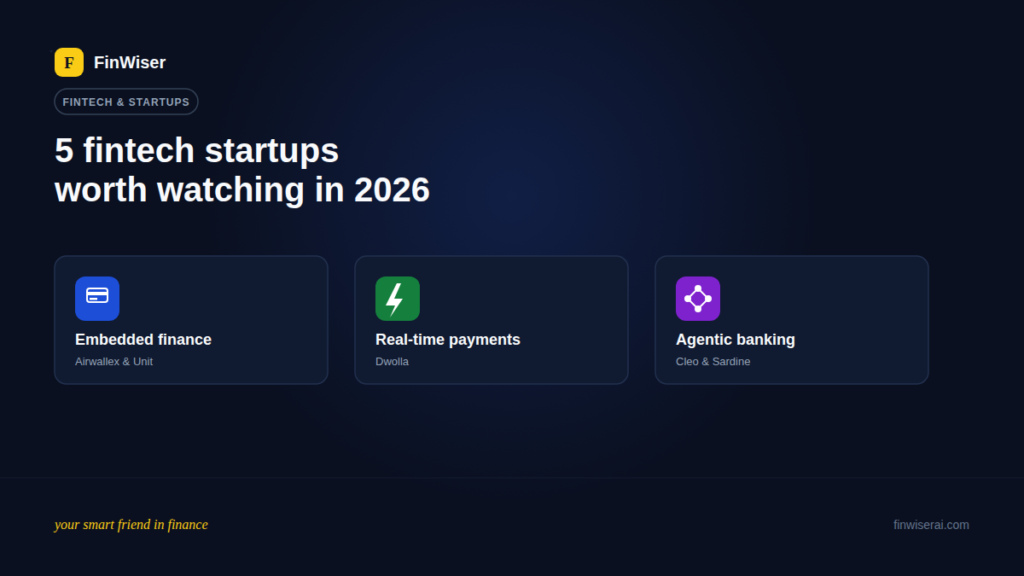
Three different ways fintech is rebuilding money movement, explained through five real companies — plus what each approach means if you try to keep your finances halal.
Fintech news in 2026 keeps circling three phrases: embedded finance, real-time payments, and agentic banking, used almost interchangeably though they solve different problems. This roundup of fintech startups to watch in 2026 walks through five real companies — Airwallex, Unit, Dwolla, Cleo, and Sardine — one from each corner of that map, so the differences show up in practice rather than marketing copy.
None of these companies compete head-to-head. Embedded finance is about who gets to offer a bank account or a card, real-time payments is about how fast money moves once it’s sent, and agentic banking is about whether software or a human makes the moment-to-moment decisions. This isn’t about one universally “correct” option — it’s about which problem each company was built to solve.
Good News — You Don’t Have to Pick One Category
Here’s what gets lost in “vs” headlines: these categories usually stack inside one product. A neobank might use Unit or Airwallex for accounts and cards, route payouts through Dwolla for instant settlement, and lean on agents like Sardine’s to flag fraud before a transaction clears. Cleo sits a layer above, talking to the end user. A founder studying fintech startups to watch in 2026 isn’t choosing between these companies so much as deciding which layers to build in-house and which to buy.
At a Glance: Five Companies Compared
Here are all five fintech startups to watch in 2026 side by side, across the criteria that actually decide whether one fits your use case.
| Criterion | Airwallex | Unit | Dwolla | Cleo | Sardine |
|---|---|---|---|---|---|
| Category | Embedded finance / global BaaS | Embedded finance / BaaS | Real-time payments orchestration | Agentic banking (consumer) | Agentic banking (risk infrastructure) |
| What it does | Embeds multi-currency accounts, cards, and treasury under a regulated banking layer | Managed embedded banking, cards, and capital via one API | Routes payments across RTP, FedNow, and ACH for instant settlement | Chat-based AI tracking spending, savings, and small cash advances | AI agents screening onboarding and transactions for fraud/AML |
| Who it’s for | Global platforms (Brex, Rippling, Deel, Canva) | U.S. software platforms adding money features | Businesses needing fast payouts | Consumers, mostly Gen Z and millennials | Banks, fintechs, merchants managing risk |
| Real-time settlement | Yes, via Payments for Platforms and Global Treasury | Yes, via partner-bank instant rails | Core product — RTP + FedNow with failover | N/A — sits on a linked bank account | N/A — a decision layer, not a money-mover |
| Agentic AI depth | Limited; roadmap points to agentic treasury | Limited; focused on managed infrastructure | Smart routing, not conversational AI | Deep — chat-first, memory-holding assistant | Deep — dedicated fraud/AML agents |
| Pricing model | Usage-based, negotiated per platform | Revenue share plus service fees | Per-transaction API pricing | Free tier plus paid tiers (~$6–$20/mo) | Enterprise, priced per screened volume |
| Scale (self-reported) | 150K+ customers, $130B+ processed/yr | 2M+ users, $100B+ annual volume | 1,400+ FedNow institutions via one API | 8M+ users (2026) | $1.48T screened, 450+ customers |
Comparing the Fintech Startups to Watch in 2026, Criteria by Criteria
The table gives you the shape of things, but the substance behind each of these fintech startups to watch in 2026 lives in the rows themselves.
Category and Core Model
Airwallex and Unit both sell banking-as-a-service: plug into their API and get accounts, cards, and money movement without becoming a bank. Dwolla is narrower and deeper — it just moves money between accounts as fast as the U.S. payment system allows. Cleo and Sardine both put an AI agent in the loop, pointed in opposite directions: Cleo talks to a person, Sardine watches a transaction.
Who Actually Uses It
Airwallex leans global, with customers like Brex, Rippling, and Canva moving money across borders, while Unit skews toward U.S. platforms adding a “Banking” tab. Dwolla serves businesses that need to pay people fast — marketplaces, payroll platforms, lenders. Cleo is a consumer app aimed at Gen Z and millennials, and Sardine sells to the banks and fintechs behind all of the above.
Real-Time Settlement Access
This is where Dwolla earns its spot: one API reaching both live U.S. instant-payment rails — RTP and FedNow — with automatic rerouting if one network is down. Airwallex and Unit touch instant rails too, but as one feature inside a broader stack rather than the whole product.
Agentic AI Depth
Cleo is the most consumer-visible agentic play here — its assistant holds conversational memory and acts on requests like “can I afford this?” Sardine’s agents work the other side of the counter, automating fraud and AML reviews that used to need a human reading case files. Airwallex, Unit, and Dwolla are more conservative — useful automation, not yet autonomous decisions.
Pricing and Revenue Model
Airwallex and Unit negotiate usage-based or revenue-share pricing, with no public price list. Dwolla charges per transaction. Cleo runs a freemium subscription, with paid tiers unlocking cash advances and a credit-builder card. Sardine sells enterprise contracts priced around screening volume.
Scale and Track Record
Scale is where these fintech startups to watch in 2026 diverge most, by self-reported figures. Airwallex processes over $130 billion a year across 150,000-plus customers; Unit moves over $100 billion across 2 million users. Dwolla’s edge is reach — FedNow alone connects it to over 1,400 institutions. Cleo counts 8 million-plus users, and Sardine says it screens $1.48 trillion in payments for 450-plus enterprise customers.
Halal-Conscious Fit
None of these five are consumer lenders in the traditional interest-bearing sense — more on that below, since it deserves its own space rather than a table cell.
What’s Actually Underneath All of This
Almost everything here sits on top of banking-as-a-service, or BaaS. In plain terms, BaaS is what lets a non-bank company offer bank accounts and cards: a licensed bank partner holds the actual regulatory approval and deposit insurance, while a company like Airwallex or Unit builds the API, dashboard, and compliance tooling on top of it.
When Cleo issues a credit-builder card, or a gig-work app pays out earnings instantly through Dwolla, there’s almost always a chartered bank quietly underneath doing the actual custody of funds. The startup is the experience layer; the bank is the regulatory foundation. Understanding that split makes any new entrant easier to evaluate, agentic or not.
The $7 Trillion Number Behind the Embedded Finance Boom
One statistic explains why embedded finance dominates so many lists of fintech startups to watch in 2026: Bain & Company and Bain Capital project embedded finance transaction value in the U.S. will reach roughly $7 trillion in 2026, up from about $2.6 trillion in 2021, accounting for close to 10% of all U.S. financial transactions. Consumer payments make up the largest slice, with B2B payments growing fastest off a smaller base.
That’s not a forecast about a niche product. It means roughly one in ten dollars moving through the U.S. financial system this year passes through a non-bank app rather than a traditional bank interface — the exact shift Airwallex and Unit exist to power.
A Halal-Conscious Look at These Fintech Startups to Watch in 2026
None of these five are, at their core, interest-based lenders. Three are infrastructure (Airwallex, Unit, Dwolla) that a builder can use for either a conventional or a halal-conscious product, and Sardine is risk software that never touches a consumer’s balance sheet. The rails are largely neutral; what matters halal-wise is what a specific platform builds on them, including which bank partner sits underneath and whether its core products involve interest.
Cleo is the one offering something closer to consumer credit: cash advances of roughly $20–$250, priced through a flat subscription fee rather than a stated interest rate. That sits differently than compounding interest, but a halal-conscious reader should still read Cleo’s actual terms and treat any small-dollar advance app — labeled halal or not — with the same caution as short-term credit generally.
Where Each Platform Wins
Where Airwallex Wins
- Global reach. Multi-currency accounts and licenses across regions suit platforms serving more than one country.
- Enterprise trust. A customer roster including Brex, Rippling, and Canva signals real transaction volume.
Where Unit Wins
- Speed to launch. Its “ready-to-launch” model can get banking features live in weeks, not months.
- Managed operations. Unit absorbs customer support and fraud exposure that smaller teams can’t staff for.
Where Dwolla Wins
- Instant-rail reach. One integration covers both RTP and FedNow, with automatic failover if a network is down.
- Depth over breadth. It moves money fast and does little else, instead of spreading across banking and lending too.
Where Cleo Wins
- Approachability. A chat-first design removes the intimidation factor that keeps young adults away from budgeting tools.
- Low commitment. A real free tier lets you test the assistant before paying for cash advances or credit-building.
Where Sardine Wins
- Purpose-built for agentic risk. Dedicated agents for onboarding, fraud, and AML review outperform general-purpose automation on narrow, high-stakes tasks.
- Institutional credibility. Customers including FIS, Deel, and GoDaddy suggest it holds up at enterprise scale.
Which of These Fintech Startups to Watch in 2026 Fits Your Situation
Building a global platform that needs accounts and cards in multiple currencies? Airwallex is the natural starting point. A U.S.-focused software company wanting banking features without hiring a compliance team should look at Unit. If money-movement speed is your actual bottleneck — payouts, disbursements, gig-worker earnings — Dwolla solves that specific problem better than a broader BaaS platform will.
If you’re an individual trying to get a handle on your own spending, Cleo is the one company here built directly for you rather than for a business behind you. And if you work in risk or compliance at a bank or fintech, Sardine represents where that discipline is heading as attacks themselves go AI-driven.
Key Takeaways
- Embedded finance, real-time payments, and agentic banking are layers of one stack, not competing products — most real fintech apps combine all three.
- Among this year’s fintech startups to watch in 2026: Airwallex and Unit compete on embedded finance, Dwolla owns real-time payments, and Cleo and Sardine represent agentic banking from opposite sides of the counter.
- Bain & Company projects U.S. embedded finance transaction value will reach roughly $7 trillion in 2026 — about 10% of all domestic financial transactions.
- Nearly all of these products sit on a licensed bank partner via banking-as-a-service; the startup is the interface, the bank is the regulatory foundation.
- None of the five are traditional interest-based lenders, but check the specific bank partner and fee structure behind any product before treating it as riba-free by default.
Sources and further reading on each of these fintech startups to watch in 2026: Airwallex, Unit, Dwolla, Cleo, and Sardine. For the embedded finance market projection cited above, see the original Bain & Company report. To keep exploring how FinWiser thinks about halal-conscious fintech comparisons, visit finwiserai.com.