
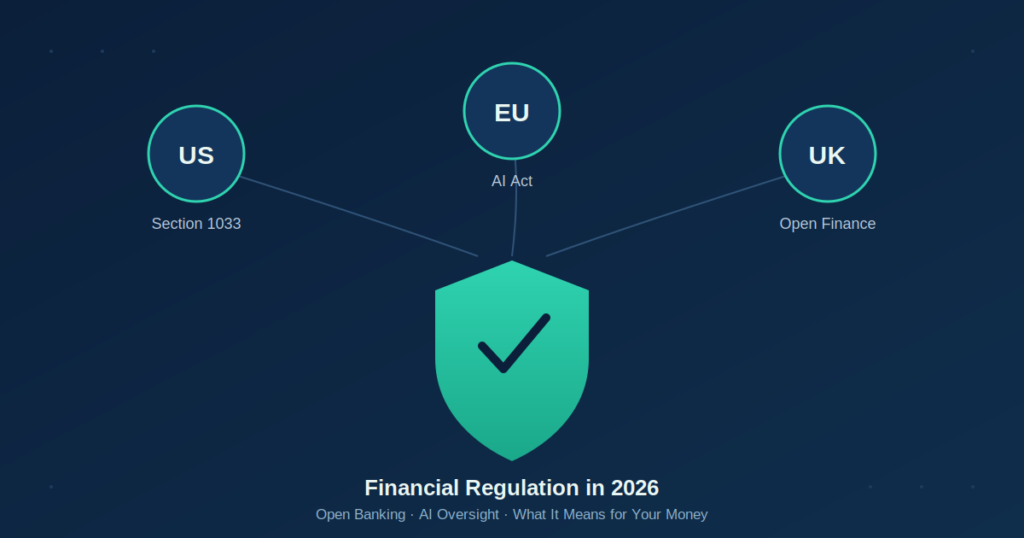
Three of the world’s biggest regulators moved on open banking and AI oversight this year. Here’s the plain-language version of financial regulation in 2026 — and why it touches your money even if you’ve never read a page of Section 1033.
- Why 2026 Is a Turning Point
- You Don’t Have to Pick a Favorite Regulator
- At a Glance: Comparing the Rules
- Why Regulators Are Watching Open Banking and AI Together
- What Actually Changed
- The 2026 Milestone That Matters
- Who’s Affected
- Your Data Rights
- AI Oversight Rules
- Enforcement Status
- The Numbers Behind the Headlines
- A Halal-Conscious Look at Financial Regulation in 2026
- Where Each Region Wins
- 5 Startups to Watch
- Which Rules Actually Apply to You
- Key Takeaways
Why 2026 Is a Turning Point
If you’ve felt like financial regulation in 2026 is suddenly everywhere in the news, you’re not imagining it. Three of the biggest regulatory bodies in global finance — the US Consumer Financial Protection Bureau, the European Commission, and the UK’s Financial Conduct Authority — have all pushed major updates on open banking and AI oversight through their systems this year.
None of it happened in one clean announcement. It’s been a messy, overlapping stretch of court injunctions, delayed deadlines, and reopened rulemaking. This guide pulls financial regulation in 2026 into one place, in plain language, without pretending any single country has it all figured out.
This isn’t about deciding which country “did it right.” It’s about understanding what’s actually enforceable right now and what any of it means for how you bank, borrow, or build a fintech product.
You Don’t Have to Pick a Favorite Regulator
Here’s the good news: you don’t have to choose between the US, EU, or UK approach the way you’d choose between two savings accounts. Your money already lives under whichever regime governs where you bank, and most fintech products increasingly satisfy more than one regime at once.
What matters is knowing which pieces apply to you. The underlying ideas rhyme across all three: give consumers more control over their financial data, and put real guardrails around AI making decisions about their money.
At a Glance: Comparing the Rules
| Criterion | 🇺🇸 United States | 🇪🇺 European Union | 🇬🇧 United Kingdom |
|---|---|---|---|
| Core rule | Section 1033 / Personal Financial Data Rights Rule (CFPB) | EU AI Act, high-risk provisions | Open Finance Roadmap under the Data (Use and Access) Act |
| 2026 milestone | April 1, 2026 compliance date for the largest data providers | August 2, 2026 transparency obligations take effect | Smart Data Accelerator use cases developed through the year |
| Who it targets | Banks, credit unions, and nonbank data providers | Anyone deploying AI in credit scoring or insurance pricing | Banks and third-party providers building on Open Banking |
| Consumer data rights | Free access to your own transaction data | Not the main focus — governs decisions, not raw data | Expanding beyond payments to mortgages, pensions, SME credit |
| AI oversight | Not yet codified federally | Mandatory human oversight, logging, explainability for high-risk AI | Referenced in FCA principles; no standalone AI statute |
| Enforcement status | Enjoined by a federal court; under reconsideration | Delayed to Dec 2027 for new systems; some obligations still land Aug 2026 | Roadmap stage; formal rules expected later |
| What it means for you | Data portability is coming, but the timeline keeps moving | If AI scores your creditworthiness, it now needs a paper trail | More of your financial life becomes shareable by design |
Why Regulators Are Watching Open Banking and AI Together
Open banking and AI oversight look like separate stories, but regulators keep bundling them. Open banking is about who gets to move your financial data. AI oversight is about what happens once that data reaches an algorithm making a decision — approving a loan, pricing insurance, flagging a transaction as fraud.
Put those together and you get the real story behind financial regulation in 2026: accountability for automated decisions built on data you didn’t hand over yourself. A lender using open banking feeds to train a credit model is exactly the overlap the EU AI Act’s Annex III was written to catch.
What Actually Changed
In the US, the CFPB’s open banking rule — built on Section 1033 of the Dodd-Frank Act — was finalized in October 2024 with a phased compliance schedule starting in 2026. A federal court in Kentucky then enjoined enforcement, and the CFPB itself asked to reconsider the rule it had just written. A revised proposal, reportedly allowing banks to charge fintechs for data access, was awaiting White House review as of early August 2026.
In the EU, the AI Act’s high-risk provisions were originally due August 2, 2026. In May, lawmakers agreed to push most deadlines to December 2027, keeping a narrower set of transparency rules — like AI chatbot disclosure — on the original date.
In the UK, the FCA published its Open Finance roadmap in April 2026, extending Open Banking-style data sharing into mortgages, pensions, insurance, and SME lending by 2030.
The 2026 Milestone That Matters
If you only remember one date from financial regulation in 2026, make it this: April 1 was supposed to be the first hard compliance deadline for US open banking, and August 2 was supposed to be the EU AI Act’s big enforcement day. Both got complicated — one by litigation, one by a negotiated delay. That’s the practical shape of financial regulation in 2026 right now: not a finished rulebook, but three regulators mid-revision at the same time.
Who’s Affected
You’re touched by this even if you’ve never worked in compliance. Use a budgeting app, a Buy Now Pay Later product, or a robo-advisor? You’re inside the open banking data chain. A bank, insurer, or lender using an automated system to price something for you puts you inside the AI oversight conversation too.
Fintech founders building anything that touches EU customers need to check AI Act exposure regardless of headquarters — the Act applies based on where the AI system’s output is used, not where the firm sits.
Your Data Rights
The US rule, when and if it takes effect, would require covered banks and nonbank providers to give consumers free electronic access to at least 24 months of their own transaction data — balances, upcoming bills, ACH activity — shareable with another provider of the consumer’s choosing.
The UK is already further along in practice: Open Banking payments are a working, mandated system built on a competition remedy, and the FCA’s roadmap widens that same principle into other financial products.
Halal-aware note on data rights
For a halal-conscious reader, wider data portability is genuinely useful — it makes it easier for a screening tool to pull your real transaction history and flag interest-bearing accounts automatically, instead of asking you to self-report. None of the three regimes covered here impose interest (riba) on you directly; they govern who can move your data, which is separate from whether a given product is itself Shariah-compliant.
AI Oversight Rules
The EU AI Act is the most codified AI oversight regime among the three. Annex III names credit scoring, insurance risk pricing, and creditworthiness assessment as “high-risk” uses, triggering requirements for human oversight, documented logging, and bias assessment. The US and UK don’t yet have an equivalent standalone AI statute for finance — oversight there currently lives inside existing banking supervision and FCA principles rather than a dedicated AI law.
Enforcement Status
This is the part most coverage skips: enforceability. The US open banking rule is legally enjoined — it exists on paper but can’t currently be enforced. The EU AI Act’s high-risk obligations were pushed to December 2027 for most new systems, though transparency rules for AI-generated content still land on the original August 2026 date. The UK’s Open Finance framework is still at the roadmap and consultation stage.
What Is Open Banking, Actually?
It’s worth pausing on the basic concept, since it underpins nearly everything above. Open banking lets you authorize a third-party app to securely read your bank data — usually through an API instead of typing your bank password into a stranger’s app (the older, riskier practice called screen scraping). You stay in control of who has access, and you can revoke it.
Open finance is the same idea stretched further: instead of just your checking account, it eventually covers mortgages, pensions, insurance, and investments too — the direction all three regulators are pointed, even where they disagree on pace and enforcement.
The Numbers Behind the Headlines
One data point puts the scale of this in perspective. In the UK, open banking payments hit 33 million in a single month — November — according to Open Banking Limited’s own reporting on the ecosystem’s eighth anniversary. That’s not a pilot program anymore; it’s daily financial infrastructure for millions of people, built on a framework that started as a competition remedy back in 2018.
Zoom out further and the regulatory technology market built to help firms comply with all of this is projected to grow from roughly $24.3 billion in 2025 to $112.1 billion by 2033, per Grand View Research figures cited in industry reporting — a sign of how much infrastructure now exists just to keep pace.
A Halal-Conscious Look at Financial Regulation in 2026
None of the three regimes here are halal-specific — they’re general consumer-protection and AI-governance frameworks. But they intersect with Shariah-compliant finance in a real way. Pakistan’s own direction is instructive: the Federal Shariat Court has ordered the full elimination of interest-based banking by 2027, and the State Bank of Pakistan has been licensing digital banks like Raqami Islamic Digital Bank specifically to build on open APIs from day one.
That’s the pattern worth watching wherever you bank: as open banking and AI oversight rules mature, they make it more feasible to verify a product is genuinely interest-free, rather than taking a bank’s word for it.
Where Each Region Wins
Where the US Wins
- Biggest potential scope. If the rule survives its legal challenges, it would cover nearly every large bank and nonbank data provider in the country.
- Consumer-first framing. The rule is explicitly about letting people switch providers without losing their financial history.
- Zero cost to consumers. As written, data access is required to be free.
Where the EU Wins
- Most detailed AI accountability. Annex III spells out exactly which financial AI uses count as high-risk.
- Cross-border reach. Any firm serving EU customers is in scope, regardless of headquarters.
- Built-in human oversight requirement. High-risk systems must be explainable and correctable, not just accurate.
Where the UK Wins
- Proven track record. UK open banking already works at scale, with tens of millions of payments processed monthly.
- Broadest long-term vision. The Open Finance roadmap plans to cover mortgages, pensions, and SME credit, not just checking accounts.
- Built on collaboration. The Smart Data Accelerator brings regulators, banks, and fintechs into the same room before rules are finalized.
5 Startups to Watch
These five companies are building the infrastructure that helps banks and fintechs keep up with financial regulation in 2026.
The default open banking API for US fintech apps, adapting around the CFPB’s evolving Section 1033 rule.
Visa-owned and PSD2-native, connecting to thousands of European banks as the default for EU-first fintechs.
AI-driven fraud and AML risk detection built for the compliance load AI oversight rules add to banks.
An AI compliance assistant that parses regulatory text and maps it to internal policy in minutes.
An AI governance platform that maps a firm’s AI systems directly to EU AI Act obligations.
Which Rules Actually Apply to You
If you bank in the US: Watch the CFPB’s revised proposal, not the original rule — fees for fintech data access may become part of the picture.
If you’re in the EU or serve EU customers: Check whether any product you use or build touches credit scoring or insurance pricing — that’s where the AI Act bites hardest.
If you’re in the UK: You’re already inside a working open banking system; track how far Open Finance expands beyond payments.
If you’re halal-conscious or based somewhere like Pakistan: Follow your own regulator’s open API and digital banking licensing moves — often a better predictor of what halal-aware tools will be possible than any single Western rule.
Key Takeaways
- Financial regulation in 2026 isn’t one finished rulebook — it’s three major regulators mid-revision, with deadlines that keep shifting.
- The US open banking rule is legally enjoined; the EU AI Act’s toughest deadlines were pushed to December 2027; the UK is still at the roadmap stage.
- Open banking and AI oversight are regulated together because the real issue is accountability for automated decisions built on your data.
- UK open banking payments already hit 33 million in a single month — proof this has moved past pilot-program status.
- Wider open data access tends to help, not hurt, halal-conscious money management by making independent Shariah screening more feasible.
For a deeper technical breakdown of the US rule, Bankrate’s coverage is a solid starting point: CFPB announces a new rule to help you transfer your data. For FinWiser’s ongoing coverage of how these rules affect halal-conscious money decisions, start at finwiserai.com.