
Sundas Tahir, Founder & CEO, FinWiser.
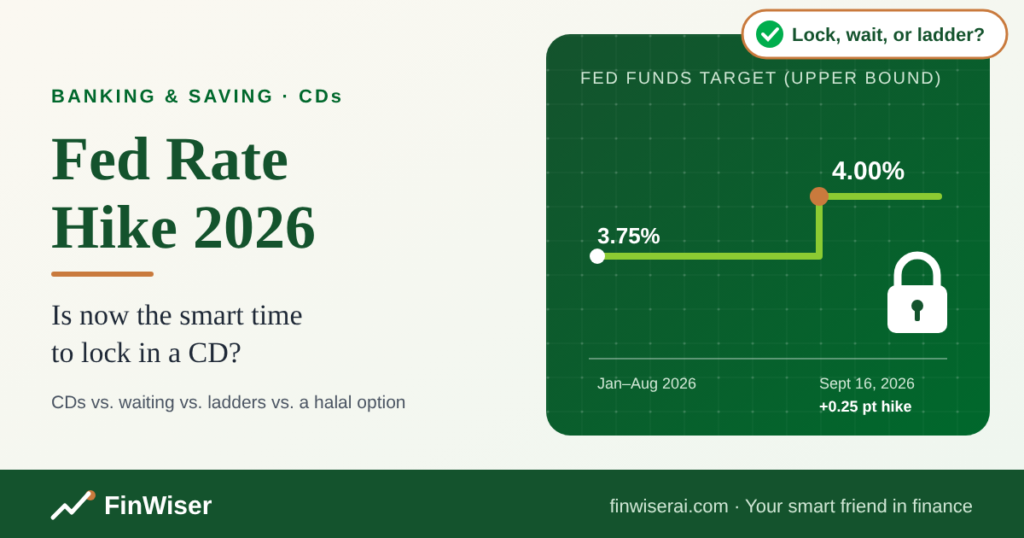
On September 16, the Federal Reserve raised its benchmark rate by a quarter point, to a range of 3.75% to 4%. That fed rate hike 2026 savers had been half-expecting since summer reversed a year that began with rates on hold after three cuts in late 2025. If you have cash sitting idle, the obvious question follows: should you grab a certificate of deposit (CD) now, before anything changes again?
There isn’t one correct answer here, and anyone promising one is guessing about the Fed’s next move. What you can do is match the choice to your own timeline. This guide compares four ways to handle your cash right now: lock in a fixed CD, stay flexible and wait, build a ladder, or use a halal profit-sharing time deposit.
Don’t try to time the Fed. Time your own money instead. Our rule of thumb: if you won’t touch the cash for at least 12 months, lock part of it now; if you might need it sooner, keep it liquid. A sensible split beats a lucky guess every time.
Good News: You Don’t Have to Choose Just One
You don’t have to bet everything on one forecast. Most savers do best with a blend: an emergency fund stays liquid, money for a known future expense goes into a CD that matures right before you need it, and longer-term cash can sit on a ladder.
The real question isn’t “CD or no CD.” It’s how much of your cash belongs in each bucket. That framing also takes the pressure off perfect timing: if rates rise, your liquid money catches the upside, and if they fall, your locked portion is already protected.
At a Glance: Your Options After the Fed Rate Hike 2026
| Criteria | Lock in a CD now | Stay liquid & wait | Build a CD ladder | Halal profit-sharing deposit |
|---|---|---|---|---|
| How the return works | Fixed APY for the full term | Variable rate that can change anytime | Fixed APYs on staggered maturities | Anticipated profit, not guaranteed |
| Rate certainty | High | Low | Medium–high | Medium |
| If the Fed hikes again | You miss the bump | You benefit quickly | Each maturing rung benefits | Renewal rate may rise |
| If rates fall | Protected until maturity | Your rate drops | Mostly protected | Depends on portfolio performance |
| Access to cash | Locked until maturity | Anytime | One rung matures regularly | Locked; no partial withdrawals |
| Early-exit cost | Often 60–180+ days of interest | None | Penalty only on the rung you break | Forfeit that quarter’s profit |
| Involves interest (riba)? | Yes | Yes | Yes | No — profit-sharing structure |
| Best for | A known goal 1–5 years out | Emergency funds, uncertain timing | Steady access plus rate protection | Halal-conscious savers with $5,000+ |
How Each Option Stacks Up
Rate certainty
A standard CD gives you the most certainty: the annual percentage yield (APY) you sign up for is what you earn until maturity. A ladder gives you that same fixed rate on each rung, just spread across different end dates. High-yield savings is the opposite, since the bank can reprice tomorrow, up or down.
The halal profit-sharing option sits in the middle. UIF discloses an anticipated profit rate upfront, but the actual payout can come in higher or lower depending on how its financing portfolio performs.
If the Fed hikes again
Whether September’s move was a one-off or the start of a new cycle is the big unknown. The Federal Open Market Committee (FOMC) said inflation remains elevated and framed the move as helping inflation return to its 2% goal sooner. That language leaves the door open to more tightening.
If another hike lands, savers in a variable account usually see their rate nudge up within weeks. A long CD opened right after the fed rate hike 2026 would miss that, while a ladder softens the regret because one rung matures regularly. Some banks also sell bump-up CDs: Synchrony Bank lets you request one rate increase during the term if its rate on new bump-up CDs rises.
If rates fall instead
Rate hikes don’t always stick. The Fed cut three times in late 2025 before pausing, and many economists spent early 2026 expecting more cuts by midyear — a forecast that turned out wrong. Forecasts can miss in either direction.
If the next move is down, a CD locked today keeps paying its original rate while savings yields slide. That protection is the core reason to lock in at all. A ladder is mostly protected too, since only the maturing rung gets repriced lower.
Access to your money
Savings accounts win easily on access. A CD is the opposite: once funded, your money is committed until the maturity date. A CD ladder is the compromise — split $10,000 across five CDs maturing a year apart, and a slice of your cash frees up every 12 months.
UIF’s time deposit is the strictest of the four. There are no withdrawals in the first seven days and no partial withdrawals before maturity, so treat it as money you genuinely won’t need.
The cost of getting out early
Breaking a CD triggers an early withdrawal penalty, usually counted in days of interest. Bankrate puts typical penalties at 60 to 180 days of interest. Synchrony, for example, charges 90 days on terms of 12 months or less and 365 days on terms of four years or more.
UIF handles it differently: close early and you forfeit the profit accrued in that calendar quarter, while keeping profit already paid in earlier quarters. With a ladder, you only pay a penalty on the single rung you break.
So before you rush to lock in after the fed rate hike 2026, run the penalty math on the worst case: needing the money halfway through the term. If that scenario would cost you more than a few months of interest, a shorter term or a no-penalty CD is the safer fit.
Why CD Rates Often Move Before the Fed Does
Here’s something that trips up a lot of savers: banks don’t wait for the Fed’s announcement to reprice CDs. CD rates track what markets expect the federal funds rate to do over the CD’s term. That means even the fed rate hike 2026 was partly priced into CDs before it was announced.
You can see it in real numbers. E*TRADE raised rates on six CD terms two days after the September decision, then nudged two terms higher again later that month, according to DepositAccounts. By late September its standard terms sat around 4.40% APY.
The practical lesson: waiting for the next hike assumes banks will hand you a jump on decision day. Often the bump is smaller than expected because most of it already happened.
The Data: The CD Rate Gap Most Savers Miss
The national average 12-month CD paid just 1.71% in August 2026, according to the FDIC National Rates and Rate Caps. Top online banks and credit unions were paying roughly 4.35% to 4.40% on the same term around the September decision.
On a $10,000 deposit held for a year, that’s about $171 versus about $440 — a gap of roughly $270 just for choosing a different bank. Before you worry about a sequel to the fed rate hike 2026, notice that where you open the CD matters far more than when.
A Halal-Aware Note on CDs and Savings
Every conventional CD, savings account and ladder in this guide pays interest. For Muslims who avoid riba, that rules out the first three options no matter how good the rate looks, and no Fed decision changes that math.
The closest U.S. equivalent is a profit-sharing time deposit. UIF Corporation, through University Bank (Member FDIC), offers 12-, 36- and 60-month terms from $5,000. The structure follows AAOIFI’s investment agency standard (No. 46) and is approved by UIF’s Sharia Supervisory Board.
Principal carries FDIC insurance, but profit is anticipated, not guaranteed. UIF’s profits come from its home, commercial and vehicle financing portfolio, so returns aren’t sealed off from the wider economy — they just aren’t promised as a fixed interest contract. Whatever follows the fed rate hike 2026, it’s that structure, not the rate, that makes it acceptable to many halal-conscious savers.
5 Providers to Know Right Now
These five stood out in the weeks after the Fed’s September decision. Rates change constantly, so confirm on each provider’s site before funding anything.
- E*TRADE from Morgan Stanley Private Bank. No minimum deposit and terms from 6 months to 5 years. It’s advertising a 12-month CD at 4.75% APY for accounts opened and funded by October 19, 2026.
- Barclays Online CDs. No minimum opening deposit. The College Investor listed its 12-month CD at 4.25% APY in a late-September roundup.
- Synchrony Bank. Standard, no-penalty and bump-up CDs, with no minimum deposit. Useful if you want an escape hatch.
- Quorum Federal Credit Union. Its certificate accounts work like CDs and are federally insured up to $250,000; membership is required. Its 12-month term was listed at 4.35% APY with a $2,500 minimum in late September.
- UIF Profit-Sharing Time Deposit. The halal option: 12, 36 or 60 months from $5,000, with anticipated profit paid quarterly.
Pros and Cons of Each Option
Where Locking In a CD Wins
- Guaranteed return. You know your exact earnings on day one, whatever follows the fed rate hike 2026.
- Protection if rates fall. Your rate holds even if the Fed reverses course.
- Built-in discipline. The penalty makes it harder to raid your savings on impulse.
- Drawback: You miss out if rates climb further.
Where Staying Liquid Wins
- Instant access. Ideal for emergency funds and uncertain plans.
- Upside if rates rise. Variable rates usually follow hikes within weeks.
- No penalties. Move money whenever you like.
- Drawback: Your yield shrinks the moment rates start falling.
Where a CD Ladder Wins
- Regular access. One rung matures on a predictable schedule.
- Hedges both directions. Part of your money always catches the current rate.
- Smaller penalties. Breaking one rung costs far less than breaking one big CD.
- Drawback: More accounts to track and maturity dates to manage.
Where a Halal Profit-Sharing Deposit Wins
- Riba-free structure. Returns come from Sharia-compliant financing, not interest.
- FDIC-insured principal. Your deposit is protected up to the standard limit.
- Clear exit rule. Closing early costs only the current quarter’s profit.
- Drawback: Profit isn’t guaranteed, and the $5,000 minimum is higher than most CDs.
After the Fed Rate Hike 2026: Which Option Fits You?
- Saving for a goal 1–3 years away? Lock a CD that matures just before you need the money.
- Building an emergency fund? Stay liquid in high-yield savings — our CD vs. money market vs. high-yield savings guide breaks down the trade-offs.
- Sitting on a lump sum and unsure? Build a ladder so you don’t have to call the Fed’s next move.
- Expecting more hikes but want something now? Choose a 6- to 12-month CD or a bump-up CD.
- Halal-conscious? Use a profit-sharing time deposit for money you won’t touch, and profit-sharing savings for the rest.
Key Takeaways
- The Fed raised rates. The fed rate hike 2026 lifted the target range to 3.75%–4% on September 16, and more tightening isn’t ruled out.
- Lock only money you won’t need. Early exit penalties often run 60–180 days of interest or more.
- Can’t decide? Ladder. It hedges against both rising and falling rates.
- Shopping beats timing. The average 12-month CD paid 1.71% versus about 4.40% at top online banks.
- Halal option exists. A profit-sharing time deposit, not a CD, is the riba-free route.
Further Reading
For another take on timing CDs around Fed decisions, Bankrate’s The Fed just held rates steady. Should I lock in a CD right now? works through the same question from earlier this year, when the Fed was still on hold. You can also read the Fed’s own September 16, 2026 FOMC statement.