
Retirement Accounts
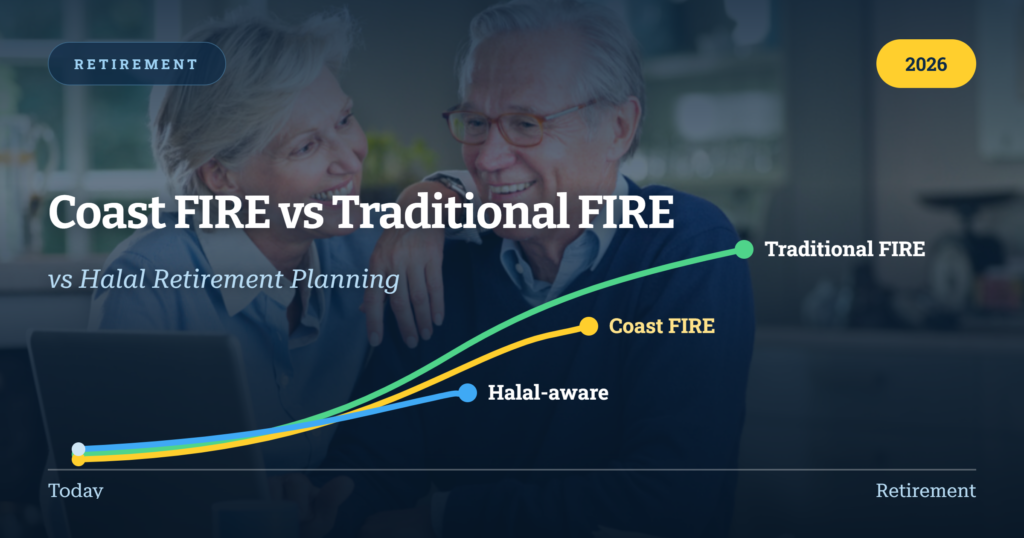
Two well-known paths to leaving the 9-to-5 early, plus how a halal-conscious saver applies either one — laid out side by side, with no verdict forced on you.
FinWiser is built halal-aware by design, and that shapes how we frame every comparison on this site — including this one.
Early retirement 2026 conversations keep circling back to the same three letters: FIRE. But “FIRE” was never one plan — it’s a family of them, and two of its most talked-about branches, Coast FIRE and Traditional FIRE, ask for very different things from your twenties, thirties, and forties.
This isn’t a piece about which one is “correct.” Coast FIRE and Traditional FIRE solve different problems, and a halal-conscious saver can build either one without touching riba. What actually matters is matching the plan to your real savings rate, your risk tolerance, and how badly you want your job to become fully optional rather than just less urgent.
Our Wisers Say: If we had to pick a lane for most readers weighing early retirement 2026 plans, it’s Coast FIRE — not because it’s superior, but because it’s forgiving. It rewards a hard early push without demanding a 50%+ savings rate for two decades straight. Traditional FIRE still wins if your actual goal is to fully stop working, not just stop worrying about money.
Good News: You Don’t Have to Pick Just One
Coast FIRE and Traditional FIRE aren’t rival, mutually exclusive plans — Coast FIRE is really just an earlier waypoint on the same road Traditional FIRE walks. Hit your Coast number in your early thirties, and you can decide later whether to keep sprinting toward full financial independence or ease off and let compounding finish the job on its own.
Plenty of savers start out as Coasters by accident, simply because they saved hard in their twenties, and only commit to a full Traditional FIRE target once they see how the numbers actually feel to live with. Nothing about picking one now locks you out of the other later.
Coast FIRE vs Traditional FIRE: What Early Retirement 2026 Actually Looks Like
Here’s the comparison at a glance — the target number, the savings rate, and what genuinely changes about your day-to-day work once you get there. All figures assume a moderate $60,000-a-year retirement lifestyle, a 7% real (inflation-adjusted) rate of return, and retirement at 65.
| Criterion | Coast FIRE | Traditional FIRE | Halal-Conscious Approach |
|---|---|---|---|
| Core idea | Save aggressively, then stop and let compounding finish the job | Save aggressively until you can cover all expenses forever | Same math as either column, screened fund lineup |
| Target number (age 30 example) | ~$140,000 invested today | $1,500,000 total | Identical number, Shariah-compliant holdings |
| Savings rate needed | 25%–40% of income | 50%+ of income | Depends on which FIRE type you pick |
| Time to reach target | ~5–10 years | ~15–25 years | Same timeline as your chosen FIRE type |
| Still working after? | Yes — to cover current expenses | No (optional) | No change from the base strategy |
| Main risk | Decades of uncontributed market exposure | Sequence-of-returns risk right after quitting | Same risk, plus a narrower fund universe |
| Halal fit | Achievable with screened equity + sukuk sleeve | Achievable with screened equity + sukuk sleeve | Requires checking your 401(k) or Roth IRA fund menu |
| Best for | Career flexibility seekers, moderate savers | High earners who want work to be fully optional | Anyone layering faith-based screening onto either goal |
Coast FIRE numbers by starting age, compared against the flat $1.5 million Traditional FIRE target for a $60,000/year lifestyle. The earlier you start, the smaller your Coast number — compounding does more of the work the longer it has to run.
How Much You Actually Need to Save
Traditional FIRE uses a simple multiplier: 25 times your annual spending, based on the 4% rule (also called the safe withdrawal rate). Spend $60,000 a year and your number is $1.5 million, full stop. Coast FIRE discounts that same $1.5 million target back to today using compound growth, so a 25-year-old needs roughly $100,000 invested now, while a 40-year-old needs closer to $277,000 to land at the identical outcome by 65.
The gap between those two numbers is the entire pitch for Coast FIRE — it’s the same destination, reached with a fraction of the capital, because time is doing more of the lifting.
The Savings Rate Each One Demands
Coast FIRE asks for an aggressive but time-limited sprint — often 25% to 40% of income for five to ten years — after which you can drop retirement contributions to zero and simply cover today’s expenses. Traditional FIRE asks for that same intensity, or more, for fifteen to twenty-five years without a real break.
That’s the trade a lot of planners underestimate: Traditional FIRE isn’t harder to start than Coast FIRE, it’s harder to sustain through a decade of raises, kids, medical bills, or a slower job market.
Timeline: When You Actually Feel Free
Coast FIRE flexibility usually arrives in five to ten years, though “free” here means free from saving pressure, not free from work. Traditional FIRE flexibility — actually quitting — typically takes fifteen to twenty-five years for most incomes.
If your priority is feeling less anxious about money soon, Coast FIRE gets you there faster. If your priority is never needing a paycheck again, only Traditional FIRE delivers that, and it asks for a patience that most Coast FIRE plans simply don’t require.
Coast FIRE trades a shorter, harder sprint for a much longer coast; Traditional FIRE keeps the savings rate high for the entire stretch, with no easing-off period built in.
What Happens to Your Job
This is the most-missed distinction between the two. Coast FIRE never promises you’ll stop working — it promises your retirement savings stop needing new contributions. You still need income to cover rent, food, and health insurance until traditional retirement age arrives. Traditional FIRE is the version where paid work genuinely becomes optional.
If the entire appeal of chasing early retirement 2026 planning for you is specifically “never work again,” Coast FIRE alone won’t get you there — it only removes the retirement-savings line item from your monthly budget, not the job itself.
Risk: What Could Go Wrong
Coast FIRE’s biggest risk is decades of market exposure with no more contributions to smooth out a bad stretch. A poor decade for stocks right when you need the number to hold can push your real retirement age later than planned, since there’s no fresh money coming in to buy the dip.
Traditional FIRE’s biggest risk is sequence-of-returns risk right after you quit — an early downturn combined with ongoing withdrawals can permanently shrink a portfolio that no longer has contributions arriving to offset it either.
Your “Number” Isn’t Fixed: Why the 4% Rule Sets Both Targets
Both strategies borrow their target from the same source: the 4% rule, a decades-old guideline suggesting a retiree can withdraw 4% of a portfolio in year one, then adjust for inflation, without running out of money over a roughly 30-year retirement. Multiply your annual spending by 25 and you get your Traditional FIRE number; discount that same figure back to today using an expected real return and you get your Coast FIRE number.
Change your assumed spending, and both numbers move together. Cut your planned retirement lifestyle from $60,000 to $45,000 a year and your Traditional FIRE target drops from $1.5 million to $1.125 million, with the Coast FIRE number shrinking by the same 25%. It’s worth understanding this link before committing to either path for your early retirement 2026 plan, because the number you’re chasing is only ever as reliable as the spending estimate sitting underneath it.
Why Early Retirement 2026 Costs More Than It Used To
The retirement target itself has been climbing for everyone, not just the FIRE community. According to Northwestern Mutual’s 2026 Planning & Progress Study, Americans now believe they’ll need $1.46 million to retire comfortably — up from $1.26 million just a year earlier, and more than 50% higher than the 2020 estimate. Almost half of respondents don’t expect to be financially ready when the time comes, and a similar share worry about outliving their savings entirely.
None of that is FIRE-specific — it’s the same inflation and longevity pressure showing up in every retirement conversation, early or traditional. But it does mean planning benefits from a number built on your own spending, not a national average, since “comfortable” varies wildly depending on where you live and what you’re already used to spending day to day.
How Halal-Conscious Investors Approach Early Retirement 2026
Neither Coast FIRE nor Traditional FIRE is inherently halal or haram — both are just savings-rate math applied to a target number. The halal-conscious version of either plan comes down to what you actually hold inside the account, not the strategy itself.
A standard target-date fund or bond-heavy portfolio typically carries interest-bearing debt, which runs into riba, so a halal-conscious saver usually swaps that sleeve for Shariah-compliant equity ETFs — screened for excess debt, interest income, and prohibited business activity — plus sukuk or other asset-backed instruments in place of conventional bonds. A 401(k) or Roth IRA can still hold these once you check your plan’s fund lineup: some employer plans already offer Amana, SP Funds, or Wahed-style options directly, while others require a self-directed brokerage window to access them.
The math behind your Coast FIRE or Traditional FIRE number doesn’t change one bit. What changes is the fund menu you’re choosing from, and possibly a slightly wider bid-ask spread or expense ratio, since Shariah-compliant funds are still a smaller, younger category than the S&P 500 index funds most FIRE calculators assume by default.
Where Coast FIRE Wins
- A shorter, defined sprint. Five to ten years of aggressive saving is a finish line you can actually see, instead of an open-ended fifteen-to-twenty-five-year grind.
- Career flexibility sooner. Once you hit your number, you can take a lower-stress job, go part-time, or switch fields without wrecking your retirement plan.
- A lower savings-rate ceiling. You don’t need the 50%+ income discipline Traditional FIRE typically demands just to hit a normal retirement age.
Where Traditional FIRE Wins
- A real end date for paid work. Traditional FIRE is the only one of the two where “never work again” is the actual outcome, not just the aspiration.
- Less market-timing exposure. Because contributions continue right up until the target is hit, a bad decade earlier in the journey has more time to recover before it matters.
- A cleaner, single number. Twenty-five times your spending is easier to explain to a partner or track on a spreadsheet than a moving Coast calculation.
Where Halal-Conscious Planning Wins
- Same math, cleaner conscience. Neither FIRE type has to be rebuilt from scratch — the strategy stays exactly the same, only the fund selection changes.
- A growing set of fund options. Shariah-compliant ETFs and robo-advisors have expanded enough in recent years that “halal-aware” no longer means picking individual stocks by hand.
- A spending-clarity habit that carries over. Screening every holding tends to make investors more deliberate generally, which helps whichever FIRE number they’re chasing.
Which One Is Right for You
If you’re in your twenties or early thirties with a savings rate under 40% and you want visible proof you’re making progress, Coast FIRE gives you a nearer finish line and genuine room to breathe once you cross it.
If you’re a high earner already saving 50%+ of income and the whole point is to stop trading time for money, Traditional FIRE is the more honest target for you — Coast FIRE will just feel like a consolation prize you never asked for.
If you’re starting later, in your forties or fifties, a hybrid approach often works best: aim for Coast FIRE now to stop the bleeding, then reassess whether a full Traditional FIRE target is realistic once you’ve lived with a few years of real numbers. And if halal compliance matters to you, layer it onto whichever of these fits your timeline — it’s a fund-selection decision, not a separate FIRE type competing for your attention.
Key Takeaways
- Coast FIRE and Traditional FIRE both run on the same 25x / 4% rule math — Coast FIRE simply discounts that number back using compound growth.
- Coast FIRE typically takes 5–10 years of aggressive saving; Traditional FIRE typically takes 15–25 years without a real break.
- Coast FIRE doesn’t mean you stop working — it means you stop needing to save for retirement specifically.
- Halal-conscious savers can apply either strategy; what changes is the fund lineup, not the underlying plan or its math.
- Americans’ own “comfortable retirement” estimate hit $1.46 million in 2026, so build your number from your real spending, not a national average.
There’s no universally correct answer between Coast FIRE and Traditional FIRE — only the one that matches how much runway you have and how badly you want work to become fully optional versus just less urgent. For a deeper walkthrough of the Coast FIRE math specifically, NerdWallet’s guide is worth the extra read. Whichever path you’re leaning toward for your early retirement 2026 plan, the fund selection and halal-screening layer sit on top the same way either time.