
Credit & Debt
Three ways a card can pay you back, compared on rewards, fees, and interest, so you can pick the one that fits how you actually spend.
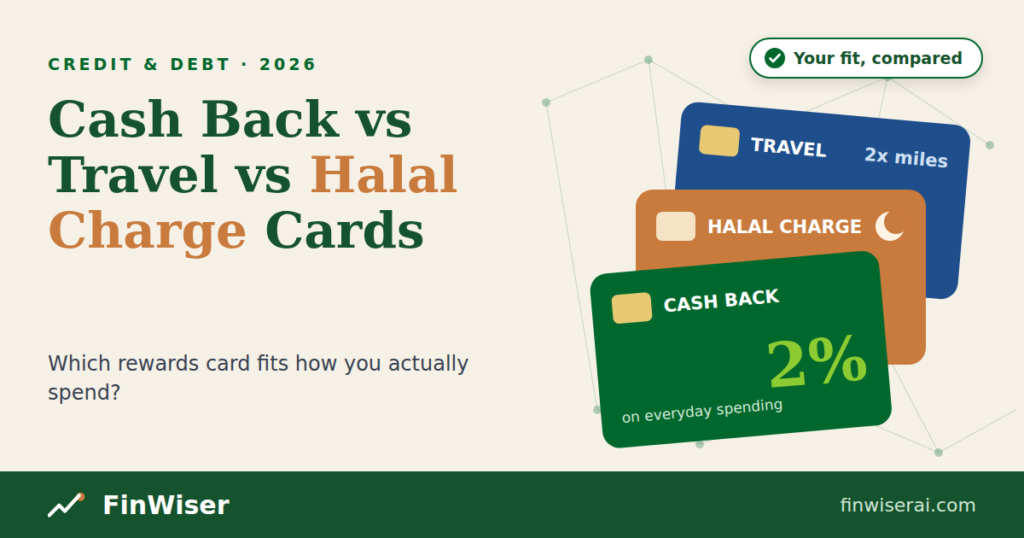
The cash back vs travel credit card question sounds like a two-way fight. In 2026 there’s a third contender worth knowing: the halal charge card, built so you never pay interest at all. Each one pays you back differently, costs you differently, and suits a different kind of spender.
This isn’t about one universally correct option. A card that’s brilliant for a frequent flyer can lose money for someone who travels once a year. And neither helps if paying interest is off the table for you. So we’ll compare all three on the same criteria, then match them to real situations.
Our Wisers Say
Pick the card for the life you have, not the life in the ad. Our rule of thumb: if you can’t name the trip you’ll book with your points in the next 12 months, take the cash. And if you ever carry a balance, no rewards card is a good deal. Fix that first.
Good news: you don’t have to choose
Plenty of people run two cards. A flat-rate cash-back card handles everyday spending, and a travel card comes out for flights, hotels, and trips abroad.
Cash rewards can pay for travel too. Move each redemption into a savings pot marked for trips, and you’ve built your own travel fund.
Halal-conscious readers can mix as well, since some Shariah-compliant cards pay cash back of their own. One caution: every extra card is another due date, so add one only when it earns its place.
Cash back vs travel credit card at a glance
Here are all three card types on the same eight criteria. The example cards are illustrations, not endorsements.
| Criteria | Cash-back cards e.g. Wells Fargo Active Cash |
Travel cards e.g. Capital One Venture |
Halal charge cards e.g. Maybank Islamic Ikhwan |
|---|---|---|---|
| Reward type | Dollars back, as a statement credit or deposit | Points or miles | Varies: cash back, points, or none |
| Typical earn rate | 1.5% to 2% flat; more in bonus categories | 2 miles per $1 flat; more through the issuer’s travel portal | Set by each issuer; some match conventional cards on select spending |
| Annual fee | Usually $0 | About $95 up to several hundred dollars | Often a fixed annual or monthly fee |
| If you don’t pay in full | Interest at the card’s APR | Interest at the card’s APR | No interest; a fixed fee or disclosed profit charge may apply |
| Foreign transaction fee | Common, typically 1% to 3% | Usually none | Varies by issuer |
| Effort to get full value | Low | Medium to high | Medium: you need to read the contract |
| Riba exposure | Interest-based contract | Interest-based contract | Designed to avoid it |
| Best for | Everyday spenders who want simplicity | Regular travelers who pay in full | Readers who avoid interest on principle |
That chart is the context for everything below. Any cash back vs travel credit card comparison assumes you pay your statement in full, because rewards stop being worth it the moment interest enters the picture.
The criteria-by-criteria breakdown
Reward value
Cash back is the easy one. Your rewards arrive as dollars with a fixed value. The Wells Fargo Active Cash Card, for example, pays an unlimited 2% on purchases, with no categories to track.
Travel rewards come as points or miles, and what they’re worth depends on how you spend them. The Capital One Venture earns 2 miles per dollar on every purchase and 5 miles per dollar on hotels, vacation rentals, and rental cars booked through Capital One Travel. You can also move miles to more than 15 travel loyalty programs.
Halal cards vary the most, because each issuer designs its own program. The Maybank Islamic Ikhwan Mastercard in Malaysia pays 5% cash back on petrol and groceries on Fridays and Saturdays, capped at RM50 a month. Rewards aren’t what set these cards apart. The contract is.
Annual fees
Fees split the cash back vs travel credit card field cleanly. Most cash-back cards charge nothing, while travel cards usually do: the Venture costs $95 a year, and premium travel cards run to several hundred dollars. A fee isn’t bad in itself, but your rewards must clear it before you come out ahead.
With Islamic cards, a fixed fee is often how the issuer earns its money in place of interest. So a fee is part of the design, not a red flag. The UK’s Score Mastercard, for instance, charges up-front and monthly fees.
Interest and carrying a balance
This is where the rewards debate stops mattering. Both conventional types charge interest at the card’s APR (annual percentage rate, the yearly price of borrowing) whenever you carry a balance past the due date. The two example cards here list variable APRs from roughly 18% to 28%, depending on your credit.
Pay the full statement balance by the due date and you generally owe no interest on purchases. Miss it, and a 2% reward is wiped out many times over, whichever side of the cash back vs travel credit card divide you chose.
A halal charge card removes this mechanism, because there’s no interest rate to trigger. But “no interest” doesn’t mean “no cost”: some Islamic cards charge a disclosed profit amount or a fixed late charge, and many issuers pass late charges on to charity.
Spending abroad and travel perks
A foreign transaction fee is a surcharge on purchases processed outside your home country. The Active Cash charges 3%. On a 2% card, that means you lose 1% on every purchase abroad.
The Venture charges no foreign transaction fee, and it adds a credit of up to $120 toward Global Entry or TSA PreCheck. This is the clearest win for travel cards.
Effort to get full value
Effort is the quiet factor in the cash back vs travel credit card choice. Cash back asks almost nothing of you. Travel cards reward homework: learning transfer partners, timing redemptions, and using credits before they expire. If that sounds like a chore, your points will sit unused.
Halal cards ask for a one-time effort instead. Read how the issuer earns its money and who certified the product.
Availability and approval
Cash-back and travel cards are everywhere in the U.S., though the best ones want strong credit. Capital One says the Venture is for people with excellent credit.
Halal cards depend on where you live. Malaysia, the UAE, and Saudi Arabia have full ranges of Islamic credit cards. The UK has a Shariah-certified credit-builder card. In the United States, HalalWallet’s 2026 review found no Shariah-certified credit card on the market at all.
Charge card vs credit card: the pay-in-full rule
A charge card requires you to pay the whole balance every billing cycle. A credit card lets you pay part and roll the rest forward, with interest. That one rule matters more than any rewards rate, and it opens a third route beside the cash back vs travel credit card pair.
Because charge card issuers earn no interest income, they often charge higher annual fees instead. Most big U.S. banks have also moved toward hybrids that let you revolve some purchases, so check the terms rather than the label.
The pay-in-full model also fits Islamic finance naturally. AAOIFI, a leading standard-setter for Islamic financial institutions, covers debit, charge, and credit cards in its Shariah Standard No. 2. When we say “halal charge card,” we mean a pay-in-full or fee-based card issued under a Shariah-approved contract.
What the data says about who really wins
Here’s the number we’d put on a sticky note. According to the Consumer Financial Protection Bureau, cardholders who paid in full each month earned 73% of all rewards in 2022 while paying just 6% of the interest and fees.
Flip it around. People who carried balances earned the remaining 27% of rewards and paid 94% of the costs. Rewards programs are largely funded by cardholders in debt.
That reframes the whole choice. The first question isn’t which rewards you prefer, but which group you’re in. If you pay in full, rewards are a real discount. If you don’t, the cheapest card beats the most rewarding one.
The halal angle on the cash back vs travel credit card choice
Standard cash-back and travel cards are interest-based contracts. In Islamic finance, interest is riba, and it’s prohibited whether you pay it or receive it.
Some halal-conscious readers use a conventional card and pay in full every month, so no interest is ever charged. Others avoid these cards entirely, because the agreement itself contains an interest clause. Scholars differ here, and we won’t pretend to settle it. Take that question to a scholar you trust.
How Islamic cards replace interest
Three structures show up most often. Ujrah is a fixed fee for the card service. Tawarruq uses a commodity sale to create a known, agreed profit instead of compounding interest. Qard hasan is an interest-free loan repaid at the end of the credit period.
Dubai Islamic Bank’s Shariah certificate, for example, describes its Al Islami credit cards as an interest-free loan with fixed service fees.
Two honest caveats. A Shariah-compliant label doesn’t make a card cheap, so compare the total yearly cost. And look for a named Shariah board or certifier, not just the word “halal” in the marketing.
If no certified card exists where you live, the cash back vs travel credit card comparison may not apply to you at all. A debit card from an Islamic bank does the everyday job with no borrowing.
Pros and cons of each card type
Where cash-back cards win
- Simplicity. A dollar back is a dollar back. There’s nothing to learn and nothing to mistime.
- Low cost. Cards like the Wells Fargo Active Cash charge no annual fee, so every reward is profit.
- Flexibility. Cash covers groceries, bills, or a flight. Points can’t always do that.
Where they fall short: foreign transaction fees are common, the ceiling on value is lower, and the contract is interest-based.
Where travel cards win
- Higher upside. Miles moved to the right partner can be worth well over a cent each.
- Travel perks. Cards like the Capital One Venture waive foreign transaction fees and add trusted-traveler credits.
- Big welcome offers. Sign-up bonuses can be worth hundreds of dollars in travel, if the spending requirement fits your normal budget.
Where they fall short: annual fees, a learning curve, and points that issuers can devalue. On the riba question, there’s no cash back vs travel credit card difference: both are interest-based contracts.
Where halal charge cards win
- No interest, by design. You can’t drift into compounding debt, because the product has no mechanism for it.
- Built-in discipline. Paying in full keeps you in the group that actually benefits from cards.
- Peace of mind. A certified card from an issuer like Dubai Islamic Bank or Maybank Islamic removes the doubt for readers who avoid riba.
Where they fall short: limited availability outside Muslim-majority markets, fees that can exceed a no-fee conventional card, and rewards that are sometimes thinner.
Five card providers to know
- Wells Fargo (U.S.). Its Active Cash Card is a benchmark for flat-rate cash back.
- Capital One (U.S.). The Venture is a straightforward entry to travel rewards.
- Maybank Islamic (Malaysia). Its Ikhwan range shows that a Shariah-compliant card can still pay strong cash back.
- Dubai Islamic Bank (UAE). One of the widest Islamic card ranges, including cash-back and charge cards.
- Score Mastercard by DND Finance (UK). Launched in 2022 as a Shariah-certified, secured credit-builder card. Confirm current availability before applying.
Cash back vs travel credit card: which one is right for you?
- You want zero hassle. Take a flat-rate cash-back card and stop thinking about it.
- You fly several times a year and pay in full. A travel card will likely beat cash, especially abroad.
- You travel once a year or less. Cash back wins. A $95 fee is hard to earn back from the sofa.
- You avoid interest on principle. Look for a certified Islamic card in your market. Where none exists, use an Islamic bank’s debit card.
- You sometimes carry a balance. Skip rewards for now and clear the balance first.
Key takeaways
- Cash back suits simple everyday spending. Travel cards suit frequent travelers who’ll do the homework.
- Rewards only pay if you clear your statement every month. CFPB data shows people who carry balances pay 94% of interest and fees.
- A travel card’s annual fee is a hurdle. Run the math on your own spending before you apply.
- Halal charge cards remove interest by design, but they cost money in other ways and aren’t sold everywhere.
- The cash back vs travel credit card choice isn’t either-or. You can combine card types, as long as each card earns its place.
Further reading
For another take on the same comparison, NerdWallet’s guide, Cash Back vs. Travel Rewards: How to Choose, walks through the conventional side in detail.
More from FinWiser on Credit & Debt