
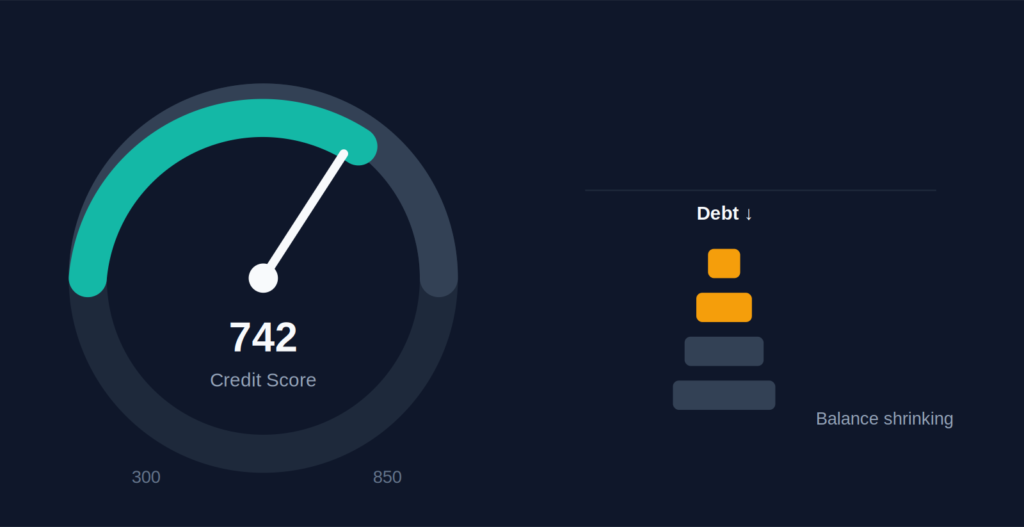
A plain-language look at the real options for fixing your credit score and shrinking what you owe — including how to do both without touching interest.
On This Page
- Good News: It Isn’t an Either-Or
- At a Glance: Five Ways to Approach It
- What Each Option Actually Does
- Cost and Interest, Including Where Riba Comes In
- How Fast You’ll Actually See Results
- The Real Impact on Your Credit Score
- How Your Credit Utilization Ratio Ties It All Together
- The Numbers Behind America’s 2026 Debt Load
- Staying Riba-Free While You Do This
- Where the Secured Credit Card Wins
- Where the Credit-Builder Loan Wins
- Where the Debt Snowball Wins
- Where the Debt Avalanche Wins
- Where Debt Consolidation Wins
- Which Path Fits Your Goals
- Key Takeaways
If you’ve ever tried to fix your credit score and pay down a balance in the same month, you already know the two goals can feel like they pull in opposite directions. Most articles treat them as separate problems. In practice, building credit and paying off debt are usually the same problem wearing two different hats.
This guide breaks down the actual methods people use — not just the buzzwords — so you can see what each one costs, how fast it works, and whether it fits a riba-free approach to money. There’s no single “correct” method here, whatever an ad for any one card or loan product might imply. What works for someone with no credit history at all looks nothing like what works for someone carrying five years of revolving balances.
It also helps to know upfront that none of these methods are exclusive to one lender or one app. Secured cards, credit-builder loans, and consolidation loans are available from most banks, credit unions, and online lenders, while the snowball and avalanche are simply repayment orders you can apply to whatever debt you already have. That means you don’t need to shop around for a “special” product before you start — you can often begin with what’s already sitting in your wallet.
Good News: Building Credit and Paying Off Debt Isn’t an Either-Or
Here’s the part most guides skip. If you already carry some debt, the way you pay it down can double as the way you build your score — because on-time payments and a falling balance both feed directly into how credit bureaus see you. You don’t need two separate plans running at once. For most people, one combined plan gets further than two competing ones.
At a Glance: Five Ways to Approach It
Here’s how the main methods stack up side by side, before we go deeper on each one.
| Criteria | Secured Credit Card | Credit-Builder Loan | Debt Snowball | Debt Avalanche | Debt Consolidation Loan |
|---|---|---|---|---|---|
| What it does | Deposit-backed card that reports on-time use | Locked savings you “borrow” and repay to build history | Pay smallest balance first, roll payment forward | Pay highest-rate balance first | Combines balances into one new loan |
| Typical cost | Refundable deposit, small annual fee | Small admin fee, interest if not paid off in full | None — just discipline | None — just discipline | Origination fee plus interest on new loan |
| Time to see results | 3–6 months of on-time payments | 6–24 months, loan-term dependent | Weeks, on the smallest balance | Slower first win, faster overall | Immediate on paper, real progress over months |
| Credit score impact | Strong, builds payment history from scratch | Strong, adds installment-loan mix | Moderate, motivational more than mathematical | Moderate, mathematically the fastest payoff | Can help utilization, but opens new account |
| Interest / riba involved | Only if balance isn’t paid in full monthly | Sometimes, check the lender’s structure first | None added, just repaying existing balances | None added, just repaying existing balances | Usually yes, unless structured as qard hasan |
| Best for | No credit history yet | Thin file, wants installment history too | Needs quick wins to stay motivated | Wants the mathematically cheapest payoff | Multiple high-rate balances, good enough score to qualify |
Chart: total U.S. credit card balances by year, based on Federal Reserve Bank of New York household debt data as reported by LendingTree’s 2026 credit card debt statistics. 2022–2024 figures are approximate year-end totals; Q4 2025 and Q1 2026 are the most recently reported quarterly figures.
What Each Option Actually Does
Every method for building credit and paying off debt does something different once you look past the marketing. A secured credit card asks for a cash deposit — usually $200 to $500 — which becomes your credit limit. Use it like a normal card and pay it off, and it reports to the bureaus just like any unsecured card would.
A credit-builder loan flips the usual order: the “loan” amount sits in a locked savings account while you make monthly payments into it, and you get the money (plus whatever interest applies) once it’s paid off. The debt snowball and debt avalanche are both repayment orders, not products — snowball tackles your smallest balance first for quick psychological wins, avalanche tackles your highest interest rate first to save the most money. A debt consolidation loan replaces several balances with one new loan, ideally at a lower blended rate.
Cost and Interest, Including Where Riba Comes In
Getting the cost side right is central to building credit and paying off debt without quietly taking on more interest than you meant to. Secured cards and credit-builder loans are cheap to start — a small fee, sometimes a refundable deposit. The real cost only shows up if you carry a balance and get charged interest, which is exactly where a halal-conscious reader needs to pay attention.
The snowball and avalanche methods add zero new interest by design; you’re simply repaying what already exists, in a smarter order. Consolidation loans are where riba most commonly creeps in, since almost all conventional consolidation products charge interest on the new balance — an interest-free option only exists if you can arrange something like a qard hasan (a benevolent, interest-free loan) with family, or a genuinely Sharia-compliant lender.
How Fast You’ll Actually See Results
Secured cards and the debt snowball both deliver visible progress fastest — a reporting cycle or two for the card, a few weeks for your first paid-off balance with the snowball. Credit-builder loans and the debt avalanche are slower to feel rewarding but tend to leave you better off within a year, since they’re built around the math rather than the momentum. Consolidation can feel instant, since your monthly bill total often drops right away, but the real payoff takes months to show up in your credit history.
A practical way to think about the timeline: if you open a secured card today and use it for one small recurring bill, you’ll likely see it reflected on your credit report within 30 to 45 days, with a noticeable score movement by month three or four. A debt snowball run alongside that same card can produce your first “balance paid off” milestone even sooner, often inside six to eight weeks, depending on how small your smallest balance is.
The Real Impact on Your Credit Score
Payment history and how much you owe relative to your limits make up the bulk of your score, so anything that keeps payments on time and balances low helps across the board. Secured cards and credit-builder loans build history where you may have none, while the snowball and avalanche both improve your score as balances fall, just on different timelines.
Consolidation can lower your utilization on old cards while opening a new account, which is a short-term wash before it becomes a net positive. Whichever method you pick, this is the metric that ties building credit and paying off debt together in practice, not just in theory.
How Your Credit Utilization Ratio Ties It All Together
Your utilization ratio — the share of your available credit you’re actually using — sits right in the middle of building credit and paying off debt, which is why the two goals overlap more than most people expect. Paying down a balance doesn’t just reduce what you owe; it directly lowers this ratio, and a lower ratio is one of the fastest levers you have on your score. That’s the real reason a well-run debt payoff plan often does more for your credit than opening a new product ever could.
Chart: the five weighted factors in a standard FICO score, based on FICO’s publicly disclosed scoring methodology.
The Numbers Behind America’s 2026 Debt Load
Total U.S. credit card balances stood at $1.252 trillion in the first quarter of 2026, according to Federal Reserve Bank of New York household debt data reported by LendingTree, down slightly from a record $1.277 trillion the previous quarter. The same data shows the 30-day delinquency rate falling to 2.92% in that quarter — its seventh straight quarterly decline. These numbers help explain why building credit and paying off debt feels harder today than it did five years ago: even as more people manage to pay on time, the total amount owed remains historically high, and average interest rates on revolving balances are still sitting above 21%.
Staying Riba-Free While You Do This
None of this requires accepting interest as a given. Paying your secured card’s statement balance in full every month means you never actually pay interest on it, even though the card technically carries an APR. The snowball and avalanche methods are naturally riba-free, since you’re only repaying principal you already owe, in a chosen order. Where it gets harder is credit-builder loans and consolidation loans, both of which are often structured with interest baked in — so read the terms closely, or look for a cooperative, community, or Islamic finance option that uses a service-fee or profit-sharing structure instead.
This is really the heart of building credit and paying off debt the halal-conscious way: the method matters less than whether interest ever actually gets charged.
Where the Secured Credit Card Wins
- No credit history required. You qualify with a deposit, not a score.
- Fully riba-free if used correctly. Pay the statement balance in full and you never touch interest.
- Deposit is refundable. Most issuers return it, or upgrade you to an unsecured card, after 6–12 months of good behavior.
Where the Credit-Builder Loan Wins
- Adds installment history. Useful if your file is all cards and no loans.
- Builds savings as a side effect. You end up with a lump sum once the term ends.
- Low barrier to approval. Because the “collateral” is the loan amount itself, approval standards are lighter than most loans.
Where the Debt Snowball Wins
- Fastest emotional win. Closing out a small balance in weeks keeps most people going.
- Zero added cost. You’re not paying for a product, just reordering payments.
- Simplifies your accounts faster. Fewer open balances sooner, which can help your score.
Where the Debt Avalanche Wins
- Cheapest path, mathematically. Killing the highest rate first saves the most in total interest.
- Shorter overall payoff time for most balance combinations once you run the numbers.
- No added interest, same as the snowball — the only difference is order.
Where Debt Consolidation Wins
- One payment instead of several. Easier to track, easier to budget around.
- Can lower your blended rate if your credit qualifies you for a better deal than your existing cards.
- Frees up utilization on old cards once those balances move to the new loan.
Which Path Fits Your Building Credit and Paying Off Debt Goals
If you have no credit history at all, start with a secured card or a credit-builder loan — you can’t skip the “someone needs to see you repay something” step. If you’re carrying several high-interest balances, the avalanche will cost you the least overall, even if it feels slower at first. If you’re disciplined on paper but need motivation, the snowball’s early wins tend to keep people consistent longer than the math-optimal choice would.
If your debt is large relative to your income and your score already qualifies for a better rate, consolidation can genuinely simplify things — just confirm the new loan’s rate first. And if staying riba-free is non-negotiable, lean on the snowball or avalanche as your core strategy, since neither one requires taking on a single dollar of new interest.
Key Takeaways
- Building credit and paying off debt is a long game, not a single decision — and for most people, one combined plan beats two separate ones.
- Secured cards and credit-builder loans are the entry points if you have little or no credit history yet.
- The snowball and avalanche methods add no new interest; they only reorder repayment of what you already owe.
- Your utilization ratio is the hidden thread connecting your score and your balance — paying down debt improves both at once.
- A riba-free path exists for nearly every method here, provided you read the terms and choose deliberately.
Whichever combination you choose from this guide, the goal is the same one it always was: building credit and paying off debt as one connected habit, not two separate chores competing for your attention.
For a deeper look at specific payoff strategies, NerdWallet’s guide to paying off debt in 2026 is a solid outside reference worth reading alongside this one.