

When budgeting methods compared side by side, picking one is less about finding the “correct” option and more about finding the one you’ll actually stick with. The 50/30/20 rule, zero-based budgeting, the envelope method, and pay-yourself-first all solve the same problem — knowing where your money goes — but they do it in very different ways. Some prioritize simplicity, some prioritize control, and some prioritize savings discipline above everything else. This guide compares all four side by side so you can match the method to your habits, income type, and goals, whether you’re building a budget from scratch or switching because your current system isn’t sticking.
At a Glance: How These Budgeting Methods Compare
The table below has these budgeting methods compared across seven key criteria, from setup effort to debt payoff fit
| Criteria | 50/30/20 | Zero-Based | Envelope | Pay-Yourself-First |
|---|---|---|---|---|
| Setup effort | Low — three broad buckets | High — every dollar assigned monthly | Medium — categories + physical/digital envelopes | Low — automate savings, spend the rest |
| Best for | Beginners, steady paychecks | Detail-oriented planners, variable expenses | Overspenders, cash-preferring budgeters | Savings-first goals, irregular discipline |
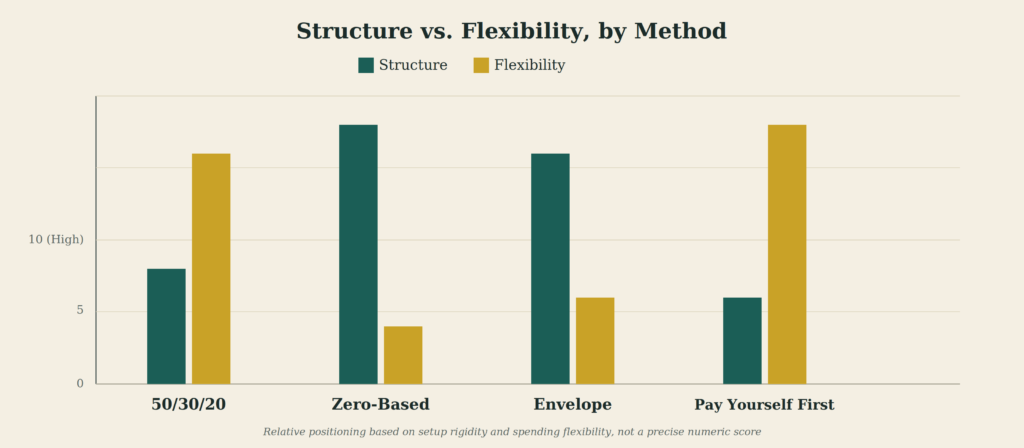
| Flexibility | High | Low — rigid by design | Low within categories | High — spending isn’t tracked closely |
| Time commitment | Low, monthly check-in | High, weekly/monthly | Medium, ongoing tracking | Very low, mostly automated |
| Overspending risk | Moderate | Low | Very low (hard cash limits) | Moderate to high on discretionary spend |
| Best for debt payoff | Workable, if the 20% is tracked closely | Strongest fit — dollar amount named monthly | Strong, if a debt envelope is funded first | Workable via automated extra payments |
Criteria-by-Criteria Breakdown
Cost and Setup
When budgeting methods compared here are weighed by setup time and cost, none of the four requires any money to start— the difference is time. The 50/30/20 rule needs almost no setup: split take-home pay into needs (50%), wants (30%), and savings/debt (20%), then track loosely against those three buckets each month. Zero based budgeting takes longer upfront since every dollar needs a named job — rent,groceries, debt payoff, savings — before the month even starts, and that assignment has to be redone every pay cycle. The envelope method requires setting up categories and either physical cash envelopes or a digital equivalent inside a budgeting app, plus an initial decision about how much goes into each one. Pay-yourself-first is the fastest to launch: set up one automated transfer to savings or investments on payday, and the rest of the budget can stay informal.
Returns and Benefit
Once these budgeting methods compared here are put into practice, the real “return” is behaviour change, not investment growth. The real “return” here is behaviour change, not investment growth. Zero-based budgeting tends to produce the sharpest awareness of spending because every dollar is accounted for — nothing slips through unnoticed. The envelope method delivers a strong psychological benefit that digital-only systems struggle to replicate:physically
running out of cash in a category is a hard stop, not a warning notification you can dismiss. 50/30/20 is easier to sustain long-term precisely because it’s flexible — there’s less friction, so people keep doing it. Pay-yourself-first guarantees savings happen on schedule but does little to control the spending that’s left over, which means it works best paired with at least loose awareness of where the remainder goes
Risk of Falling Off the Wagon
When these budgeting methods compared side by side are tested against real life, some hold up better than others if things get busy.Zero-based and envelope budgeting are the most failure-prone if life gets busy, since both need regular upkeep — miss a few weeks of tracking and the system falls out of
sync with reality. 50/30/20 survives inconsistency better because it’s a loose guideline rather than a strict ledger; even a rough mental check-in keeps it useful. Pay-yourself first is the most “set and forget” of the four — once the automated transfer is in place,the savings goal is met regardless of what happens to the rest of the paycheck, whichmakes it resilient to busy months but blind to overspending elsewhere.
Accessibility for Different Income Types
Looking at these budgeting methods compared by income type reveals a clear pattern for freelancers and gig workers.Irregular income (freelancers, commission-based earners, gig workers) tends to struggle with zero-based budgeting month to month, since the “zero” target shifts every time income does. Pay-yourself-first and 50/30/20 adapt more easily to fluctuating paychecks because both scale with whatever comes in rather than assuming a fixed
baseline. The envelope method works for any income type but is easiest to manage with a predictable paycheck cycle, since irregular income means irregular envelope refills.
Fit With Debt Payoff Goals
For anyone paying down debt, these budgeting methods compared on structure alone don’t tell the full story.For anyone actively paying down debt, the choice of method matters more than it first appears. Zero-based budgeting is the strongest fit here because it forces a specific dollar amount toward debt every single month, rather than letting it compete loosely with other spending. The envelope method can work well for the “avalanche” or “snowball” approach if a dedicated debt-payoff envelope is funded first, before discretionary categories. 50/30/20’s “20%” bucket covers both savings and debt, which can work but risks under-funding one or the other if not tracked carefully. Pay-yourself-first can be adapted to debt payoff by treating the extra payment like a savings transfer —automated, before anything else touches the account.
Halal-Aware Note
Now that these budgeting methods compared side by side show where each stands, it’s worth noting: none of the four requires an interest-based (riba) product to function.—they’re organizational systems, not financial products. That said, where they intersect with money movement matters: the envelope method’s cash-first approach naturally sidesteps revolving credit card debt, and pay-yourself-first pairs cleanly with a halal savings account or Shariah-screened investment vehicle for the portion set aside.Readers building a fully halal money system should pick whichever budgeting method fits their habits, then route the “savings” or “20%” portion into halal-compliant accounts and instruments.
Which Method Is Right for You
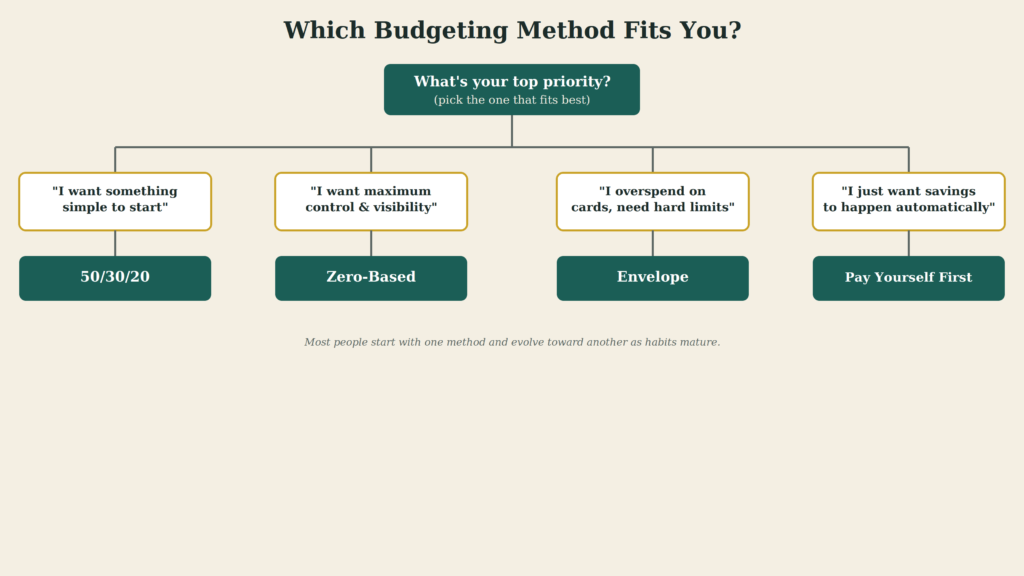
Having these budgeting methods compared side by side, here’s how to match one to your situation.
If you’re a beginner or just want a simple starting point: go with 50/30/20.
It requires the least maintenance and still gives you a clear read on whether you’re overspending on wants.
If you have variable expenses or want maximum control: zero-based budgeting
forces the visibility that catches leaks other methods miss — worth the extra time if
you’re willing to put in the work monthly
If you’re a visual or cash-based spender who overspends on cards: the envelope method’s hard limits are the most effective guardrail, especially for categories
like groceries or entertainment.
If your priority is guaranteeing savings happen no matter what: pay-yourselffirst is the lowest-effort way to make sure a goal — an emergency fund, a halal investment account, a debt payoff fund — gets funded before anything else touches your
paycheck.
Most people don’t stick with one method forever. It’s common to start with 50/30/20 for the learning curve, then graduate to zero-based budgeting or layer in pay-yourself-first automation once these budgeting methods compared here become second nature to use together.
Here’s what stands out once these budgeting methods compared throughout this guide are weighed against each other.
Key Takeaways
-
All four methods solve the same core problem — visibility and control over spending — through different mechanisms: ratio-based (50/30/20), full allocation (zerobased), hard cash limits (envelope), or automated savings first (pay-yourselffirst). -
Zero-based and envelope budgeting demand the most ongoing effort but offer the tightest control -
50/30/20 and pay-yourself-first are the easiest to sustain long-term, especially for irregular income. -
None of the four methods requires interest-based products — they’re structural, not financial, so a halal money system can be built on top of any of them.
This article compared budgeting methods in depth as part of FinWiser’s Personal Finance pillar. For a deeper dive into automating your savings, see our guide to pay-yourself-first automation tools.