
AI & Money Tools > Learn > Budgeting Apps vs AI Advisors vs Robo-Screeners: Which AI Finance Tool Actually Fits You?
Budgeting Apps vs AI Advisors vs Robo-Screeners: Which AI Finance Tool Actually Fits You?
Three very different jobs are hiding under the label “AI finance tool” — here’s how to tell which one your money actually needs.
ST
Sundas Tahir
Founder & CEO, FinWiser AI
✓ Reviewed & fact-checked before publishing
She’s currently building FinWiser Labs’ own halal-aware AI stock screener, which makes her both qualified to write this and a little biased — she’ll flag it where it matters.
Every finance app now claims to run on “AI,” which is a bit like every restaurant claiming its food is “artisanal.” Sometimes it’s true. Sometimes it’s a chatbot bolted onto a spreadsheet. Somewhere in that noise, three genuinely different categories of tools have quietly become useful: budgeting apps that watch your spending, AI advisors that manage your investments, and robo-screeners that help you evaluate individual stocks before you buy them.
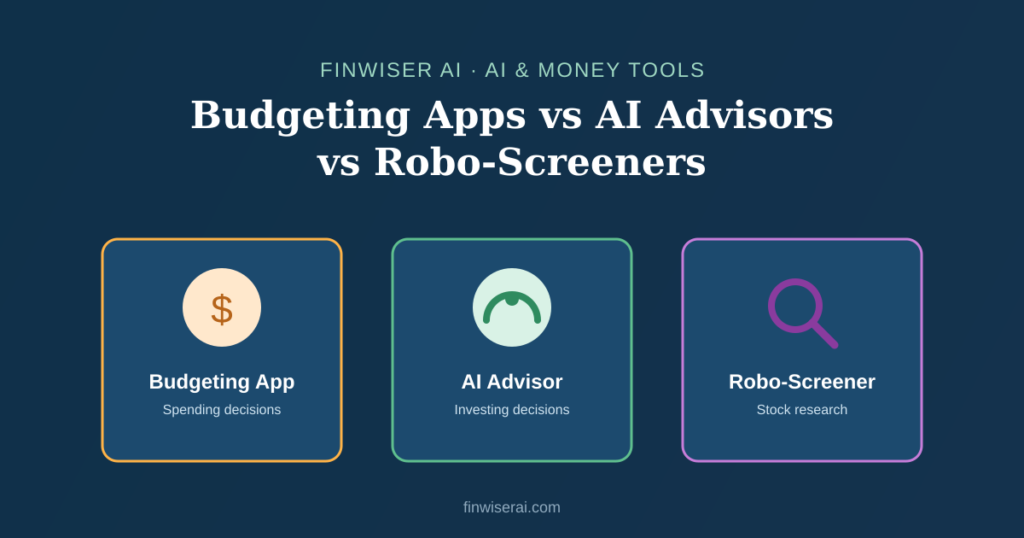
Set side by side, budgeting apps vs AI advisors vs robo-screeners get lumped together constantly, which causes most of the confusion. A budgeting app and an AI advisor aren’t competing products — they’re not even doing the same job. One watches money leaving your account. The other decides what to do with money you’ve already saved. A robo-screener does neither; it just helps you think faster before you pull the trigger on a stock. This guide breaks down what each one actually does, what it costs, and — since we build a halal-aware screener ourselves — where riba considerations show up in each category.
There’s no single “correct” tool here, and that’s genuinely the point of this comparison, not a cop-out. The right pick depends on which part of your money life is currently a mess.
Good news: you don’t have to pick just one. These three tools solve different problems, and most people who actually make progress with money end up running two of them side by side — a budgeting app to stop the bleeding, plus either an AI advisor or a robo-screener depending on whether they want investing handed off or want to keep picking their own stocks with better information.
At a Glance: Budgeting Apps vs AI Advisors vs Robo-Screeners
| Criteria | Budgeting Apps | AI Advisors (Robo-Advisors) | Robo-Screeners |
|---|---|---|---|
| Primary job | Track spending, flag waste, nudge better habits | Build and manage an investment portfolio for you | Analyze and rank individual stocks before you buy |
| Typical monthly cost | $0-$15/month | 0.25%-0.50% of assets managed annually | $0-$40/month (often free tier available) |
| Access to your money | Read-only, connects to accounts to categorize transactions | Discretionary — moves and rebalances your invested funds | Read-only, you place trades yourself |
| Learning curve | Low — set up categories, let it run | Low — answer a risk questionnaire, hand off control | Medium — you still need to understand what the score means |
| Best for | Anyone whose spending is the actual problem | Anyone who wants investing on autopilot | Anyone who enjoys picking stocks but wants a second opinion |
| Where it falls short | Doesn’t touch investing or long-term planning at all | Doesn’t account for your full financial picture or goals outside the account | Doesn’t execute anything — the decision and the risk stay with you |
| Human backup available? | Rarely — mostly self-serve support | Often, at a premium tier (certified planner access) | Rarely — it’s a research tool, not an advisory relationship |
| Halal-aware options available? | Not usually a concern by design, but overdraft/credit nudges can involve interest | Limited — most default portfolios include conventional bonds and interest-bearing instruments | Growing — shariah-screening filters exist and are becoming more common |
What the Costs Actually Look Like Side by Side
On cost, budgeting apps vs AI advisors vs robo-screeners split pretty cleanly. Budgeting apps are the cheapest entry point almost every time, which makes sense — they’re not managing your money, they’re just narrating it back to you in a nicer voice. AI advisors charge as a percentage of what they’re managing, so the dollar cost climbs with your balance even though the percentage stays flat. Robo-screeners sit in between, usually with a free tier that’s good enough until you want deeper data.
What It Actually Does
A budgeting app connects to your bank and card accounts, sorts every transaction into a category, and tells you where the money actually went — usually with more honesty than you’d like. Apps like Cleo, Rocket Money, and Monarch Money have leaned into AI chat interfaces that can answer “can I afford this?” in plain English instead of making you dig through a spreadsheet.
An AI advisor, or robo-advisor, is a different animal entirely. You answer a handful of questions about your goals, timeline, and risk tolerance, and it builds and rebalances an actual investment portfolio on your behalf. Betterment, Wealthfront, and Schwab Intelligent Portfolios fall into this bucket. You’re not managing anything day to day; you’re handing the steering wheel over.
Rounding out budgeting apps vs AI advisors vs robo-screeners, a robo-screener doesn’t touch your money or your portfolio at all. It’s a research layer — you feed it a stock or a set of filters, and it ranks or scores companies based on fundamentals, momentum, or whatever criteria it’s built around. You still place every trade yourself. Think of it as a very fast, very tireless research assistant rather than a decision-maker.
Who Each One Is Actually Built For
Budgeting apps are for anyone whose real problem is the outflow — money disappearing faster than it should, subscriptions nobody remembers signing up for, a paycheck that vanishes by the 20th. If that’s you, sophisticated investing tools are solving the wrong problem.
AI advisors are for people who have money to invest but don’t want to become amateur portfolio managers. If your instinct is “just tell me what to do and rebalance it automatically,” this category exists specifically for you.
Robo-screeners are for people who already enjoy picking their own stocks and want a faster, less emotional way to narrow down candidates. If you like the process of investing — not just the outcome — this is the category that respects that instinct instead of replacing it.
Where Each One Breaks Down
The limits are just as telling as the strengths across budgeting apps vs AI advisors vs robo-screeners. Budgeting apps stop at the border of investing entirely. They’ll happily tell you you’re overspending on takeout, but they have nothing to say about whether your retirement account is allocated sensibly.
AI advisors, meanwhile, generally only see the account you’ve handed them. They don’t know about the rental property, the side business, or the parent you’re helping support — so the “personalized” plan is only as complete as the slice of your life it can actually see.
Robo-screeners have the opposite weakness: they’re read-only by nature. A high score on a screener doesn’t execute a trade, size a position, or manage risk after you buy — that part is still entirely on you, which is exactly why it should never be mistaken for advice.
That diagram is the honest version of “which one do I need” — a budgeting app decides what’s left over to invest, an AI advisor takes that leftover and manages it for you, and a robo-screener runs alongside as a separate research lane for people still picking their own individual stocks.
Related Concept: “Robo” Doesn’t Mean the Same Thing Twice
Worth clearing up on the budgeting apps vs AI advisors vs robo-screeners question, since the naming overlap is where most people get tangled: a robo-advisor and a robo-screener share a word and basically nothing else. A robo-advisor is discretionary — you give it authority to hold and move your actual investment funds. A robo-screener is advisory in the loosest sense — it hands you a ranked list or a score, and then steps back entirely. One drives the car. The other just gives you better directions before you drive it yourself. Confusing the two is how people end up assuming a stock screener is “managing” their portfolio when nothing has actually been invested at all.
What the Data Actually Says
Skepticism about AI handling money is reasonable, but the adoption numbers tell a less dramatic story than the headlines suggest. According to a NerdWallet survey, about 48% of Americans say using AI will have a positive impact on their personal finances — nearly half, but still short of a consensus. That split roughly matches what shows up in practice: people are comfortable letting AI summarize and categorize, more cautious about letting it make outright decisions with real money attached.
That’s a reasonable place to land, and it lines up with how trust actually splits across budgeting apps vs AI advisors vs robo-screeners. Read-only tools — budgeting apps and screeners — carry a lower trust bar because a wrong categorization or a bad score just costs you a little time. A robo-advisor moving actual dollars is a different level of trust, which is exactly why it’s worth understanding what you’re handing over before you connect an account.
The Halal-Aware Note
Riba shows up differently across these three categories, and it’s worth knowing where before you connect anything. Budgeting apps themselves are usually neutral — they’re just reading transactions — but watch for built-in features like overdraft-protection lines of credit or “cash advance” nudges, since those frequently carry interest even when the app’s tone makes them sound like a friendly favor.
AI advisors are where this gets more real. Most default portfolios are built from conventional index funds that include interest-bearing bonds and companies with debt structures that don’t screen as halal, so the “set it and forget it” convenience usually comes bundled with instruments a halal-conscious investor would want to avoid. A small number of advisors now offer shariah-compliant portfolio options specifically, so it’s worth asking directly rather than assuming the default allocation works for you.
Of the three — budgeting apps vs AI advisors vs robo-screeners — robo-screeners are actually the friendliest category on halal-awareness, since screening for shariah-compliant stocks — filtering out excess debt, interest income, and non-halal business lines — is exactly the kind of rules-based filtering these tools are built to do well. That’s the gap FinWiser Labs is building its own screener to close, so we’ll say plainly: we’re building in this space, and that’s the lens we’re looking through.
Where Each Tool Wins
Where Budgeting Apps Win
- Cheapest way in. Most have a usable free tier, so there’s no financial barrier to just trying one this week.
- Fastest behavior change. Seeing your own spending laid out bluntly tends to change habits faster than any lecture could.
- Zero investing risk. It only watches money — it can’t lose you anything by making a bad call.
Where AI Advisors Win
- True hands-off investing. Rebalancing, tax-loss harvesting, and allocation happen without you lifting a finger.
- Removes emotional trading. There’s no panic-selling during a dip because there’s no manual “sell” button in the moment of panic.
- Scales with your balance. The bigger your account gets, the more sophisticated the management behind it tends to become.
Where Robo-Screeners Win
- Keeps you in the driver’s seat. You stay the one making the actual investment decisions, just with better filtering first.
- Speeds up research. What used to take an evening of digging through filings can take minutes.
- Fits values-based filtering well. Rules-based screens — halal-compliance included — are exactly the kind of task this category handles cleanly.
Which One Is Right for You
If your bank balance is a mystery to you by the middle of every month, start with a budgeting app — nothing else on this list matters until spending stops being the emergency.
If you’ve got savings sitting in a low-interest account doing nothing, and the idea of picking individual investments makes your eyes glaze over, an AI advisor is built exactly for that discomfort.
If you already enjoy researching individual stocks and want a faster, more consistent way to narrow the field before you buy, a robo-screener adds real speed without taking the decision away from you.
And if you’re still weighing budgeting apps vs AI advisors vs robo-screeners and aren’t sure which bucket you’re in — start with the budgeting app regardless. It’s the cheapest, lowest-risk starting point, and it usually reveals which of the other two you actually need next.
Key Takeaways
- Budgeting apps, AI advisors, and robo-screeners solve three different problems — spending, investing, and stock research — not one shared problem with three brands.
- Only AI advisors actually hold discretionary control over your money; the other two are read-only by design.
- Nearly half of Americans (48%, per NerdWallet) already see AI as a net positive for their finances, but trust drops as the tool’s authority over real money rises.
- Most default robo-advisor portfolios include conventional interest-bearing instruments, so halal-conscious investors should ask about shariah-compliant options directly rather than assume.
- Robo-screeners are currently the easiest category to apply values-based filtering to, halal-compliance included.
That’s the short version of budgeting apps vs AI advisors vs robo-screeners: spend, invest, or research, matched to the tool actually built for it.
For a deeper look at where AI in personal finance tends to help versus where it’s worth staying cautious, NerdWallet’s “Should You Use AI for Personal Finance? What to Consider — and Avoid” is a solid, independent read on the subject.