
Investing · Stock Comparison
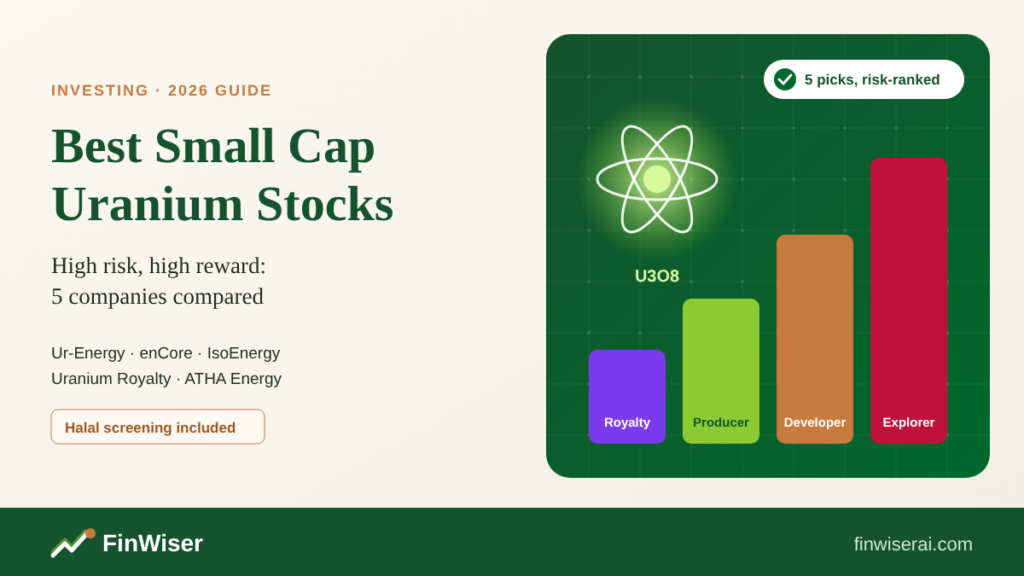
Five smaller uranium companies — a producer, a struggling producer, a developer, a royalty holder and an explorer — offer very different ways to bet on nuclear fuel, each with its own way to lose money.
Uranium has had a strong two years, and the big names everyone talks about have already been bid up. So investors go hunting further down the size ladder for the best small cap uranium stocks, where a single drill result or permit can double a share price. It can also halve it, and that second part rarely makes the headlines.
This guide compares five real, listed companies that sit under (or near) the small-cap line of about $2 billion in market value. There is no single “correct” pick here. Each one fits a different reader, a different risk appetite and a different view of where uranium goes next.
🌱 Our Wisers Say
Treat small uranium names as a satellite, never the core. Our rule of thumb: size any single junior so that losing 70% of it would sting but not change your plans. In this sector, a drop that deep isn’t a far-fetched worst case. One company on this list lost about 63% in the past year.
Good News: You Don’t Have to Pick Just One
If you like the theme but don’t want to bet on one management team, a basket does the stock-picking for you. The Sprott Junior Uranium Miners ETF (URNJ) holds 41 uranium companies, and as of October 16, 2026, Sprott reports that 46.5% of the portfolio sits in companies worth under $2 billion.
An exchange-traded fund (ETF) won’t spare you the sector’s swings, but it does spread out the single-company risk. Many readers end up with a small ETF position plus one or two of the best small cap uranium stocks they understand well. That mix keeps the upside without staking everything on one permit.
At a Glance: The Best Small Cap Uranium Stocks Compared
Market values move daily in this sector, so treat the figures below as rough sizes from mid-to-late 2026, and check a live quote before you act.
| Criteria | Ur-Energy | enCore Energy | IsoEnergy | Uranium Royalty | ATHA Energy |
|---|---|---|---|---|---|
| Ticker | URG (NYSE American) | EU (Nasdaq) | ISOU (NYSE American) | UROY (Nasdaq) | SASK (TSXV) / SASKF (OTC) |
| Stage | Producer | Producer, struggling | Developer | Royalty & physical uranium | Explorer |
| Main asset | Lost Creek & Shirley Basin, Wyoming | Alta Mesa, South Texas | Hurricane deposit, Saskatchewan | Royalties on Canadian mines | Angilak, Nunavut |
| Rough size (2026) | ~$530M | ~$180–220M | ~$600–680M | ~$1.3–1.6B | ~$260M |
| Revenue today | Yes, growing | Yes, shrinking output | No | Small, lumpy | No |
| Biggest risk | Still loss-making | Permits, cash burn | Years from production | Share issuance | Drill results |
| Risk level | High | Very high | High | Moderate-high | Extreme |
How the Five Stack Up, Criterion by Criterion
Business Stage and Revenue
Stage tells you what kind of risk you’re buying. Ur-Energy and enCore already pull uranium out of the ground using in-situ recovery, which dissolves uranium underground and pumps it up rather than digging an open pit. IsoEnergy owns some of the richest ore in the world but isn’t mining it yet.
Uranium Royalty is a different animal. It collects a royalty, a cut of other miners’ output, and also holds physical uranium. ATHA Energy is pure exploration: it has no mine, no revenue, and is still drilling to prove how much uranium it has.
Among the best small cap uranium stocks, stage is the single biggest clue to how a share price will behave. A producer can disappoint on costs. An explorer can disappoint on everything at once.
Costs and Cash Discipline
Ur-Energy’s latest numbers show what “working” looks like for a small producer. In the second quarter of 2026 it sold 215,000 pounds, earned $14.4 million, and reported a cash cost of $40.20 per pound sold, according to its quarterly filing with the SEC. It still posted a small loss per share, but the direction is right.
enCore shows the opposite. Its Q2 2026 report showed extraction for the first half of the year falling to 131,274 pounds from 317,613 a year earlier, as permitting delays in South Texas slowed new wellfields. The company cut its 2026 production outlook and expects a key permit in Q4 2026.
Jurisdiction and Project Quality
IsoEnergy’s Hurricane deposit in Saskatchewan’s Athabasca Basin is described by the company as the world’s highest-grade indicated uranium resource. In June 2026 it also closed its purchase of Australia’s Toro Energy, adding the Wiluna project and giving it assets in three countries.
ATHA’s Angilak project in Nunavut is remote, which raises costs and shortens the drilling season. The company ran its largest program yet in 2026, about 20,000 metres with three rigs from May to September, funded by a C$63 million raise in February.
Dilution Risk
Small miners fund themselves by selling new shares, which shrinks your slice of the company. That’s called dilution, and it’s the quiet cost of owning juniors. Explorers like ATHA and developers like IsoEnergy will need more capital before they ever sell a pound.
Uranium Royalty has renewed its at-the-market equity program, a standing permission to sell new shares into the market. IsoEnergy issued about 4.36 million new shares to pay for Toro. None of this is a red flag by itself, but it’s money that comes out of existing holders’ upside.
A practical habit: before buying any of the best small cap uranium stocks, compare its share count today with two years ago. A share count that keeps climbing tells you who has been paying for the growth.
Leverage to the Uranium Price
Explorers and developers tend to move hardest when uranium sentiment turns, because their whole value is a bet on future prices. Producers move too, but their contracts lock in prices ahead of time. The royalty model is usually the calmest of the five, since it benefits from higher prices without paying to run a mine.
This leverage is exactly why small uranium names earn their high-risk, high-reward label. It works in both directions, and it usually works faster on the way down.
Why Miners Don’t Get the Headline Uranium Price
Most news stories quote the spot price, the price for uranium delivered right now. But uranium doesn’t trade on an open exchange. Most of it is sold through private multi-year contracts signed with utilities, often at prices agreed long before delivery.
That gap is real money. Ur-Energy’s average sales price in Q2 2026 was $66.85 per pound, and enCore delivered at an average of $70.10 per pound in the first half of 2026, both well below the spot prices of the same months. When you judge the best small cap uranium stocks, look at what each company actually realizes per pound, not the number on the evening news.
By the Numbers: The Commodity Rose, the Small Stocks Didn’t All Follow
According to Cameco’s industry-average price series, uranium’s spot price went from $64.23 per pound at the end of March 2025 to $89.63 at the end of September 2026. That’s a rise of roughly 40% in 18 months. Over the same stretch, the long-term contract price hit $96.50, its highest point in that series.
Yet enCore’s share price fell about 63% in the year to mid-September 2026, per Angel One’s market data. The lesson is blunt: a small uranium stock can fall while uranium rises, because company execution beats commodity tailwinds.
Are the Best Small Cap Uranium Stocks Halal?
Uranium mining itself is a permissible business activity for most Shariah screens, and none of these companies is a bank or lender. Owning shares involves profit and loss, not riba. The question is the balance sheet, which widely used AAOIFI-based screens test with three ratios.
Those ratios are interest-bearing debt under 30% of market value, interest-bearing cash and securities under 30%, and income from impermissible sources under 5% of revenue. Small caps can trip the second ratio in a surprising way: an explorer sitting on a big cash raise in interest-paying deposits can fail when its share price drops.
Uranium Royalty deserves a closer look too, since it describes investing in debt of uranium companies alongside royalties. Because market values swing so much here, a pass today can be a fail next quarter. Re-check with a halal stock screener before buying, and purify any small impermissible share of dividends or gains.
Pros and Cons of Each Company
Every one of the best small cap uranium stocks below has a genuine strength and a genuine catch. Read the catch first.
Where Ur-Energy Wins
- Two operating hubs. Shirley Basin started up alongside Lost Creek in 2026, giving it a second source of pounds.
- Low cash costs. Around $40 per pound leaves room for profit at today’s contract prices.
- The catch. It still isn’t consistently profitable, and contracted prices trail spot.
Where enCore Energy Wins
- Deep project pipeline. Beyond Texas, it holds Dewey Burdock in South Dakota and Gas Hills in Wyoming.
- Turnaround upside. After a steep fall, good permitting news could move the stock sharply.
- The catch. Falling output and a large quarterly loss make this the most fragile producer here.
Where IsoEnergy Wins
- World-class grade. Hurricane’s ore quality could mean low costs if it’s ever mined.
- Diversified map. Assets now span Canada, the US and Australia.
- The catch. No revenue, and production is years away.
Where Uranium Royalty Wins
- No mine to run. It earns from other operators’ output without their operating costs.
- Physical uranium exposure. Its inventory tracks the commodity more directly than a miner.
- The catch. Its 2026 Sweetwater deal added non-uranium assets, diluting the pure-play story.
Where ATHA Energy Wins
- Funded drilling. The February 2026 raise pays for an aggressive exploration push.
- Extra lottery tickets. It holds a 10% carried interest in Athabasca claims run by NexGen and IsoEnergy.
- The catch. Angilak has no modern resource estimate yet, so value rests on drill results.
Which One Is Right for You?
Picking among the best small cap uranium stocks is less about which company is “best” and more about which risk you can live with.
- You want the calmest uranium exposure. Look at Uranium Royalty first, or skip single names for URNJ.
- You want a real business with revenue. Ur-Energy is the steadier of the two producers.
- You like turnarounds and can stomach losses. enCore is the contrarian bet, sized small.
- You’re patient and think long-term. IsoEnergy’s grade is a multi-year story.
- You want the biggest swing. ATHA is the purest speculation on this list, so keep the position tiny.
Key Takeaways
- The best small cap uranium stocks differ mainly by stage: royalty, producer, developer or explorer.
- Rising uranium prices don’t guarantee rising share prices, as enCore’s 2026 slide shows.
- Miners sell mostly through contracts, so check the price each one actually realizes per pound.
- Expect dilution from explorers and developers, and size positions as satellites.
- Halal-conscious investors should re-screen often, since small-cap ratios move with the share price.
About the author
Sundas Tahir
Founder & CEO, FinWiser
Sundas Tahir founded FinWiser to make money decisions clearer. With close to eight years in finance and fintech, she has worked hands-on with financial accounts, payment flows and disputes, the day-to-day mechanics of how money actually moves. She writes about investing, banking and money tools with a halal-aware lens. Nothing here is personal financial advice. Think of FinWiser as the smart friend who reads the fine print so you don’t have to.
Further Reading From Top Finance Publishers
These outlets have covered the same question from different angles. Each link was checked before publishing.
- The Motley Fool: Top uranium stocks for 2026 and how to invest (covers the larger names for comparison)
- Investing News Network: 5 best-performing Canadian uranium stocks in 2026 (includes ATHA Energy)
- SmartAsset: How to buy uranium stocks (a beginner’s walkthrough of stocks vs ETFs)
- Musaffa Academy: The only 3 numbers that matter when screening halal stocks (the AAOIFI ratios explained)