
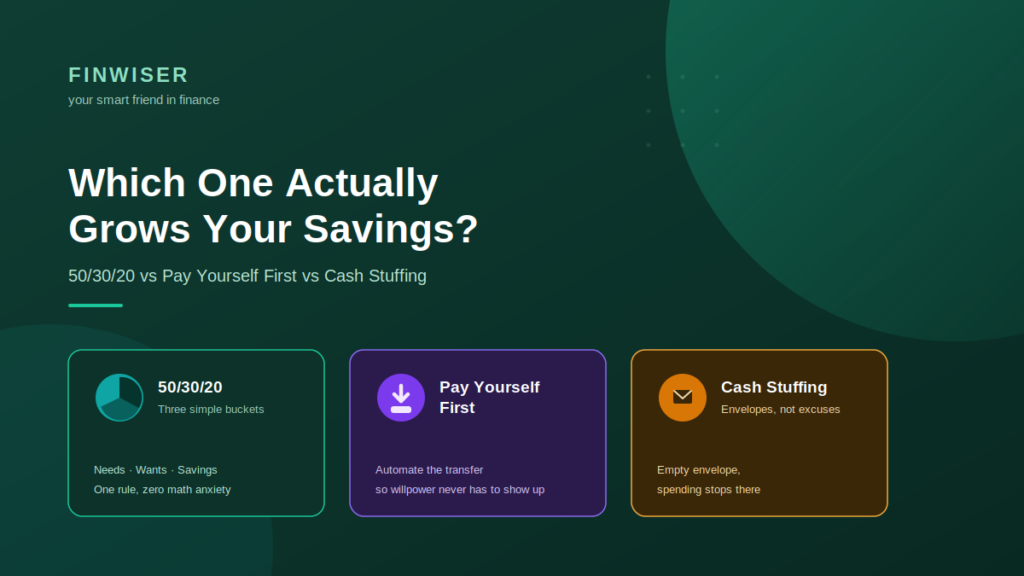
Three ways normal people actually save money, minus the guru energy: split your paycheck into buckets, pay your future self before anyone else gets a cut, or physically stuff cash into envelopes like it’s 1962 and it’s working great.
- Good News: You Don’t Have to Pick a Side
- At a Glance
- How the Three Compare
- Effort Required
- Automation vs. Willpower
- Flexibility
- Debt Payoff Friendliness
- Why Your Brain Trusts Cash More Than Numbers
- The Real Numbers Behind Cash Stuffing
- Is Any of This Halal? (Spoiler: Mostly)
- Where 50/30/20 Wins
- Where Pay-Yourself-First Wins
- Where Cash Stuffing Wins
- Which One Is Right for You
- Key Takeaways
Somewhere on the internet right now, someone is filming themselves stuffing twenty-dollar bills into a binder labeled “Groceries,” ring light and all. Meanwhile, a spreadsheet person is quietly automating 20% of their paycheck into savings and judging the binder people a little. Both of them, annoyingly, are doing fine. This article compares 50/30/20, pay-yourself-first, and cash stuffing — the three most popular ways to actually save money in 2026 — so you can figure out which one won’t make you quit budgeting by February.
None of these is secretly the “correct” one, no matter what a 23-year-old on TikTok insists between sponsored segments. The best saving strategy is the one you’ll still be doing in six months, not the one that looks best in a highlight reel. All three genuinely work; they just ask different things of you.
Good News: You Don’t Have to Pick a Side
You are allowed to mix these. A lot of people run pay-yourself-first for retirement and long-term savings, then cash-stuff a couple of chronically-overspent categories like dining out or “impulse Target trips,” while quietly using 50/30/20 percentages as a sanity check on the whole thing. This isn’t cheating. Budgeting methods are tools, not team jerseys.
50/30/20 vs Pay-Yourself-First vs Cash Stuffing: The Best Saving Strategy at a Glance
Here’s the side-by-side before we get into the weeds. Skim it, judge yourself a little, keep reading.
| Criteria | 50/30/20 | Pay Yourself First | Cash Stuffing |
|---|---|---|---|
| Best for | People who want one simple rule for everything | People who overspend the second money sits in checking | People who spend less when it’s physically painful to |
| Effort required | Low to medium — track three broad buckets | Low — set it once, forget it | Medium to high — manual tracking, physical or digital |
| Automation-friendly | Somewhat, with budgeting apps | Extremely — this is basically its whole personality | Not really, and that’s the point |
| Flexibility | Rigid percentages, flexible categories | Very flexible on spending, firm on the transfer | Rigid once the envelope’s empty, full stop |
| Good for debt payoff | Yes, within the 20% bucket | Yes, if you route extra payments there first | Yes, but mainly by blocking new spending |
| Interest / riba exposure | Depends where the 20% lands | Depends on the savings account used | None — it’s physical cash |
| Real-world popularity | The most-cited budgeting rule, period | Popular with “set and forget” savers | Resurging hard on social media since 2022 |
Rough shares of monthly income under each approach at a $4,000/month take-home, next to the share of young adults who’ve actually tried cash stuffing. Numbers are illustrative for the percentage-based methods; the cash-stuffing figure is a real reported survey result (see sources below).
Effort Required
50/30/20 asks you to sort spending into three buckets and not lie to yourself about what counts as a “want.” That daily latte is a want. We’ve all tried the recategorization trick; it doesn’t work. Pay-yourself-first is the laziest of the three in the best possible way — you configure one automatic transfer and your job is basically done.
Cash stuffing takes the most ongoing effort, whether that’s physically counting bills into envelopes or manually logging every swipe in a digital envelope app. Some find that effort meditative; others find it exhausting by week two. If low maintenance matters more than anything else, that alone might decide your best saving strategy before you read the rest of this.
Automation vs. Willpower
This is the real fault line between all three methods, more than the percentages or the envelopes. Pay-yourself-first removes willpower from the equation almost entirely — the money leaves before you can develop feelings about it. 50/30/20 needs you to check in periodically, but a budgeting app can automate most of the tracking.
Cash stuffing runs almost entirely on willpower, except it’s cleverly disguised as a physical constraint instead of a moral test. An empty envelope doesn’t care how strong your willpower is; it just has no money left in it. If you’ve quit every willpower-based budget you’ve ever tried, that’s a real signal about which of these is your best saving strategy, not just mine.
Flexibility
50/30/20’s percentages are fixed, but what falls into each bucket is entirely up to you, which makes it forgiving for irregular months. Pay-yourself-first is flexible almost everywhere except the one thing that matters: the savings transfer itself doesn’t budge.
Cash stuffing is the least flexible in the moment — an empty grocery envelope on day 20 means beans and rice until next payday, no negotiating with yourself. That rigidity is either its best feature or its biggest flaw, depending on how your last unplanned Target run went. If you crave structure that doesn’t bend, cash stuffing may genuinely be your best saving strategy; if you want room to breathe, it probably isn’t.
Debt Payoff Friendliness
All three can be pointed at debt, they just aim differently. 50/30/20 folds extra debt payments into its 20% bucket alongside savings, which works but means the two goals compete for the same slice. Pay-yourself-first can route that automatic transfer straight at a loan balance instead of a savings account, which is oddly satisfying to watch happen without lifting a finger.
Cash stuffing attacks debt indirectly — by making new spending physically harder, it frees up more cash to throw at what you already owe. It won’t pay the loan itself, but it stops the hole from getting deeper while you climb out. For someone actively drowning in credit card interest, the smartest savings approach might honestly be whichever one frees up cash fastest, debt-focused features be damned.
Why Your Brain Trusts Cash More Than Numbers
There’s a real behavioral reason cash stuffing keeps coming back instead of dying out like most TikTok trends. Physically watching a stack of bills shrink registers as loss in a way a declining app balance doesn’t — your brain treats “$40 left in this envelope” as more real than “$40 left” on a screen, even though it’s the exact same $40.
Pay-yourself-first works for the opposite reason: it removes the moment of decision entirely, so there’s no willpower test to fail. Neither trick is more virtuous than the other; the best saving strategy is simply whichever psychological loophole your brain falls for.
The Real Numbers Behind Cash Stuffing
Cash stuffing isn’t just aesthetic binders and Pinterest boards. According to a study cited by Truist, about 28% of millennials and Gen Zers surveyed — people aged 18 to 41 — say they’ve actually used cash stuffing for everyday purchases, not just for show. That’s a meaningful chunk of two entire generations willingly going back to a Great Depression-era budgeting method, cards in their wallets be damned.
It’s a useful reminder that “old-fashioned” and “effective for you specifically” aren’t opposites. A method doesn’t need to be new to be effective; it just needs to fit how you actually behave with money.
Is Any of This Halal? (Spoiler: Mostly)
None of these three methods is inherently about interest, which is good news if riba is on your radar. Cash stuffing is the cleanest of the three on this front — physical cash in an envelope earns nothing and owes nothing, so there’s simply no interest question to ask.
50/30/20 and pay-yourself-first both depend on where that saved money lands. Park it in a conventional interest-bearing account and you’re earning riba you’ll need to purify or avoid; park it in a halal-compliant account instead, and the method itself stays clean. The strategy isn’t the problem — the parking spot is. For a halal-conscious reader, the best saving strategy is really two decisions: the method, and the account.
With the mechanics and the halal angle out of the way, here’s the part everyone actually skips to first: the pros and cons of each option, stated plainly, no spreadsheet required to understand them.
Where 50/30/20 Wins
- One rule, zero math anxiety. Three buckets are easier to hold in your head than a dozen line-item categories.
- Room for a life. The 30% “wants” bucket means you don’t have to feel guilty about every dinner out.
- Scales with income. A raise just means bigger buckets, no system redesign required.
- Great starter budget. It’s the one most people can explain to a friend in under a minute.
Where Pay-Yourself-First Wins
For plenty of people, this quietly turns out to be the best saving strategy simply because it asks the least of them on a bad day.
- Set it once, done forever. No weekly check-ins, no category math, no spreadsheets to maintain.
- Immune to a bad week. The transfer happens whether or not you’re too tired to think about money that day.
- Best for inconsistent spenders. If your “wants” spending swings wildly month to month, this doesn’t punish you for it.
- Works for debt or savings. Point the same automation at either goal without rebuilding anything.
Where Cash Stuffing Wins
- Impulse spending hits a wall. No card in your hand means no 2am online cart to regret.
- Instantly visible progress. A thinning stack of cash is more motivating than a number changing on a screen.
- Forgives a rough first month. One overspent envelope doesn’t wreck the whole system the way a blown percentage can feel like it does.
- Works great for chronic overspending categories. Dining out, clothes, and “little treats” respond especially well to a hard cap.
Three solid options, three different relationships with your own self-control — which is really what picking the right one comes down to.
Which One Is Right for You
Honestly, the best saving strategy is whichever one you won’t quietly abandon by March, so be a little suspicious of the one that sounds most impressive to explain at a dinner party.
You’re new to budgeting
Start with 50/30/20 — three buckets is genuinely all the complexity you need on day one.
You forget to save on purpose
Pay-yourself-first fixes this by removing “remembering” from the process entirely.
You overspend in one specific category
Cash-stuff just that category and leave the rest of your budget alone.
You want it all
Automate the savings transfer, cash-stuff your weak spot, and use 50/30/20 percentages as a monthly gut check.
- The best saving strategy is the one that survives contact with a bad month, not the one that photographs well.
- 50/30/20 gives structure without much math; pay-yourself-first removes willpower from the equation entirely; cash stuffing makes overspending physically inconvenient.
- About 28% of surveyed millennials and Gen Zers have actually used cash stuffing for everyday purchases — it’s a real habit, not just an aesthetic.
- None of the three methods involves interest by default, but where you park the money can introduce riba, so check the account, not just the method.
- Combining all three — automate, cash-stuff your weak spot, sanity-check with percentages — is a completely legitimate best saving strategy of its own.
A few real digital tools worth a look if you want help running any of these: Goodbudget for a digital envelope system, YNAB for a more structured category-based approach, and EveryDollar for zero-based budgeting. For a deeper walkthrough of all four major budgeting methods side by side, NerdWallet’s guide on how to choose the right budget system is worth a read. And for more comparisons like this one, browse the rest of the guides on FinWiser.