
Disclosure: I have no affiliate or advertising relationship with any bank or account named in this article — FinWiser doesn’t run an ads or affiliate program yet, so nothing here is ranked by who pays the most.
- You Don’t Have to Pick Just One
- At a Glance Comparison
- Rate and APY Potential
- Minimum Deposits and Fees
- Debit Cards and Check-Writing
- Balance Tiers and Caps
- Safety and Insurance
- Customer Service and App Experience
- MMA vs. Money Market Fund
- A Real Number Worth Knowing
- A Halal-Conscious Note
- Where Each Account Wins
- Which One Is Right for You
- Key Takeaways
If your cash is sitting in a regular checking account earning close to nothing, you’ve probably typed some version of “best money market accounts” into a search bar hoping for a straight answer. The honest one is that “best” depends on what you actually need from the account — a top APY, a debit card, check-writing, or just a low bar to open one.
This isn’t a single-winner list. Five accounts stand out for very different reasons, and the right one for you depends on how you plan to use it, not just which line has the highest number.
Good News: You Don’t Have to Pick Just One
You’re not locked into a single bank forever. Plenty of savers open one MMA for the top rate and keep a second, smaller one at a bank with a debit card for occasional spending — there’s no rule against splitting cash across two or three accounts to get the best of each.
Layering accounts like this is often smarter than settling for one account that’s merely “good enough” at everything instead of genuinely great at the one thing you need most.
Best Money Market Accounts of 2026: At a Glance
Before the deeper breakdown, here’s how five of today’s top nationally available money market accounts stack up side by side.
| Criteria | Zynlo Bank | Quontic Bank | Redneck Bank | Vio Bank | Sallie Mae |
|---|---|---|---|---|---|
| APY (Aug 2026) | 3.90% | 3.80% | 3.70%* | 3.70% | 3.50% |
| Min. deposit to open | $0 | $100 | $500 | $100 | $0 |
| Monthly fee | $0 | $0 | $0 | $0 | $0 |
| Debit/ATM card | No | Yes | Yes | No | No |
| Check-writing | 3rd-party only | Yes | No | No | Yes |
| Balance cap on rate | None | None | $100,000 | None | None |
| FDIC insured | Yes | Yes | Yes | Yes | Yes |
*Redneck Bank’s Mega Money Market pays 3.70% APY on balances up to $100,000; balances above that earn a lower rate. Rates change frequently — always confirm the current rate directly with the bank before opening an account.
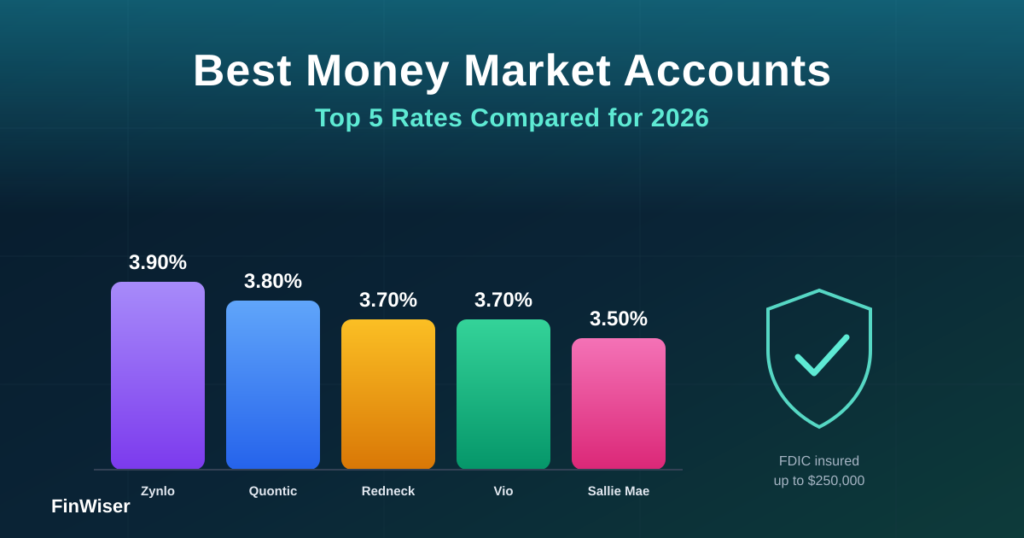
Top advertised APYs vs. the 0.45% national average money market yield, mid-August 2026.
Rate and APY Potential
Zynlo Bank currently leads this group at 3.90% APY, with no minimum balance needed to earn it. Quontic Bank follows close behind at 3.80% APY across every balance tier, from a penny to seven figures. Redneck Bank and Vio Bank both land at 3.70% APY, though Redneck’s rate only applies up to a $100,000 balance cap. Sallie Mae Bank trails the group at 3.50% APY but makes up ground elsewhere, which is really the whole point of a best money market accounts comparison: the top number rarely tells the full story.
Minimum Deposits and Fees
None of these five charges a monthly maintenance fee, which removes one of the biggest silent drags on savings — plenty of brick-and-mortar money market accounts still charge $10 to $15 a month unless you maintain a hefty balance. Where they differ is the opening deposit: Zynlo and Sallie Mae both let you start with $0, Quontic and Vio ask for $100, and Redneck Bank sets the highest bar at $500. None of that changes what you earn once the account is funded — it only affects how much cash you need on day one, which matters more for someone opening their first account than someone shifting an existing balance.
Debit Cards and Check-Writing
This is where the five accounts split into real personalities, and it’s honestly the criterion most best money market accounts roundups gloss over in favor of the APY column. Quontic and Redneck Bank both include a debit card, so you can spend directly from the account or hit an ATM without a transfer first. Sallie Mae skips the card but includes check-writing, useful for the occasional large or irregular payment like a security deposit or a contractor invoice. Zynlo and Vio Bank offer neither a card nor built-in checks — they’re built purely as places to park money and grow it, not spend from it day to day, which keeps the temptation to dip into savings a little lower.
Balance Tiers and Caps
Four of the five pay their advertised APY on every dollar in the account, with no ceiling — a detail that’s easy to miss when a best money market accounts list only shows the headline rate. Redneck Bank is the outlier: its 3.70% rate only applies up to $100,000, and anything above that drops to a much lower rate — so a $150,000 balance would actually earn less blended interest there than the same amount parked at Quontic or Vio. For most individual savers this cap is irrelevant, but it matters if you’re parking a genuinely large balance, like proceeds from a home sale or a business’s operating cash.
Safety and Insurance
All five are FDIC-insured up to $250,000 per depositor, per institution, which is the same protection you’d get from any major bank. Redneck Bank operates through All America Bank, Vio Bank through MidFirst Bank, and Zynlo through PeoplesBank — smaller or newer-sounding brand names here are often just the online division of a long-established, fully insured institution.
Customer Service and Mobile Experience
This is the criterion that rarely shows up in a best money market accounts spreadsheet but matters the moment something goes wrong. Zynlo and Vio both run as fully online divisions of small community banks, which tends to mean lean support hours and a no-frills app rather than a polished, feature-heavy one. Quontic and Redneck Bank, both built around debit-card use, generally invest more in mobile deposit and card-management features since customers are actually swiping the card day to day. Sallie Mae’s phone support runs weekday business hours only, a trade-off worth knowing if you’d rather bank somewhere with weekend or evening phone access.
MMA vs. Money Market Fund: Don’t Confuse the Two
One mix-up trips up a lot of people doing this kind of research: a bank money market account and a money market mutual fund are not the same product, even though they share a name. The accounts profiled in this article are FDIC-insured bank deposits — your principal is protected the same way a savings account’s is.
A money market fund, by contrast, is an investment product you’d buy through a brokerage like Vanguard or Fidelity. It isn’t FDIC-insured, and while it’s historically very low-risk, it’s still technically possible to lose money. If you saw “money market” mentioned inside an investment or 401(k) account, that’s almost certainly the fund version, not the bank account version covered here — a distinction worth confirming before you move any real money.
A Real Number Worth Knowing
The average money market account nationwide paid just 0.45% APY during the week of August 12, 2026, according to Bankrate’s weekly survey of more than 2,200 banks and credit unions — meaning the top accounts on this list are paying roughly eight times the national average.
That gap is the entire argument for shopping around instead of settling for whatever your primary bank happens to offer. A saver who moves $10,000 from a 0.45% account into one of the best money market accounts on this list picks up more than $300 a year in extra interest, without taking on any additional risk.
A Halal-Conscious Note on Money Market Accounts
Every account in this article pays interest (riba) by design — that’s the entire mechanism behind the APY figures compared above. For a halal-conscious reader, the useful question isn’t which of these five accounts pays the most, but whether a conventional interest-bearing account fits your approach to saving in the first place.
If interest isn’t something you’re comfortable earning, look into Shariah-compliant alternatives such as Islamic banking profit-and-loss-sharing accounts, and treat the rates above as a benchmark for what a conventional account offers, not a menu to pick from.
Where Each Account Wins
Every account on this list made the cut for the best money market accounts comparison for a different reason — here’s exactly where each one pulls ahead.
Where Zynlo Bank Wins
- Top rate on the list. 3.90% APY with no minimum deposit or balance requirement to earn it.
- Genuinely fee-free. No monthly fee, no balance tiers, no catch.
- Backed by a community bank. Zynlo runs through PeoplesBank, a Massachusetts institution chartered in 1885.
Where Quontic Bank Wins
- Debit card plus a strong rate. 3.80% APY on every tier, with a card most competitors don’t offer.
- No balance cap. The rate applies whether you’re holding $100 or $150,000.
- Fast account opening. The application typically takes just a few minutes to complete online.
Where Redneck Bank Wins
- Card plus a competitive rate. 3.70% APY on balances up to $100,000, with debit card access included.
- ATM network. Thousands of fee-free ATMs, useful if you’ll actually touch this cash in person.
- Long-standing parent bank. Redneck Bank is the online division of All America Bank, founded in 1969.
Where Vio Bank Wins
- Low barrier, strong rate. 3.70% APY with just a $100 opening deposit.
- Backed by a large, established bank. Vio is a division of MidFirst Bank, one of the largest privately owned banks in the country.
- Simple product line. Just savings, money market, and CDs — no confusing tiered checking accounts to sort through.
Where Sallie Mae Wins
- Check-writing without a minimum. Write checks directly from the account with $0 required to open.
- Simple, predictable structure. No balance tiers or fee traps to track.
- Solid brand recognition. Sallie Mae Bank is publicly traded and well known well beyond its student-lending roots.
Which One Is Right for You
Matching yourself to one of the best money market accounts on this list comes down to two questions: how much you’ll actually touch the money, and how large a balance you’re planning to keep in it.
- Want the single highest rate? Zynlo Bank currently tops this list with no strings attached.
- Want to spend directly from the account? Quontic or Redneck Bank both include a debit card.
- Need to write occasional checks? Sallie Mae is built for exactly that, with no minimum balance.
- Sitting on a larger balance? Quontic or Vio Bank apply their full rate with no cap.
There’s no universal answer among these five — just the one that matches how you’ll actually use the money.
Key Takeaways: Best Money Market Accounts of 2026
- Zynlo Bank currently leads this group at 3.90% APY with no minimum balance required.
- Quontic Bank and Redneck Bank are the only two on this list that include a debit card.
- The national average money market rate is just 0.45% APY, roughly eight times lower than the top accounts here.
- All five accounts are FDIC-insured up to $250,000 per depositor, so safety isn’t what should separate them.
- Rate alone doesn’t make an account the best fit — access, fees, and balance caps matter just as much.
Rates on every one of these accounts are variable and can move without notice, so treat the numbers above as a snapshot rather than a promise — always confirm the current APY on the bank’s own page before opening one of the best money market accounts featured here. For a live, constantly updated rate table across even more banks, Bankrate’s money market account rate guide is a solid next stop. And for more comparisons like this one, explore more banking and savings breakdowns on FinWiser.