
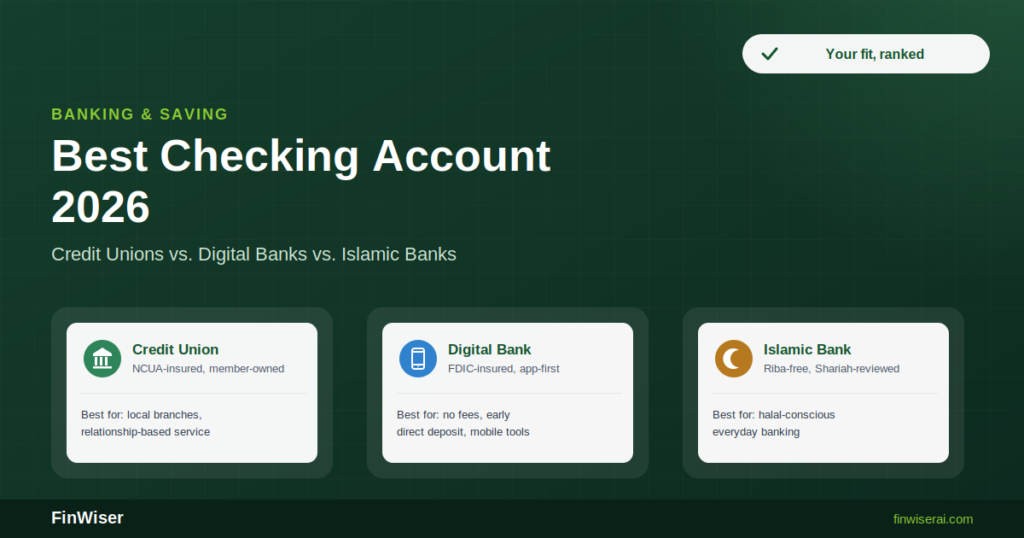
If you’ve searched for the best checking account 2026 has to offer, you’ve probably noticed the results don’t agree with each other. One list says a credit union. Another pushes a fee-free digital bank. A third barely mentions Islamic banks at all, even though they’re a real, federally insured option for anyone who wants to keep interest (riba) out of their everyday banking. There isn’t one universally “correct” answer here — the right pick depends on how you bank, not on which institution has the flashiest app.
This guide breaks down credit unions, digital banks (also called neobanks), and Islamic banks side by side, using the same criteria for each, so you can see where they actually differ and where the differences don’t matter much for your day-to-day spending account.
Pick your checking account around the one friction you personally can’t tolerate — not around the highest advertised rate. If overdrafts stress you out, weight that criterion heavily and ignore a slightly better APY elsewhere. If you need cash deposits every week, ATM access matters more than anything else on this page. The “best” account is the one whose weak points you’ll never actually notice.
Good News: You Don’t Have to Choose Just One
Most people don’t actually need a single account to do everything, and that’s part of what makes the best checking account 2026 question a little misleading — it assumes a single winner exists.
A common, low-effort setup: keep a fee-free digital bank account for everyday spending and early direct deposit, maintain a local credit union account for cash deposits and in-person service, and route your core savings through a riba-free Islamic bank account if halal compliance matters to you. None of these institutions charge you for existing — the only real cost is remembering which debit card is in which pocket.
At a Glance: Best Checking Account 2026 Options Compared
The table below lines up all three account types across the same eight criteria, so you’re comparing apples to apples instead of marketing copy to marketing copy — and so the best checking account 2026 label actually means something specific to your situation.
| Credit Union | Digital Bank | Islamic Bank | |
|---|---|---|---|
| Monthly fee | Usually $0, sometimes waived with direct deposit or e-statements | $0 at nearly every major provider | $0–$100 minimum opening deposit; low or no monthly fee |
| Deposit insurance | NCUA, $250,000 per depositor | FDIC, $250,000, via a partner bank | FDIC or NCUA, $250,000 — same coverage |
| Typical APY on checking | 0.10%–4.50%, often with conditions | 0%–4.50%, often needs direct deposit | 0% by design; some pay discretionary profit-share |
| Riba-free by design | No — standard interest-based checking | No — standard interest-based checking | Yes — no guaranteed interest paid or charged |
| ATM / branch access | Shared branching network, thousands of co-op ATMs | 40,000–95,000+ fee-free ATMs, no branches | Limited branches, often 1–2 states; remote account access |
| Overdraft handling | Varies widely — some fee-free buffers, some flat fees | Often fee-free with a set buffer (e.g. up to $200) | Typically declines the transaction rather than charging interest |
| Eligibility | Membership required (employer, area, or small donation) | Open to any U.S. resident with valid ID | Open to any U.S. resident with valid ID |
| Best for | In-person service, local relationships | No fees, fast direct deposit, mobile-first users | Halal-conscious everyday banking |
Criteria-by-Criteria Breakdown
Zooming in on each criterion separately makes it easier to spot exactly where the best checking account 2026 pick for you diverges from the pick for someone with different priorities.
Fees and Minimum Balance
All three account types have largely converged on $0 monthly fees for a basic checking account — the era of paying $12 a month just to have a checking account is mostly over outside of legacy big banks. Credit unions sometimes waive the fee only if you sign up for e-statements or a set number of debit transactions.
Digital banks like Chime and SoFi charge no monthly fee at all, on any tier. Islamic banks such as University Islamic Financial (UIF) and Stearns Bank’s Salaam Banking division may ask for a modest minimum opening deposit, sometimes around $100, but typically don’t charge ongoing fees either.
Interest and Returns
This is where the three categories genuinely diverge. Credit unions and digital banks both compete on APY (annual percentage yield) — the rate your checking balance earns — with top accounts like Connexus Credit Union’s Xtraordinary Checking reaching 4.50% and SoFi paying up to 4.50% with qualifying direct deposits.
Islamic bank checking accounts pay 0% guaranteed interest by design, because a fixed, predetermined return on a deposit is riba — interest — which is prohibited in Islamic finance. Some Islamic institutions instead pay a discretionary, non-contractual profit share (Mudarabah) that isn’t guaranteed in advance, which keeps the structure halal.
Safety and Deposit Insurance
Every option on this page protects your money the same way, just through a different federal agency. Credit unions are insured by the NCUA; banks — including digital banks’ partner banks and Islamic banks — are insured by the FDIC. Both cover up to $250,000 per depositor, per ownership category, and are backed by the U.S. government.
ATM and Branch Access
Digital banks generally win on raw ATM count, with networks like Allpoint and MoneyPass putting 40,000 to over 90,000 fee-free machines within reach nationwide. Credit unions counter with shared branching — a co-op arrangement that lets members of one credit union do business at thousands of other member credit unions’ branches.
Islamic banks are the most limited here: most are concentrated in one or two states (Michigan, California) with a small physical footprint, though remote account opening and mobile deposit make that less of a dealbreaker than it used to be.
Digital Experience and Customer Service
Digital banks were built app-first, so this is their home turf: 24/7 chat support, instant push notifications, and early direct deposit up to two days ahead of payday. Credit unions have closed much of the gap with modern mobile apps, though phone support hours are often shorter and vary branch to branch. Islamic banks tend to have the smallest support teams of the three, reflecting their smaller scale rather than any structural weakness.
Eligibility and Who Can Join
Credit unions are the only category with a membership requirement — you typically need to work for a specific employer, live in a certain area, or make a small one-time donation to a partner foundation. Digital banks and Islamic banks are both open to any U.S. resident who can pass identity verification, with no membership hoops.
The Overdraft Fee Question Nobody Asks Upfront
Every checking account comparison focuses on what you’ll earn. Fewer focus on what you might lose to a single mistimed purchase. The Consumer Financial Protection Bureau has spent years scrutinizing surprise overdraft fees — charges assessed on transactions a customer had no reasonable way to anticipate. A traditional bank might charge $35 per overdraft, multiple times a day.
Many digital banks now offer a fee-free buffer instead (Chime’s SpotMe covers up to $200 with no fee), and Islamic banks structurally avoid the issue by declining the transaction outright rather than extending interest-bearing credit to cover it. Before you compare APYs, check the overdraft policy — it’s the line item most likely to actually cost you money.
By the Numbers: How Big Is the Credit Union Safety Net?
As of 2026, roughly 4,600 credit unions in the United States carry NCUA insurance, protecting deposits for tens of millions of members under the same $250,000 coverage limit as FDIC-insured banks — a scale worth keeping in mind whenever the best checking account 2026 conversation assumes credit unions are a small, niche category.
No member has ever lost insured funds at a federally insured credit union since the NCUA was created — the same clean track record the FDIC holds for banks. That parity is worth remembering the next time an ad implies that “NCUA” is somehow a lesser guarantee than “FDIC.” It isn’t; it’s just a different name on the same shield.
A Halal-Aware Note on Checking Accounts
If you’re banking with halal compliance in mind, the checking account itself is usually the easy part of the best checking account 2026 decision — it’s the interest that needs attention, not the debit card. A conventional checking account that doesn’t advertise interest, or where you decline/donate any interest paid, functions similarly to a halal account for day-to-day spending, since riba is about interest actually accruing to you, not about which logo is on your card.
That said, a dedicated Islamic bank — such as University Islamic Financial, Stearns Bank’s Salaam Banking division, or American Finance House Lariba — goes further. It structures the account around Wadiah (safekeeping, zero guaranteed return) or Mudarabah (profit-sharing) instead of interest from the start, with oversight from a published Shariah supervisory board. For a core spending account, either approach is defensible; for savings you intend to hold and grow, the dedicated Islamic bank is the more thorough choice.
Pros and Cons, Side by Side
Where Credit Unions Win
- Local, relationship-based service. A real person who knows your name still counts for something when something goes wrong with your account.
- Competitive APY on checking. Several credit unions pay more interest on checking than most banks pay on savings.
- Shared branching. Thousands of co-op branches nationwide soften the “small institution” downside.
- Not-for-profit structure. Profits get returned to members as lower fees and better rates rather than paid out to shareholders.
Where Digital Banks Win
- Zero fees, zero friction. No monthly fee, often no minimum balance, and account opening takes minutes.
- Early direct deposit. Getting paid up to two days early is a genuine, repeatable benefit, not a gimmick.
- Best-in-class apps. Budgeting tools, instant notifications, and 24/7 chat support built for a phone-first life.
- Huge ATM networks. No branches, but tens of thousands of fee-free machines make that mostly moot.
Where Islamic Banks Win
- Genuine riba-free structure. No guaranteed interest paid or charged, reviewed by a Shariah supervisory board.
- Same federal insurance. FDIC or NCUA coverage up to $250,000 — full compliance doesn’t mean giving up federal protection.
- Ethical screening. Deposits are steered away from alcohol, gambling, and other haram industries.
- A dedicated Shariah board. Ongoing religious oversight, not a one-time compliance stamp.
Which Is the Best Checking Account 2026 Pick for You?
If you want a person to call and don’t mind a small membership step, a credit union is the comfortable choice. If your priority is paying nothing, getting paid early, and never touching a branch, a digital bank wins easily. If riba-free structure and Shariah oversight are non-negotiable for you, a dedicated Islamic bank is worth the smaller branch footprint. And if you’ve been flagged by ChexSystems in the past, several digital banks and credit unions specifically market second-chance accounts that skip the traditional credit check.
Key Takeaways
- All three account types — credit unions, digital banks, and Islamic banks — now typically charge $0 in monthly fees, so fees alone shouldn’t decide the best checking account 2026 comparison for you.
- Deposit insurance is functionally identical across all three: $250,000 per depositor, backed by the U.S. government, whether the shield says NCUA or FDIC.
- Digital banks currently lead on APY and ATM access; credit unions lead on in-person service; Islamic banks lead on genuine riba-free structure.
- Overdraft policy varies more than interest rate does — check it before you open any account, not after your first mistimed purchase.
- You don’t need to pick just one. Layering a digital bank for spending with a credit union or Islamic bank for savings is a common, low-effort setup.
For a broader, continuously updated ranking that goes beyond these three categories, NerdWallet’s Best Checking Accounts roundup surveys around 100 institutions each month and is worth a look before you settle on the best checking account 2026 has to offer for your specific situation.
More from FinWiser on Banking & Saving: