
Credit & Debt > Learn > Debt Settlement vs Bankruptcy vs Doing Nothing: What Happens to Your Credit in Each Scenario (2026)
Credit & Debt · Learn
Negotiating, filing or simply waiting: here is what each path does to your credit report and score, and for how long.
Where I sit: my day job is in accounts receivable, on the collecting side of the table (commercial invoices, not consumer debt). That shapes how I read creditor behaviour in this piece.
If your debts have outrun your income, you have three real paths: negotiate to pay less (debt settlement), ask a court for relief (bankruptcy), or stop paying and wait. Most debt settlement vs bankruptcy comparisons skip that third path, even though it is the one many people land on by default. All three damage your credit. They do it at different speeds, for different lengths of time, and with very different endings.
This guide follows what happens to your credit report and score in each scenario, under U.S. rules as of 2026. There is no universally correct option. The right one depends on what you owe, earn and own, and how much uncertainty you can live with.
Our Wisers Say
Judge each path by where your credit lands in three years, not by the size of the first drop. People fixate on the word “bankruptcy” and overlook that a finished case stops the bleeding within months, while a stalled settlement plan or an ignored debt can keep adding fresh negative marks for years. The worst outcome is usually the unplanned one.
Good News: You Don’t Have to Choose Today
None of these doors locks behind you straight away. You can try settling one account yourself and still file for bankruptcy later if that fails.
There is a fourth door worth knocking on first: nonprofit credit counseling. A counselor can set up a debt management plan, which repays the full balance over three to five years at reduced interest and avoids the lasting credit damage of the other paths. If you can afford that payment, you may not need the three options below.
At a Glance: Debt Settlement vs Bankruptcy vs Doing Nothing
| Criterion | Debt Settlement | Bankruptcy | Do Nothing |
|---|---|---|---|
| Immediate score hit | Large. Missed payments come first, then a “settled” mark. | The largest single drop. | Large and repeating, as each missed month is reported. |
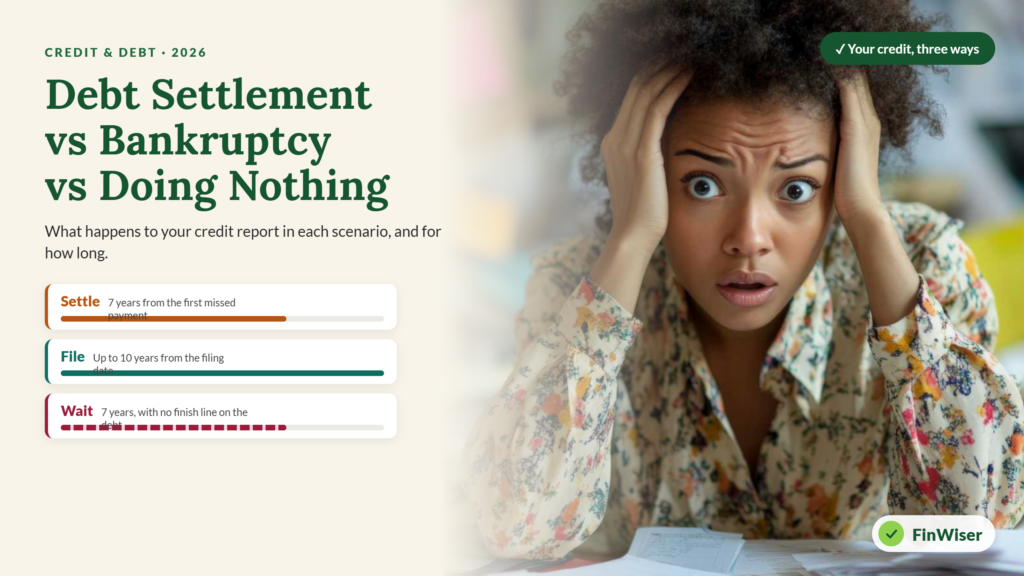
| Time on credit report | 7 years from the first missed payment. | Up to 10 years (Chapter 7); 7 years (Chapter 13). | 7 years from the first missed payment. |
| Is the debt erased? | Only the accounts that settle. | Yes, for most unsecured debt. | No. It can be sold, collected or sued on. |
| Typical cost | 15%–25% of enrolled debt via a company; possible tax on forgiven amounts. | $338 court fee for Chapter 7, plus attorney fees if you hire one. | Nothing upfront. Late fees and interest pile up. |
| Lawsuit protection | None. | Yes. Collection pauses once you file. | None. |
| Time to finish | 2–4 years. | Months (Chapter 7); 3–5 years (Chapter 13). | Open-ended. |
| Interest (riba) meanwhile | Keeps accruing until each account settles. | Ends on discharged debts. | Keeps accruing. |
Debt Settlement vs Bankruptcy vs Doing Nothing, Criterion by Criterion
The Immediate Hit to Your Score
FICO, the most widely used credit score, has published scenario ranges that show the pattern. A bankruptcy filing cost a 680 score roughly 130 to 150 points and a 780 score 220 to 240. A settlement cost 45 to 65 points at 680 and 105 to 125 at 780.
Those settlement figures understate real life, because a settlement program usually tells you to stop paying first. Each missed payment is its own hit: 60 to 80 points for the first 30-day late mark at 680. Doing nothing produces the same string of late marks, with no resolution at the end.
Higher scores fall further. If your credit is already bruised by missed payments, the extra damage is smaller than these numbers suggest.
How Long It Stays on Your Credit Report
Under federal credit reporting law, most negative items can be reported for seven years. For a settled or unpaid account, that clock starts at the first missed payment that led to the default, not on the day you settle. Settling late does not restart it.
Bankruptcy runs on its own clock, counted from the filing date. A Chapter 7 case (liquidation) can be reported for up to 10 years. The credit bureaus generally remove a completed Chapter 13 case (a repayment plan) after seven.
On the calendar alone, the debt settlement vs bankruptcy gap is three years at most. Settling and ignoring a debt leave marks for the same length of time, but “settled” reads better to a future lender than a collection account that was never resolved.
Whether the Debt Actually Goes Away
Bankruptcy is the only path with a legal finish line. A Chapter 7 discharge wipes out most unsecured debt, such as credit cards, medical bills and personal loans, typically within a few months. Chapter 13 instead puts you on a court-supervised repayment plan lasting three to five years.
Settlement clears only the accounts where a creditor agrees to a deal. The CFPB warns that settlement companies often cannot settle every debt, and some creditors refuse to deal with them.
Doing nothing erases nothing. The balance grows, and the account is usually charged off (written off as a loss by the lender, typically after about 180 days) and passed to a collector. You still owe it.
What Each Path Costs You
Settlement companies typically charge 15% to 25% of the debt you enroll, and they are not allowed to collect that fee until a debt is actually settled. On $20,000 of enrolled debt, that is $3,000 to $5,000 on top of what you pay creditors. The IRS may also treat forgiven debt as taxable income.
Chapter 7 carries a $338 court filing fee, which low-income filers can ask to have waived, plus attorney fees if you hire one. Price both sides of the debt settlement vs bankruptcy choice before you sign anything. Waiting costs nothing on day one; its price arrives later, as penalty interest and late fees.
Protection From Lawsuits and Wage Garnishment
Filing for bankruptcy triggers an automatic stay, a court order that pauses most collection activity. That includes lawsuits and wage garnishment (money taken straight from your paycheck). Neither other path offers this.
During a settlement program you are deliberately behind on payments, and creditors may sue while you are still saving up. If you are doing nothing and get sued, never ignore the summons. A court can award a judgment against you simply because you did not show up.
How Soon You Can Start Rebuilding
Rebuilding starts when the negative marks stop arriving. With Chapter 7 that can be a few months after filing. With settlement it is whenever the last account settles, often two to four years in.
With no plan, there is no such date, and a debt that changes hands can show up as a new collection account. That is why the debt settlement vs bankruptcy question is really about timing. A planned filing sometimes leaves a healthier score three years on than an unfinished settlement would.
Two Clocks People Confuse: Credit Reporting and the Statute of Limitations
The seven-year credit reporting period is one clock. The statute of limitations is a separate one: a time limit on how long a creditor can use the courts to collect. It varies by state and by type of debt, and some debts, such as federal student loans, have none.
Once that limit passes, the debt is “time-barred.” In most states collectors can still ask you to pay, but they cannot sue or threaten to. Your credit report is unaffected.
Here is the trap for anyone waiting things out. In some states, a partial payment, or even acknowledging an old debt, can restart the limitation period.
By the Numbers: Bankruptcy Filings Are Climbing Again
Personal bankruptcy filings in the U.S. rose 12% to 581,570 in the 12 months ending June 30, 2026, according to the Administrative Office of the U.S. Courts. Across all filers, about 382,000 cases were Chapter 7 and roughly 215,000 were Chapter 13.
Context matters, though. Total filings remain far below the peak of nearly 1.6 million in 2010. Still, hundreds of thousands of ordinary households file every year, so the debt settlement vs bankruptcy decision deserves a clear-eyed look rather than shame.
Interest, Riba and the Halal-Conscious Reader
Everything discussed here is conventional, interest-bearing debt, which means it involves riba (interest, which Islamic finance prohibits). A reader trying to avoid riba usually has two aims: stop the interest from growing, and still honour the principal they borrowed.
Seen that way, the three paths rank differently. Waiting is the weakest, because interest and penalty charges keep compounding. Settlement and bankruptcy both end the accrual, though each typically leaves part of the principal unpaid.
Many scholars treat repaying what you actually borrowed as a personal obligation, even where the law has released you. Some readers therefore choose to repay principal voluntarily later, once they are able. That is a question for a scholar you trust; this guide covers only your credit and your legal position.
Debt Settlement vs Bankruptcy vs Doing Nothing: Where Each Wins
Where Debt Settlement Wins
- No court involved. There is no public bankruptcy record and no trustee reviewing your finances.
- You keep more control. You choose which accounts to negotiate, and can do it yourself for free.
- A shorter shadow than Chapter 7. Settled accounts drop off your report three years sooner.
- The catch. Nothing obliges a creditor to say yes, and you are exposed to collectors the whole time.
Where Bankruptcy Wins
- Certainty. A discharge is a court order, and creditors must stop.
- Speed. A Chapter 7 case is usually over in months.
- Everything at once. Creditors are dealt with together, not one negotiation at a time.
- The catch. It is public, it is the heaviest single mark on a report, and Chapter 7 has an income test not everyone passes.
Where Doing Nothing Wins
- There is little a creditor could take. If your income is legally protected (Social Security, for example) and you own very little, a judgment may be hard to enforce.
- The debt is already old. Near the end of the seven-year reporting period, settling adds little for your credit.
- The catch. It is the only path with no finish line, and it turns risky the moment you are served with a lawsuit.
5 Providers and Nonprofits to Know
These are widely used names, not endorsements. Whichever side of debt settlement vs bankruptcy you lean toward, start with the nonprofits, whose advice costs little or nothing.
- NFCC. The National Foundation for Credit Counseling, a nonprofit network of certified counseling agencies.
- Money Management International. A large nonprofit agency offering credit counseling and debt management plans.
- Upsolve. A nonprofit whose free tool helps eligible low-income filers complete Chapter 7 without a lawyer.
- National Debt Relief. A for-profit settlement company founded in 2009 (Bankrate’s review).
- Freedom Debt Relief. A for-profit settlement company founded in 2002 (NerdWallet’s review).
Which One Is Right for You?
- You could keep up if interest dropped. Start with nonprofit credit counseling and ask about a debt management plan.
- You owe far more than you could repay in five years. This is where debt settlement vs bankruptcy usually tips toward filing. Ask a bankruptcy attorney about Chapter 7; some offer a free first consultation.
- You have steady income and a home or car to protect. Ask about Chapter 13, which lets you catch up on missed payments over time.
- You have a lump sum and one or two delinquent accounts. Try settling directly with the creditor before paying a company to do it.
- You have no income or assets a creditor can reach. Waiting may be rational, but confirm that with free legal aid first.
Key Takeaways
- All three paths hurt your credit. They differ in how long the damage keeps arriving.
- Settled and unpaid accounts stay for seven years from the first missed payment. Chapter 7 stays for up to ten from filing.
- Only bankruptcy legally erases debt and pauses lawsuits.
- Doing nothing is a choice too, and the only one with no end date.
- On debt settlement vs bankruptcy, compare where each leaves you in three years, and speak to a nonprofit counselor before you pay anyone.
Keep Reading
For a second view on settlement and its alternatives, see NerdWallet’s guide, Debt Settlement: How Paying Less Than You Owe Actually Works. This article is general education, not legal advice; state laws differ.
More from FinWiser on Credit & Debt