
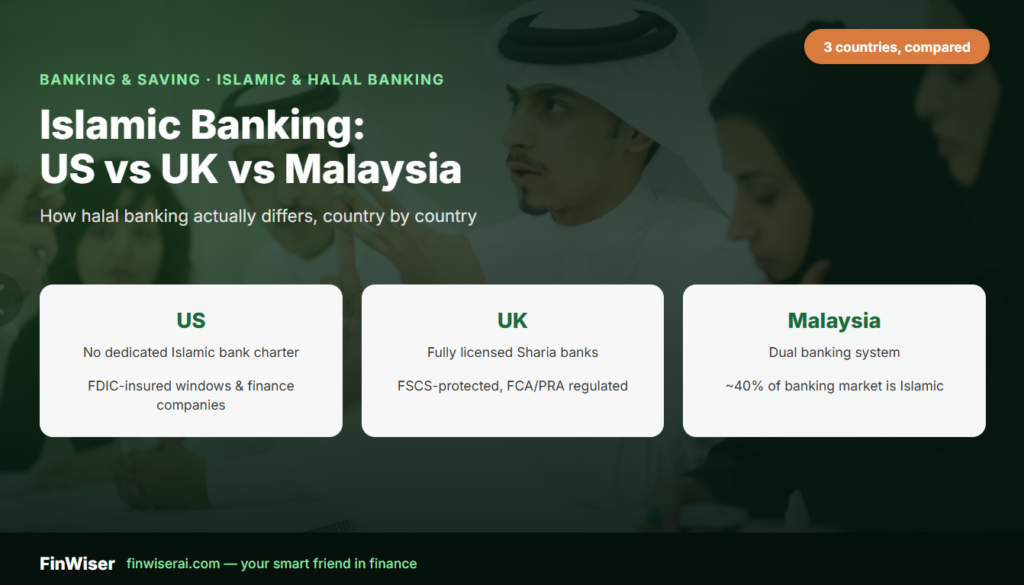
Ask someone in Kuala Lumpur, London, and Chicago what “Islamic banking” means, and you’ll get three genuinely different answers. In Malaysia, it means a fully licensed bank sitting right next to a conventional one, regulated under the same central bank. In the UK, it means a small number of dedicated Sharia-compliant banks with the same deposit protection as any high-street name. In the US, it usually means a finance company or a “banking program” bolted onto a conventional, FDIC-insured bank — not a separately chartered Islamic bank at all.
None of that makes one country’s version more “real” than another’s. It just means the shape of the system — how it’s regulated, what it’s called, and how protected your money is — depends almost entirely on where you happen to be banking. This guide walks through how it actually works in the US, the UK, and Malaysia, and where each one comes up short or ahead for a halal-conscious saver.
Our Wisers Say
If you want religious and regulatory certainty in one package, Malaysia’s dual banking system is the cleanest version of Islamic banking on Earth — full-fledged Islamic banks, a national Shariah Advisory Council, and roughly 40% of the whole banking market built around it. If you’re in the UK, you get a smaller but genuinely dedicated option in banks like Al Rayan. If you’re in the US, don’t expect one bank to do it all — expect to combine a halal-ish deposit account with a separate halal financing provider.
Good news: you don’t have to pick just one system. A lot of people reading this aren’t choosing a single country’s system for life — they’re American Muslims with family savings in Malaysia, UK residents with a mortgage-free relative back home, or expats who’ll bank under two or three of these systems over a decade. Understanding how each one is built means you can move between them without assuming your home country’s rules travel with you.
At a Glance: Islamic Banking in the US, UK, and Malaysia
Before the country-by-country breakdown, here’s how the three stack up side by side on the criteria that actually change your experience as a customer.
| United States | United Kingdom | Malaysia | |
|---|---|---|---|
| Regulatory model | No dedicated Islamic bank charter; oversight comes from standard federal/state bank regulators | Fully licensed Islamic banks regulated like any other bank, under the FCA and PRA | Dual banking system under the Islamic Financial Services Act 2013, supervised by Bank Negara Malaysia |
| Type of institution | Conventional banks running an Islamic “window,” plus non-bank finance companies | Standalone, wholly Sharia-compliant retail banks | Dedicated Islamic banks and Islamic subsidiaries of major banking groups |
| Deposit protection | FDIC insurance up to $250,000, where the underlying institution is FDIC-insured | FSCS protection up to £120,000 per person, per authorised firm | PIDM (Malaysia Deposit Insurance Corporation) covers Islamic deposits separately from conventional ones |
| Home financing | Available through specialist providers (murabaha/ijara structures), separate from deposit accounts | Available directly through the same Islamic bank via ijara or diminishing musharakah | Widely available through Islamic banks alongside standard savings and current accounts |
| Approx. share of banking market | Well under 1% of total US banking assets | Roughly 1–2% of total UK banking assets | Close to 40% of domestic financing and deposits |
| Open to non-Muslim customers | Yes, though marketing rarely targets them | Yes — Al Rayan reports a large share of savers are non-Muslim, drawn by competitive rates | Yes, by law; Islamic accounts are marketed to the general public |
| Common contract structures | Murabaha (cost-plus sale), ijara (lease), musharakah (partnership) | Ijara, diminishing musharakah, wakala (agency) deposits | Mudarabah (profit-sharing), tawarruq, murabaha, wakala |
| Sovereign/wholesale market | No sovereign sukuk issuance | First Western country to issue sovereign sukuk (2014, expanded 2021) | World’s largest and most established sukuk market |
Approximate share of each country’s total domestic banking assets/financing held by Islamic banks. Malaysia figure reflects Bank Negara Malaysia’s reported Islamic financing and deposit market share; US and UK figures are directional estimates based on relative market size.
How Islamic Banking Is Regulated in Each Country
United States: No Charter, Just Workarounds
There’s no such thing as a federally chartered “Islamic bank” in the US. Instead, Islamic banking here happens in two separate lanes. The first is a Sharia-compliant “banking program” run inside an otherwise conventional, FDIC-insured bank — Stearns Bank’s Salaam Banking division is the clearest current example, offering riba-free checking and profit-sharing deposits inside a nationally chartered bank. The second lane is standalone finance companies, like University Islamic Financial (UIF), that handle home and vehicle financing through murabaha and ijara contracts but aren’t themselves a bank.
That split exists because US banking law doesn’t recognize “Islamic bank” as a separate charter type — every institution still has to fit into an existing conventional regulatory box, Islamic contract structures included.
United Kingdom: A Genuine Islamic Bank Charter
The UK went a different direction. Al Rayan Bank (formerly Islamic Bank of Britain) has operated as a standalone, fully licensed retail bank since 2004, regulated by the same FCA and PRA framework as any conventional bank, with the same FSCS deposit protection. Gatehouse Bank offers a similar model. The UK government has also actively courted this market — it became the first Western country to issue a sovereign sukuk in 2014, and issued a second, larger one in 2021, positioning London as a genuine hub for Islamic finance rather than a niche add-on.
Malaysia: A Fully Parallel System
Malaysia regulates Islamic banks under its own dedicated law — the Islamic Financial Services Act 2013 — administered by Bank Negara Malaysia, the central bank. Islamic banks like Bank Islam Malaysia sit alongside conventional banks (and Islamic subsidiaries of groups like Maybank and CIMB) under one supervisory roof, with a national Shariah Advisory Council setting standards that apply across the whole industry. Islamic financing and deposits now make up close to 40% of Malaysia’s domestic banking market — a scale no Western country comes close to.
What Actually Makes a Bank “Islamic”?
Since “Islamic banking” doesn’t mean one fixed thing across countries, it’s worth being clear on what actually earns the label. At minimum, three things have to be true: no riba (interest), no financing of businesses considered impermissible (alcohol, gambling, conventional insurance), and an independent Shariah board reviewing every product before it launches. Returns get generated instead through profit-sharing (mudarabah), cost-plus sales (murabaha), or leasing (ijara) — structures where the bank is taking on real commercial risk rather than just lending money and collecting a guaranteed markup.
In wholesale and capital markets, the equivalent of a bond is a sukuk — a certificate representing part-ownership of a real asset, rather than a debt obligation. Malaysia runs the world’s largest sukuk market by a wide margin; the UK has issued sovereign sukuk twice; the US has none.
Just How Big Is the Industry Right Now?
Globally, Islamic finance assets reached roughly $5.98 trillion in 2024, according to the 2025 Islamic Finance Development Report from the London Stock Exchange Group and the Islamic Corporation for the Development of the Private Sector — and Islamic banking makes up the largest single slice of that, at somewhere around 70% of total industry assets. Malaysia, Saudi Arabia, and Iran together account for roughly 72% of that global total, with Malaysia alone holding an estimated $761 billion in Islamic finance assets. The US and UK, by contrast, are rounding errors in the same dataset — which is exactly why the experience of banking under each system feels so different depending on which of the three countries you’re in.
A Halal-Aware Note
Even within Islamic banking, the level of scholarly comfort varies. Malaysia’s Shariah Advisory Council permits tawarruq (a commodity-based financing structure) widely, though some scholars outside Malaysia consider it a closer cousin to conventional lending than other structures like ijara or musharakah. In the US, because there’s no dedicated Islamic bank, a religiously cautious saver often ends up stacking two providers — a riba-free deposit account from somewhere like Stearns Salaam Banking, plus separate halal home financing from a provider like UIF — rather than getting both from one institution the way UK and Malaysian customers can.
Where Each Country Wins
Where the US Wins
- FDIC-backed deposit safety. Salaam Banking-style products sit inside a federally insured bank, so your deposit protection is identical to any conventional US account.
- No religious-market segregation. Providers explicitly serve customers of any faith looking for interest-free banking, not just Muslims.
- Growing, if thin, options. UIF, Stearns Salaam Banking, and Devon Bank give US Muslims more choice today than five years ago, even without a dedicated charter.
Where the UK Wins
- One-stop banking. Al Rayan and Gatehouse offer deposits, current accounts, and home financing under a single Sharia-compliant institution.
- Full regulatory parity. FCA/PRA oversight and FSCS protection up to £120,000 apply exactly as they would at any conventional UK bank.
- Government-backed credibility. Two sovereign sukuk issuances signal this isn’t a fringe product in UK financial policy.
Where Malaysia Wins
- Scale and maturity. Islamic banking is close to 40% of the domestic market, not a niche corner of it.
- Consistent national standards. A single Shariah Advisory Council under Bank Negara Malaysia sets rules that apply system-wide, reducing product-by-product ambiguity.
- Depth of product range. From everyday savings to sukuk investing, Malaysian Islamic banks cover nearly everything a conventional bank does.
Which One Is Right for You
You live in the US and want maximum deposit safety: An FDIC-insured Islamic banking program, like Stearns Salaam Banking, keeps your deposit protection identical to a conventional account.
You live in the UK and want one bank for everything: A dedicated Islamic bank like Al Rayan gives you deposits and home financing together, with full FSCS protection.
You want the deepest, most established system available: Malaysia’s Islamic finance sector offers the broadest product range and the longest regulatory track record of the three.
You split your life across borders: Learn each system on its own terms rather than assuming one country’s protections or contract structures carry over to another.
Key Takeaways
- Islamic banking isn’t one global product — it’s regulated, structured, and sized completely differently in the US, UK, and Malaysia.
- The US has no dedicated Islamic bank charter; expect to combine an FDIC-insured deposit program with a separate halal financing provider.
- The UK offers fully licensed, standalone Islamic banks with the same FSCS protection (now £120,000) as conventional banks.
- Malaysia runs the world’s most mature dual banking system, with Islamic banks making up nearly 40% of its domestic market.
- All three avoid riba, but the contract structures, deposit protection, and product depth on offer genuinely change depending on where you bank.
For a deeper technical explainer on how Islamic banking works and where it came from, Investopedia’s overview of the topic is a solid starting point.
More from FinWiser on Banking & Saving: