
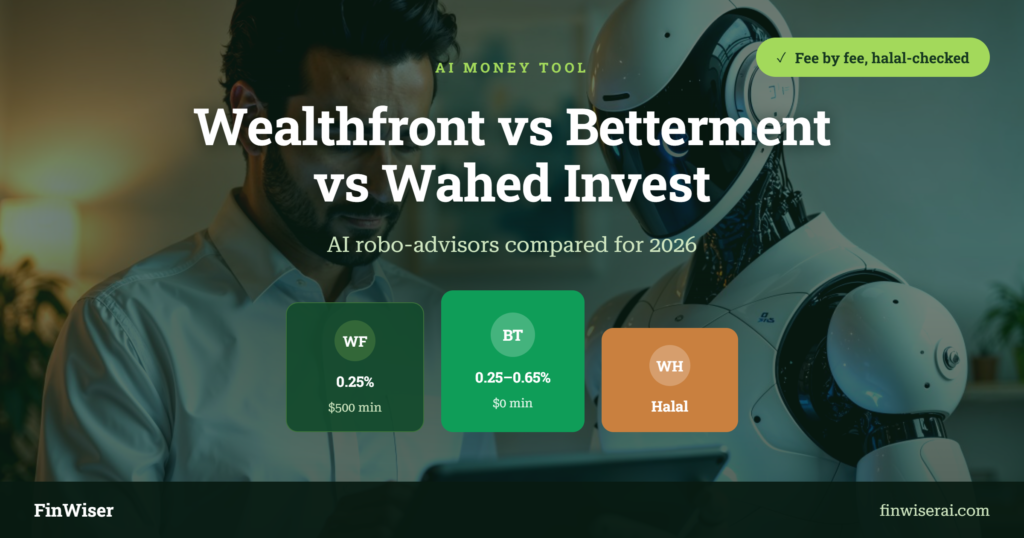
If you’ve narrowed a robo-advisor search down to Wealthfront, Betterment, or Wahed Invest, you’re really choosing between three philosophies dressed up as apps. Wealthfront optimizes hard for taxes, Betterment optimizes for goals and hands you a human if you want one, and Wahed Invest optimizes for something the other two don’t touch: making sure nothing in your portfolio earns or pays interest. This comparison of three of the most-searched AI robo-advisors walks through what each one charges, invests in, and is — and isn’t — built for.
There’s no single “correct” pick among these AI robo-advisors. The right one depends on your balance, whether Shariah compliance is a requirement rather than a nice-to-have, and how much you want a licensed human on the other end of a phone call.
Video: “Wealthfront vs Betterment: Which Robo-Advisor Wins in 2026?” by Dr. Abhishek Gadre, The Money Matters MD Show.
Good news: you don’t have to lock yourself into just one of these AI robo-advisors forever. Plenty of investors run a taxable account at Wealthfront or Betterment for the tax efficiency, and keep retirement or halal-designated savings at Wahed Invest — splitting money by purpose rather than betting everything on a single platform.
At a Glance: AI Robo-Advisors Compared
Here’s a fast side-by-side of all three AI robo-advisors on the eight things that matter most before you fund an account.
| Criteria | Wealthfront | Betterment | Wahed Invest |
|---|---|---|---|
| Best for | Hands-off investors with $500+ who care about taxes | Beginners who want a $0 minimum and optional human help | Muslim investors and anyone who wants a halal-by-default portfolio |
| Account minimum | $500 (automated investing); $1 for stock investing | $0 (Digital); $100,000 (Premium) | $100 |
| Annual fee | 0.25% flat, every balance | 0.25% (Digital) / 0.65% (Premium) | 0.49% all-in wrap fee |
| What it invests in | Diversified stock/bond ETFs; stock-level direct indexing at $100K+ | Diversified stock/bond ETFs; SRI and crypto portfolio options | Wahed’s own Shariah-screened equity ETFs, sukuk, and gold |
| Tax-loss harvesting | Yes — daily, every balance | Yes — daily, taxable accounts | Not offered |
| Human advisor | None, at any tier | Yes — Premium tier ($100K+) | None on individual accounts |
| Halal-compliant | No — holds conventional bonds and interest-bearing cash | No — holds conventional bonds and interest-bearing cash | Yes — built halal by construction |
| Regulator / protection | SEC-registered RIA; SIPC-protected | SEC-registered RIA; SIPC-protected | SEC-registered RIA; assets at Apex Clearing, SIPC-protected to $500,000 |
Fees and Minimums for These AI Robo-Advisors
On a pure percentage basis, Wealthfront and Betterment’s entry-level Digital plan both land at 0.25% a year — roughly a quarter of what a traditional human advisor typically charges. Betterment’s Premium tier jumps to 0.65% once your balance clears $100,000, mainly to pay for unlimited access to a Certified Financial Planner.
Wahed Invest charges a flat 0.49% wrap fee that already bundles in management, custody, and trading — there’s no separate line item for the underlying fund’s expense ratio the way there is with Wealthfront and Betterment’s ETF-based portfolios. On a $50,000 balance, that’s roughly $170 a year at Wealthfront or Betterment Digital, versus about $245 at Wahed — the price of an all-in, halal-screened wrap. Wahed’s $100 minimum is also the lowest of the three, well below Wealthfront’s $500, and Betterment’s Digital plan has no minimum at all.
Tax Tools: Who Actually Helps You Keep More
Both Wealthfront and Betterment run daily automated tax-loss harvesting across taxable accounts at no extra cost — selling a position that’s dipped below its purchase price and buying something similar, so you can bank the loss against future capital gains without changing your actual market exposure. Wealthfront goes a step further above $100,000 with stock-level direct indexing, which harvests losses on individual stocks inside an index rather than only at the fund level.
Wahed Invest doesn’t offer tax-loss harvesting at all. That matters less inside a tax-advantaged IRA, where gains and losses aren’t taxed year to year anyway, but it’s worth knowing if you’re planning to open a taxable account with any of these AI robo-advisors.
Human Help, When You Want It
Wealthfront is fully automated at every tier — there’s a support team for account issues, but no phone line for investment advice. Betterment is the only one of the three that puts a licensed human on the other end, and only once you hold $100,000 in its Premium plan. Wahed Invest sits in between: there’s no personal advisor for your account, but a Shariah Supervisory Board of Islamic scholars reviews and signs off on the entire fund lineup — a different, portfolio-wide kind of oversight rather than one-on-one advice.
Halal Compliance: Built In or Bolted On
This is where the three platforms actually diverge, not just compete on price. Wealthfront and Betterment both build portfolios that include conventional bond ETFs and sweep uninvested cash into interest-bearing accounts — both of which involve riba, or interest, which is not permissible under Islamic finance. Neither platform offers a Shariah-screened portfolio option at all, for any account size.
Wahed Invest was built the opposite way. Every one of its six risk tiers — from Very Conservative to Very Aggressive — holds only Shariah-screened equity ETFs, sukuk (Islamic bonds structured around asset performance instead of interest), and gold, and never conventional bonds or an interest-bearing cash sweep. Wahed publishes its quarterly purification amounts (the small sliver of incidental income a Shariah board flags for donation) directly on its fund pages, which is the kind of transparency conventional robo-advisors simply don’t need to offer.
How Robo-Advisors Actually Invest Your Money
All three platforms are fiduciary, SEC-registered investment advisers, legally obligated to act in your best interest rather than just recommend something “suitable.” What differs is the engine underneath. Wealthfront and Betterment build portfolios out of low-cost, diversified ETFs — baskets of stocks and bonds bundled into a single fund — and rebalance automatically as markets drift from your target allocation.
Wahed Invest builds portfolios the same mechanical way — pick a risk tier, get an automated allocation, get rebalanced over time — but swaps in Shariah-screened building blocks instead of a conventional stock-and-bond mix. None of the three let you hand-pick individual securities inside your managed account; that trade-off, automation over control, is the whole premise of a robo-advisor, halal or not.
AI Robo-Advisors by the Numbers
Robo-advisors have gone from a niche experiment to a genuine asset class. As of fiscal year 2026, Wealthfront alone reported $94.1 billion in total platform assets and 1.42 million funded clients, up 17% year over year — and that’s a single platform among dozens now competing in the category. The growth of AI robo-advisors as a whole is exactly why halal-aware investors now have a real automated option in Wahed Invest, instead of having to build a Shariah-compliant portfolio by hand, fund by fund.
Where Each of These AI Robo-Advisors Wins
Where Wealthfront Wins
- Tax-loss harvesting on every balance. Daily and automatic, with direct indexing at $100,000 for even finer-grained harvesting.
- The strongest cash account of the three. FDIC coverage up to $8 million through partner banks, well above the standard $250,000.
- Deeper planning tools. The Path tool models scenarios like buying a home or taking a sabbatical.
- A flat rate at every balance. 0.25%, with no premium tier to trigger a higher fee.
Where Betterment Wins
- No minimum to start. Open a Digital account with nothing and add money as you go.
- A human is actually reachable. Premium unlocks unlimited CFP access, which Wealthfront doesn’t offer at any balance.
- More portfolio variety. Socially responsible and crypto options sit alongside the core ETF mix.
- Goal-based structure. The interface is built around named goals — retirement, a house, an emergency fund.
Where Wahed Invest Wins
- The only one that’s halal by default. No screening required — every portfolio is Shariah-compliant from day one.
- The lowest minimum of the three. $100 gets you started, a fifth of Wealthfront’s $500.
- Shariah Supervisory Board oversight. Portfolio construction is reviewed by Islamic scholars, not just a compliance team.
- Expanding beyond stocks. A fractional halal real estate option and a fee-free halal savings account sit alongside the managed portfolios.
Which One Is Right for You
Halal compliance is a requirement, not a preference: Wahed Invest is the only real answer here — the other two don’t offer a Shariah-screened portfolio at any tier.
Starting with less than $500, adding money as you go: Betterment’s $0 minimum is the easiest on-ramp.
$100,000+ in a taxable account, focused on minimizing tax: Wealthfront’s direct indexing is built for exactly this.
Want a licensed human to talk to eventually: Betterment Premium is the only one that offers it.
Key Takeaways
- Wealthfront and Betterment both charge 0.25% at their base tier, but only Wealthfront keeps that flat rate at every balance — Betterment’s Premium plan rises to 0.65% at $100,000.
- Wahed Invest’s 0.49% wrap fee already covers management, custody, and trading, with the lowest minimum of the three at $100.
- Only Wahed Invest is halal by construction; Wealthfront and Betterment both hold conventional bonds and interest-bearing cash.
- Wealthfront’s tax-loss harvesting and direct indexing are the deepest tax tools among these AI robo-advisors, especially above $100,000.
- Betterment is the only platform of the three offering access to a human Certified Financial Planner, through its Premium tier.
The Bottom Line
All three are legitimate, SEC-registered ways to put investing on autopilot — what matters is what’s inside the portfolio and who’s watching it. For a broader, ongoing look at how Wealthfront and Betterment compare outside the halal lens, NerdWallet’s side-by-side comparison is worth a bookmark.
More from FinWiser on AI Money Tool: