
Bias disclosure: FinWiser has no lender, servicer, or advertiser relationship tied to PSLF or federal loan forgiveness — nothing in this guide earns us a commission.
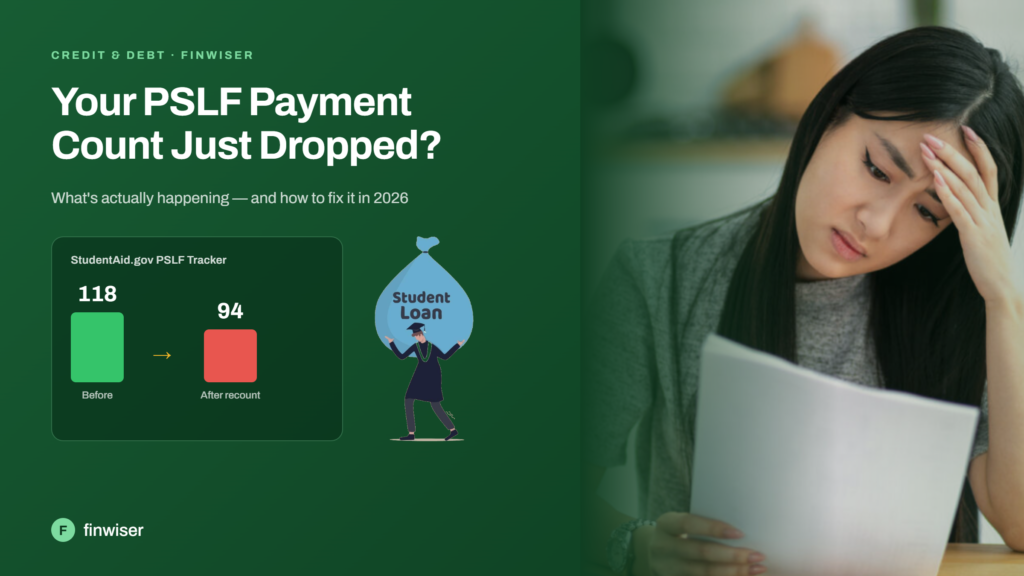
If your PSLF payment count just dropped, you’re not imagining it and you’re not alone. Over the past few weeks, borrowers working toward Public Service Loan Forgiveness (PSLF) have logged into StudentAid.gov and watched their qualifying payment total fall — sometimes by 10 payments, sometimes by more than 20 — with little explanation beyond a vague on-screen notice. This isn’t about one single “correct” number the government is hiding from you. It’s a messy, still-unfolding correction that’s affecting different borrowers for different reasons.
This guide walks through what’s actually causing the drop, which situations are temporary versus genuinely worth fighting, and exactly what to do next — whether you’re 20 payments in or sitting one payment away from forgiveness.
Our Wisers Say
Our take: don’t panic, but don’t ignore it either. A dropped PSLF payment count is usually a paperwork or system issue, not proof that years of payments vanished. Screenshot your tracker today, keep every document your servicer sends you, and give the Education Department’s own review process a few weeks before escalating. Most borrowers get their count corrected — the ones who struggle are usually the ones who didn’t document anything along the way.
Good News: A Dip in Your PSLF Payment Count Isn’t Always Permanent
Here’s the part that gets lost in the panic: a lower number on your tracker doesn’t automatically mean you lost real progress. In many cases, the underlying qualifying months you actually worked and paid are still there — they’re just miscounted, mid-recalculation, or temporarily hidden behind a “weighted average” process that hasn’t finished posting yet. A genuine, permanent loss of PSLF credit is the less common outcome, not the default one.
At a Glance: Why Your PSLF Payment Count Dropped
Before going deeper, here’s a fast comparison of the three most common reasons this happens right now, and what each one actually means for you.
| System / Coding Error | Consolidation Weighted-Average Reset | Employment Certification Reprocessing | |
|---|---|---|---|
| What triggers it | The Education Department reprocessing old account histories to fix prior “coding errors” | You submitted a Direct Consolidation Loan application | Submitting a routine, otherwise normal employment certification form |
| Is it permanent? | Usually temporary; department says it’s correcting itself | Temporary display issue — the real number reappears in weeks | Can be temporary or a genuine denial, depending on the reason given |
| Who it typically affects | Long-time borrowers with older, transferred loan histories | Anyone who recently consolidated multiple federal loans | Borrowers who just re-certified employment, especially in July |
| What to check first | Your saved payment history and prior PSLF tracker screenshots | Your pre-consolidation qualifying payment count on each old loan | The specific denial reason listed next to the ineligible months |
| Who fixes it | The Education Department’s ongoing internal review | Automatically, once the weighted average recalculation posts | Your servicer, after you dispute or resubmit documentation |
| Typical resolution time | Weeks to a few months, based on current reports | A few weeks to a few months after consolidation closes | Three to six months, longer if escalated |
| Where to escalate | FSA Ombudsman, then a congressional caseworker | Your loan servicer, with your pre-consolidation numbers in hand | Servicer reconsideration request, then FSA Ombudsman |
How the 2026 PSLF Payment Count Story Has Unfolded
This is a live, evolving situation. The Education Department has not published a firm date for when every affected borrower’s count will be corrected — the current guidance is simply “soon.”
How the Three Causes Compare, One by One
The table above is the summary. Here’s the reasoning behind each one, because knowing why your PSLF payment count moved changes what you should actually do next.
What Triggers Each Type of Drop
System and coding errors trace back to how loan servicers historically logged payments made under the wrong repayment plan, during forbearance, or across multiple transfers between servicers like MOHELA. The department says it’s now correcting those old records — for some borrowers that means credit added, for others it means credit removed.
A consolidation-triggered drop works differently. The moment you take out a Direct Consolidation Loan, your PSLF payment count resets to zero because, legally, it’s a brand-new loan. A weighted average of your old qualifying payments gets reapplied weeks later — the zero you see in between is a display state, not your final total.
Employment certification issues are the most straightforward: your servicer reprocesses a certification form and flags certain months as ineligible, often due to a status change, a gap in forbearance, or a repayment plan that no longer qualifies.
Is a Lower PSLF Payment Count Permanent or Temporary?
Most coding-error and consolidation-related drops are temporary — the number corrects itself once the department’s internal review or your servicer’s weighted-average calculation finishes running. Employment certification denials are the ones most likely to stick, because they usually reflect a genuine eligibility question rather than a data glitch.
How Long a PSLF Payment Count Fix Takes
Based on current borrower and advocate reports, coding-error corrections and weighted-average recalculations are generally running weeks to a few months. Employment certification disputes take longer — three to six months is common when a servicer has to manually recount, and it can stretch past a year if you don’t stay on top of it.
Where to Escalate If Nothing Changes
Start with your loan servicer and request a manual recount in writing. If weeks pass with no movement, file a complaint with the Federal Student Aid (FSA) Ombudsman. If that stalls too, a congressional caseworker in your representative’s office can often get a response that a phone queue never will — this is a legitimate, free resource, not a last resort you should feel embarrassed to use.
How the PSLF Buyback Program Fits In
If some of your missing months fall during a period of deferment or forbearance rather than a data error, the PSLF Buyback program is the relevant tool, not a dispute. Buyback lets you retroactively purchase credit for specific months so they count toward your 120, based on what you would have paid under an income-driven repayment plan at the time. The program has a real backlog — some borrowers have waited two years or more — though recent process changes appear to be shrinking that wait. If you were on the SAVE plan during the 2024–2026 administrative forbearance, know that your buyback amount won’t be calculated using the SAVE formula, since that plan is no longer in effect.
Before you submit a buyback request, gather your income documentation for the months in question — the department typically bases the buyback amount on what you would have owed under an income-driven repayment plan at the time, and missing income records are one of the most common reasons a request gets delayed. If you were enrolled in an IDR plan immediately before or after the gap, that existing payment amount usually speeds things up considerably.
By the Numbers: What We Actually Know
According to a Brookings Institution analysis, by January 2026 more than 1.2 million borrowers had received a combined $90.6 billion in PSLF forgiveness, with an average of nearly $75,000 forgiven per borrower. That scale is exactly why a shaky PSLF payment count matters so much right now — for many households, this single number is standing between them and six figures of debt relief. Put another way: the average PSLF borrower forgives more debt in one approval than most Americans carry across every credit card, auto loan, and personal loan combined, which is part of why the current confusion has drawn attention from consumer advocates and lawmakers alike.
A Halal-Aware Note on Student Loan Forgiveness
Federal student loans, including the ones eligible for PSLF, are conventional interest-bearing debt — the interest charged on them is riba under Islamic finance principles, even when the rate is modest. That doesn’t change your options here: once you’ve taken on a federal loan, working toward forgiveness through qualifying public-service employment is simply retiring debt you already owe, not entering into a new interest-bearing arrangement. A halal-conscious borrower can pursue PSLF the same way any other borrower does; the halal consideration applies more to future borrowing decisions than to fixing a payment count on debt that already exists. If you’re weighing how to handle other debts alongside your student loans, our comparison of riba-free financing options is a useful next read.
What Each Cause Means for You
If It’s a System or Coding Error
- You likely haven’t lost real progress. The underlying qualifying months you worked are probably still valid; the display is catching up to reality.
- Documentation is your leverage. Old PSLF tracker screenshots and employment certification approvals are the fastest way to prove your prior count if the correction runs long.
- Patience has a limit. Give the department’s stated review a few weeks, then escalate — don’t wait indefinitely on a vague “soon.”
If It’s a Consolidation Weighted-Average Reset
- Zero is not your final number. A brand-new consolidation loan always starts at zero qualifying payments by definition — that’s structural, not an error.
- Do the math yourself. You can estimate your reapplied weighted-average count using your pre-consolidation balances and payment counts on each old loan.
- Certify employment before you consolidate next time. Doing so ensures the weighted average applies correctly the first time.
If It’s an Employment Certification Reprocessing Issue
- Read the denial reason carefully. The specific months and the stated reason tell you whether this is fixable or a genuine eligibility gap.
- Resubmit with better documentation if the denial looks like a paperwork mismatch rather than an actual ineligibility.
- This is the category most worth disputing quickly, since certification issues are less likely to self-correct than the other two causes.
Which Situation Matches Yours
Key Takeaways
- A dropped PSLF payment count is usually caused by one of three things: a department-wide coding correction, a consolidation-triggered reset, or an employment certification reprocessing issue.
- Most of these corrections are temporary — a genuine, permanent loss of PSLF credit is the less common outcome.
- Document everything now: download your payment history, save certification approvals, and screenshot your tracker monthly.
- If your missing months are from deferment or forbearance, look at the PSLF Buyback program instead of a straight dispute.
- Escalate in order — servicer, then FSA Ombudsman, then a congressional caseworker — if it doesn’t correct within a reasonable window.
More Resources
This story is still developing, and the Education Department has already changed its explanation once — from calling early reports a display glitch to confirming some reversals were intentional data corrections. For continuing coverage as the review progresses, CNBC’s reporting is a solid source to bookmark: Education Department recalculates student loan forgiveness counts, setting some PSLF borrowers back.
More from FinWiser on Credit & Debt: