
Disclosure: I have no affiliate or advertising relationship with any bank, credit union, or account named in this article — FinWiser doesn’t run an ads or affiliate program yet, so nothing here is ranked by who pays the most.
- You Don’t Have to Pick Just One
- At a Glance Comparison
- Rate and APY Potential
- How You Access Your Money
- Minimum Deposits and Fees
- Safety and Insurance
- Fixed vs. Variable Rates
- Who Each Account Actually Fits
- How the Fed’s 2026 Pause Is Shaping These Rates
- A Real Number Worth Knowing
- A Halal-Conscious Note
- Where Each Option Wins
- Which One Is Right for You
- Key Takeaways
If you’ve got cash sitting in a checking account earning next to nothing, you’ve probably already started weighing CD vs money market vs high-yield savings, trying to figure out which one actually wins in 2026. The honest answer is that it depends — on how soon you need the money, how much flexibility you want from your bank, and how you feel about locking funds away for a fixed return.
This isn’t a piece built to crown one universal winner. Certificates of deposit (CDs), money market accounts (MMAs), and high-yield savings accounts (HYSAs) all solve the same basic problem — keeping your cash safe while it earns something — but they go about it differently enough that the right pick genuinely changes from person to person.
Good News: You Don’t Have to Pick Just One
Here’s the part most comparison articles skip: you’re not required to choose a single account and stick with it forever. Plenty of savers split their cash — an emergency fund in a high-yield savings account for instant access, a CD for money they know they won’t touch for a year, and a money market account for a balance that needs both a decent rate and occasional check-writing.
Layering accounts this way often beats forcing one option to do every job, since different chunks of your savings usually want different homes rather than one account trying to cover everything at once.
CD vs Money Market vs High-Yield Savings: At a Glance
Before the deeper breakdown, here’s how CDs, money market accounts, and high-yield savings accounts stack up side by side on the criteria that matter most.
| Criteria | CD | Money Market Account | High-Yield Savings |
|---|---|---|---|
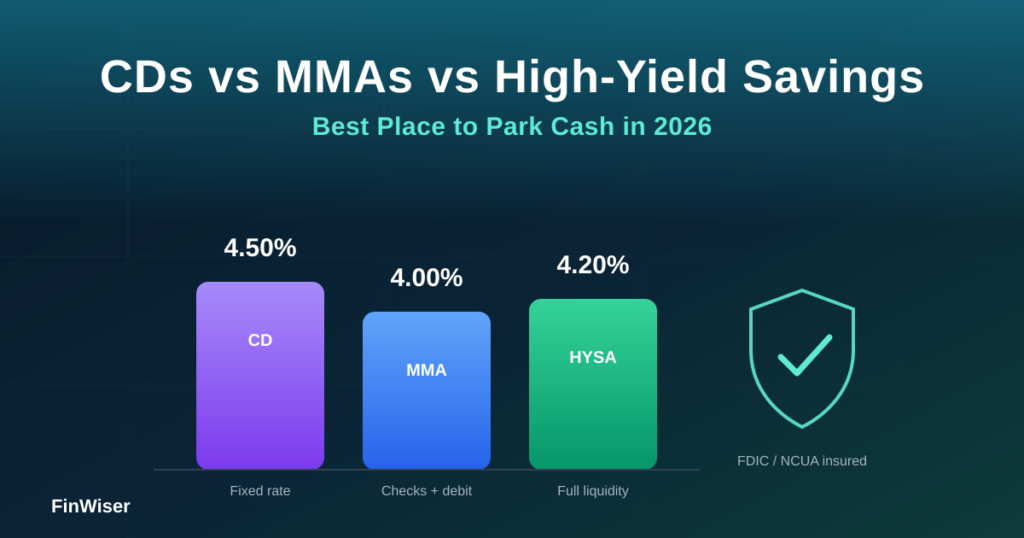
| Typical top APY (Aug 2026) | 3.95%–4.50% | Up to ~4.00% | Up to ~4.20% |
| Rate type | Fixed for the term | Variable | Variable |
| Typical minimum deposit | $0–$2,500 | Often $1,000+ | Often $0 |
| Access to funds | Locked until maturity | Checks/debit, some limits | Transfers only |
| FDIC/NCUA insured | Yes, up to $250,000 | Yes, up to $250,000 | Yes, up to $250,000 |
| Early withdrawal penalty | Yes, several months’ interest | No, but limits may apply | No, but limits may apply |
| Best for | Money untouched for months/years | Large, flexible balances | Emergency funds |
Rates reflect a general survey of top nationally available offers as of mid-August 2026 and change frequently — always check a specific bank’s current rate before opening an account.
Top nationally available rates vs. the 0.45% national average money market yield, mid-August 2026.
Rate and APY Potential
Rate is usually the first thing savers check when comparing CD vs money market vs high-yield savings, and the order looks a little different than it did a couple of years ago. CDs are currently paying some of the strongest guaranteed rates of the three, with well-known accounts landing between roughly 3.95% and 4.50% APY depending on term. Top high-yield savings accounts aren’t far behind, with some advertising north of 4.20% APY, while money market accounts sit a touch lower, clustering closer to 4.00% APY at the top of the market.
A few names currently near the top of the rate tables include Ally Bank, SoFi, and Forbright Bank — worth a look if a specific rate matters more to you than brand recognition.
How You Access Your Money
This is where the three products pull furthest apart. A CD locks your deposit for a fixed term — anywhere from a few months to several years — and pulling money out early usually costs a chunk of the interest you’ve earned. Money market accounts sit at the other end, with many offering check-writing privileges or a debit card so your cash stays genuinely spendable.
High-yield savings accounts land in the middle: you can transfer money out whenever you need it, just usually without a card or checkbook attached, and transfers can take a day or two to land in an external account.
Minimum Deposits and Fees
The entry price matters just as much as the rate once you’re actually comparing CD vs money market vs high-yield savings options. Minimums vary more by bank than by account type, but there are patterns. Money market accounts more often ask for a higher opening or minimum balance to avoid a monthly fee, since the checking-style features cost the bank more to offer. High-yield savings accounts frequently have no minimum at all — several accounts on this month’s top-rate lists open with $0. CDs sit in between: some open with $0, others want $500 to $2,500 to unlock the advertised rate.
Safety and Insurance
Safety is the one category where CD vs money market vs high-yield savings doesn’t really matter — all three are protected the same way, which is easy to forget once the rate comparisons start pulling focus. As long as the institution is FDIC-insured (or NCUA-insured for a credit union), your CD, MMA, and HYSA balances are each covered up to $250,000 per depositor, per institution. That protection doesn’t change based on which of the three you pick, so safety alone isn’t a reason to favor one over another.
Fixed vs. Variable Rates
A CD’s rate is locked the day you open it and stays put for the whole term, which is either an advantage or a drawback depending on where rates are headed. Money market and high-yield savings rates are variable, and banks can adjust them at any time, usually in step with the Federal Reserve. In a rate environment where cuts are still on the table, that fixed CD rate starts to look a lot more appealing to savers who want certainty.
Who Each Account Actually Fits
This is really the crux of the CD vs money market vs high-yield savings decision: CDs make the most sense for money you’re confident you won’t need before a specific date — a house down payment 18 months out, for example. Money market accounts suit savers who want a strong rate but also want the option to write a check or swipe a card without transferring funds first. High-yield savings accounts are the default pick for an emergency fund: full liquidity, a competitive rate, and no term to plan around.
How the Fed’s 2026 Pause Is Shaping These Rates
None of these three products exists in a vacuum — all of them move, directly or indirectly, with the Federal Reserve’s benchmark rate. After cutting rates three times at the end of 2025, the Fed held steady through its first several meetings of 2026 as inflation and oil prices ticked back up. That pause is a big part of why CD rates have stayed competitive with savings and money market rates this year instead of drifting further behind them.
This is precisely why the CD vs money market vs high-yield savings comparison keeps shifting mid-year: if the Fed does cut again later in 2026, variable rates on money market and high-yield savings accounts will likely follow within weeks, while a CD opened today keeps its rate locked regardless of what happens next. That’s the practical argument for locking in a fixed CD rate sooner rather than later, if the money truly won’t be touched before the term ends.
A Real Number Worth Knowing
The average money market account nationwide paid just 0.45% APY during the week of August 12, 2026, according to Bankrate’s weekly survey of more than 2,200 banks and credit unions — a fraction of what the best-paying accounts were offering at the same time.
That gap is exactly why shopping around, rather than defaulting to whichever bank you already use, matters so much once you actually run the CD vs money market vs high-yield savings numbers. Staying in a low-rate default account while a competitive CD, MMA, or HYSA sits one application away is one of the most expensive habits a saver can have.
A Halal-Conscious Note on Interest-Bearing Accounts
CDs, money market accounts, and high-yield savings accounts are all interest-based (riba) products by design — the return you’re comparing throughout this article is interest, however it’s labeled on a bank’s website. For a halal-conscious reader, the question isn’t which of these three ranks highest, but whether a conventional interest-bearing account belongs in the plan at all.
If earning interest isn’t something you’re comfortable with, look instead at Shariah-compliant alternatives, such as Islamic banking profit-and-loss-sharing accounts (mudarabah), and treat the APY figures on this page as reference points for what you’re opting out of, not a menu to choose from.
Where Each Option Wins
Every one of these three has a genuine edge somewhere — here’s exactly where each pulls ahead in the CD vs money market vs high-yield savings matchup.
Where CDs Win
- Locked-in rate protection. Once you open the CD, the rate can’t drop on you, even if the Fed cuts again before your term ends.
- Slightly higher ceiling right now. The strongest CD offers are currently outpacing the strongest MMA and HYSA offers.
- Built-in discipline. The early withdrawal penalty is a feature for savers who know they’d otherwise be tempted to dip into the account.
Where Money Market Accounts Win
- Spendable without a transfer. Check-writing and debit access mean you’re not waiting a day or two to reach your own money.
- Solid rate without locking anything up. You get a competitive APY and still keep near-instant access.
- Good fit for large, flexible balances. Higher minimums pay off if you’re already sitting on a five-figure cushion.
Where High-Yield Savings Accounts Win
- Lowest barrier to entry. Many open with $0 and no ongoing minimum balance.
- Top rates in the category right now. Several HYSAs are currently out-earning the best money market offers.
- Purpose-built for emergency funds. Full liquidity with no term and no penalty for pulling money out.
CD vs Money Market vs High-Yield Savings: Which One Fits You?
- Building an emergency fund? A high-yield savings account is close to the obvious answer — you want the money reachable the day something goes wrong, and today’s top HYSAs pay competitively enough that liquidity doesn’t cost you much.
- Saving for a goal 6–18 months out? A CD in that maturity range locks in a fixed rate for exactly the window you need, and you likely won’t miss the access.
- Holding a large balance you might need to tap? A money market account gives you a strong rate without giving up the checkbook.
- Not sure yet? Split the difference — an HYSA for the portion you might need on short notice, a CD for the portion you know you won’t.
There’s no single wrong answer among the three — just a right fit that’s specific to your own timeline and comfort with locking money away.
Key Takeaways: CD vs Money Market vs High-Yield Savings
- CDs are currently edging out MMAs and HYSAs on top APY, with well-known offers ranging from roughly 3.95% to 4.50% depending on term.
- Money market and high-yield savings rates are variable, so they’ll likely move if the Fed cuts again later in 2026 — a CD opened today won’t.
- The national average money market rate sits at just 0.45% APY, which is the real cost of leaving cash in a default account instead of shopping around.
- FDIC or NCUA insurance covers all three account types identically up to $250,000, so safety isn’t what should decide between them.
- None of the three is inherently right for everyone — the winning mix depends entirely on when you’ll actually need the money.
Whichever way the CD vs money market vs high-yield savings decision lands for you, the right account is simply the one that matches your timeline. For a deeper feature-by-feature breakdown of how these account types compare, Bankrate’s guide to money market accounts, savings accounts, and CDs is a solid next read. And for more comparisons like this one, explore more banking and savings breakdowns on FinWiser.