
Banking & Saving > Learn > Free Checking vs. Fee-Based vs. Islamic Checking Accounts Compared
Three checking accounts, three different cost structures — here’s what each one actually costs you, in dollars and, for some readers, in principle.
On This Page
- At a Glance: This Checking Account Comparison Side by Side
- Good News — You Don’t Have to Choose Just One
- Criteria-by-Criteria: The Full Checking Account Comparison
- What “Interest” Actually Means on a Checking Account
- The Numbers Behind This Checking Account Comparison
- Where Each Type of Checking Account Wins
- Which One Is Right for You
- Islamic & Riba-Free Checking Providers to Watch
- Key Takeaways
Most people open a checking account once, in their late teens or early twenties, and never think about it again. That’s worth revisiting, because checking accounts aren’t interchangeable. A free account, a fee-based account, and a riba-free (Islamic) account run on three different business models, and each one asks something different of you — a minimum balance, a direct-deposit habit, or a set of principles about how money should and shouldn’t grow.
This checking account comparison puts all three side by side, with real numbers, so you can see exactly what you’re paying, or not paying, whichever route you take. There’s no universally “correct” answer here, and that’s the point. A free account is the sensible default for most people. A fee-based, interest-earning account can occasionally out-earn its own cost if you keep a high balance. An Islamic checking account isn’t really about cost at all — it’s about whether the account’s structure lines up with your principles, and for a growing number of U.S. account holders, that question carries as much weight as the fee schedule.
Good News — You Don’t Have to Choose Just One
Here’s something most comparison articles skip: these three categories aren’t mutually exclusive. Plenty of people run a free checking account for everyday bill-pay and debit-card spending, then keep a separate riba-free account at a provider like University Islamic Financial for money they want to hold in a way that matches their values.
Others open a fee-based, interest-checking account to park a larger balance, then donate whatever interest it earns to charity — a workaround several Islamic scholars accept when no local halal option exists. A halal-conscious reader doesn’t have to pick one lane forever; the real decision usually isn’t “which one,” it’s how much of your money sits where, and why.
At a Glance: This Checking Account Comparison Side by Side
Before the details, here’s the checking account comparison in one table: the same eight criteria applied to a typical free account, a typical fee-based (interest) account, and a typical U.S. Islamic checking account. Treat these as representative ranges — individual banks vary, sometimes widely, within each category.
| Free Checking | Fee-Based / Interest Checking | Islamic (Riba-Free) Checking | |
|---|---|---|---|
| Typical monthly fee | $0 | $5–$25 | $0–$10 |
| Minimum balance to waive fee | None required | Often $1,500–$25,000+ | Rarely required |
| Interest / return | None, or minimal | Guaranteed APY, usually under 1% | None guaranteed; profit-sharing only |
| Riba (interest) status | Interest-free by default | Interest-bearing | Structured to avoid riba entirely |
| Deposit insurance | FDIC/NCUA up to $250,000 | FDIC/NCUA up to $250,000 | FDIC/NCUA up to $250,000 |
| ATM access | Often broad, online banks lead | Broad at large banks | Narrower network |
| Overdraft fees | Varies, some $0 | Varies, some $30+ | Typically avoided by design |
| Best for | Most people, low balances | High, stable balances | Faith-driven, principle-first banking |
Source: Bankrate 2025 Checking Account and ATM Fee Study. Most U.S. Islamic checking providers price closer to the free-checking bar than either fee-based figure, since their revenue model leans on financing products rather than deposit fees.
Criteria-by-Criteria: The Full Checking Account Comparison
Averages hide a lot of variation between individual banks, so let’s break this checking account comparison down criterion by criterion — starting with the one most people check first.
Cost & Monthly Fees
Free checking accounts, in the strict sense, charge no monthly maintenance fee and require no minimum balance to keep it that way — accounts like Capital One 360 Checking or Ally’s Spending Account are common examples. “No-fee” and “free” get used loosely in marketing, though: some accounts are fee-free only if you maintain a minimum balance or set up direct deposit, which makes them conditional rather than genuinely free.
Fee-based checking splits into two flavors. Non-interest checking with a maintenance fee is the traditional branch-bank model, in effect paying for the branch network and in-person service. Interest-bearing checking usually carries a higher fee still, because the bank pays you something in return — it only pencils out if the interest earned covers, or exceeds, that fee.
Islamic checking accounts, in practice, tend to price like free checking: little to no monthly maintenance fee, since the provider’s revenue model typically comes from financing products, like halal home financing, rather than deposit fees.
Interest, Yield & Riba
On a conventional account, interest is a fixed, guaranteed payment the bank makes to you for holding your deposit, expressed as an annual percentage yield, or APY. Even at the higher end for checking, that yield rarely beats inflation — checking APYs typically run well under 1%, against 4%+ on many high-yield savings accounts.
So for a purely financial reader, the deeper question usually isn’t “does this account pay interest,” it’s “is checking even the right place to hold money I’m not spending soon.”
A Halal-Conscious Note on Riba-Free Checking
For Muslim account holders, the interest question isn’t about yield at all — it’s about riba, any predetermined, guaranteed return on money, which is prohibited in Islamic finance regardless of the rate. A genuinely riba-free checking account avoids paying, or charging, interest and is typically structured as a profit-sharing arrangement instead, sometimes called Mudarabah, where any return comes from real economic activity rather than a fixed rate promised in advance.
In the U.S., riba-free checking is usually offered by a small number of dedicated providers — a faith-based division of an FDIC-insured bank, or a member-owned credit union built around the same principle — rather than mainstream banks. That means a smaller ATM network and fewer branches, and it’s worth confirming Sharia compliance directly with the provider, since standards differ by institution and by scholar.
Deposit Insurance & Safety
This is one area where the checking account comparison flattens out: all three account types, when offered through a properly chartered U.S. bank or credit union, carry federal deposit insurance up to $250,000 per depositor — FDIC for banks, NCUA for credit unions. That’s true whether the account is free, fee-based, or structured as riba-free; the insurance follows the institution’s charter, not the account’s pricing or religious structure.
Worth double-checking with any newer or smaller provider: which institution actually holds the deposit, since some fintech apps route funds through a partner bank rather than holding a charter themselves.
Accessibility, ATMs & Overdrafts
Free, fee-based, and Islamic checking accounts differ most in day-to-day convenience. Large conventional banks and most free online accounts offer broad fee-free ATM networks, sometimes tens of thousands of machines, plus 24/7 mobile support. Islamic checking providers, being smaller and more specialized, typically offer a narrower ATM footprint and manage more of the relationship by phone or online banking rather than in a branch.
Overdraft handling varies more by provider than by category: some free and fee-based accounts have eliminated overdraft fees entirely, while others still charge $30 or more per occurrence. Riba-free providers generally avoid a flat overdraft penalty fee outright and instead decline the transaction or require a linked backup source.
What “Interest” Actually Means on a Checking Account
It’s worth pausing on how checking-account interest is actually calculated, because the mechanics explain why fee-based checking so rarely beats a free account for most people. APY compounds a stated rate over a year, but most checking accounts pay tiered interest that only applies to balances above a threshold — an account advertising 1% APY might only pay meaningfully once your balance crosses $10,000 or more.
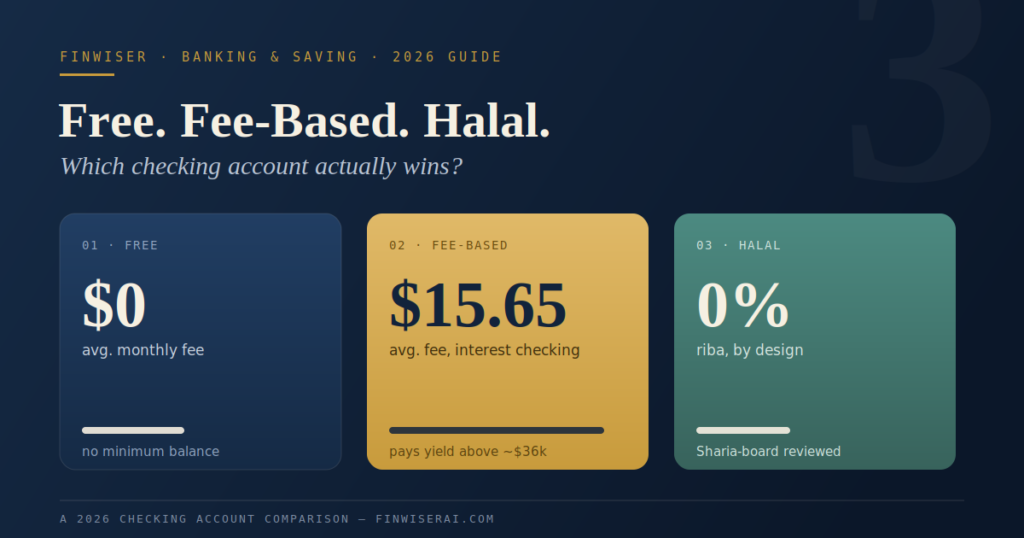
That’s also why comparing accounts on APY alone is misleading. A $0-fee account paying no interest and a $15-fee account paying 0.5% APY only break even around $36,000 in average balance — below that, the free account wins outright. It’s the same math that makes many riba-free accounts easy to recommend on pure economics, not just principle: nothing to break even against.
The Numbers Behind This Checking Account Comparison
This checking account comparison comes into sharpest focus with real numbers. According to Bankrate’s 2025 Checking Account and ATM Fee Study, the average monthly maintenance fee on non-interest checking accounts is $5.47, while the average fee on interest-bearing checking accounts is nearly three times higher, at $15.65 — before counting overdraft or ATM charges. The same study found 47% of non-interest checking accounts charge no fee at all once standard waiver conditions, like direct deposit, are met.
In other words: the free option here isn’t a niche pick, it’s close to the median outcome once you shop around, while the higher-yield fee-based option is a deliberate trade only worth making above a specific balance.
Where Each Type of Checking Account Wins
No single account wins every category. Here’s where each one genuinely has the edge, stripped of any “best overall” marketing language.
Where Free Checking Wins
- No fee, no math. Nothing to calculate or offset — the account costs $0 regardless of your balance or habits.
- Best for beginners and low balances. There’s no minimum balance to track, so it’s the easiest account to hold well.
- Widest availability. Nearly every online bank, and most large banks, offer a genuinely free option today.
Where Fee-Based (Interest) Checking Wins
- Meaningful yield at high balances. Above roughly $30,000–$40,000, the interest earned can outweigh the fee entirely.
- Bundled perks. Fee-based accounts more often bundle cash back, higher ATM reimbursement caps, or premium support.
- Relationship pricing. Many banks waive the fee once you also hold a mortgage, brokerage account, or large combined balance with them.
Where Islamic Checking Wins
- Principle-first structure. It’s the only category built specifically to avoid riba by design, not as a personal workaround.
- Fee profile close to free checking. Most riba-free providers charge little or nothing in monthly fees.
- Independent Sharia oversight. Accounts are typically reviewed by a dedicated Sharia board, a layer conventional accounts don’t offer at all.
Which One Is Right for You
Bringing this checking account comparison down to a single choice depends mostly on your balance, your habits, and — for some readers — your principles. A few common situations:
Opening your first account, or keeping a modest balance: a free checking account is the straightforward choice — nothing to track, nothing to offset.
Consistently high balance that won’t move much: a fee-based interest checking account, or a checking-plus-savings hybrid, can be worth the fee once you clear the break-even point above.
Riba-free banking matters to your faith: an Islamic checking account is worth the smaller ATM network, often paired with a free account for everyday spending.
You overdraft often: prioritize whichever account has eliminated overdraft fees outright, over optimizing for yield or branding.
Running a small business: look at the business-checking version of each category, since fees and minimums differ from personal accounts.
Islamic & Riba-Free Checking Providers to Watch
If riba-free banking is new territory, these are real, currently operating U.S. providers worth researching directly — confirm current fees and Sharia board oversight on each one’s own site before opening an account, since terms change.
- University Islamic Financial (UIF) — a Michigan-based, FDIC-insured division of University Bank offering riba-free checking, savings, and Murabaha home financing.
- Stearns Salaam Banking — a riba-free banking division of Stearns Bank, N.A., built on profit-sharing rather than interest.
- Maun Federal Credit Union — a community-founded, NCUA-chartered credit union built around riba-free banking principles.
- Devon Bank — a Chicago community bank that pioneered U.S. Islamic home financing in 2003, alongside its everyday checking products.
Key Takeaways
- Free checking is the right default for most people — nothing to offset and no minimum balance to track.
- Fee-based, interest-earning checking only pays off once your average balance clears a specific break-even point, often in the tens of thousands of dollars.
- Islamic checking accounts avoid riba by design, price close to free checking, and add independent Sharia board oversight — with a smaller branch and ATM footprint in exchange.
- Whichever side of this checking account comparison you land on, all three account types carry the same federal deposit insurance once held at a properly chartered bank or credit union.
- You don’t have to choose only one — many households layer a free everyday account with a values-aligned or high-balance account for money they aren’t spending immediately.
For a deeper look at current no-fee options, see Bankrate’s roundup of the year’s best free checking accounts. And for more FinWiser breakdowns like this one, browse our banking & saving guides.