
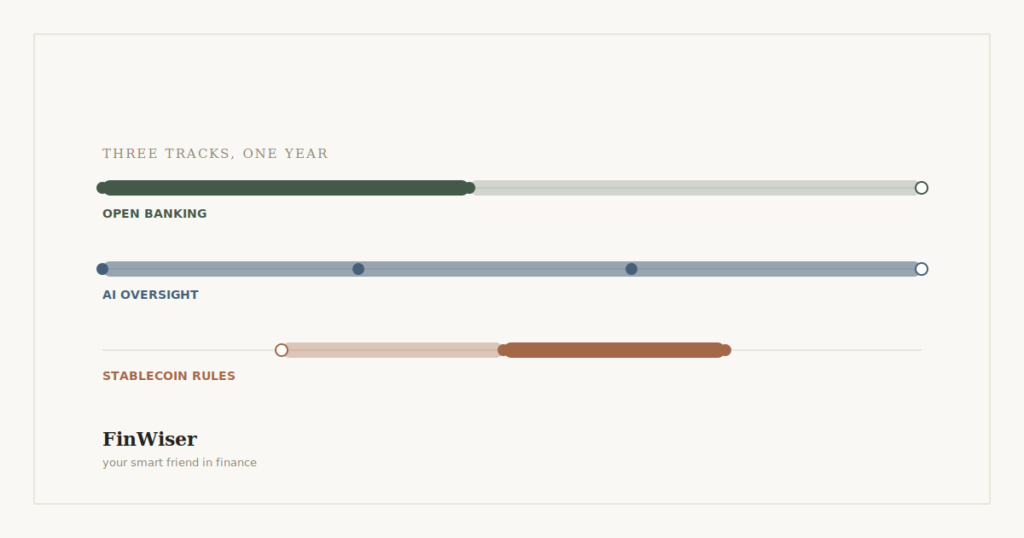
Three separate regulatory tracks — data-sharing, AI oversight, and stablecoins — are all moving in 2026, and none of them require you to pick a side.
Disclosure: FinWiser has no advertiser, lending, or affiliate relationship with any company, agency, or platform named in this article.
- Three Fronts of Financial Regulation Changes 2026
- At a Glance: Compared
- Where Each One Stands
- Who’s Affected
- Dates to Watch
- What Changes in Practice
- What to Actually Do
- Halal-Aware Note
- Why the Speeds Differ
- The Numbers Behind the Gap
- Where Each One Wins
- Which One Is Right for You
- Key Takeaways
- Startups to Watch
Every few months, a new headline claims that banking is about to change forever. Most of the time, nothing changes for the average account holder by the following Monday. But 2026 is different: three separate regulatory tracks — open banking, AI oversight, and stablecoin rules — are moving at once, and each one touches how your money moves, who can see it, and who is accountable when something goes wrong. Reading the news, though, this can look like a pile of legal jargon with no throughline. That’s exactly why FinWiser is tracking financial regulation changes 2026 as one connected story instead of three unrelated ones.
This isn’t about picking a “winner” among these three shifts. They aren’t competing products — they’re overlapping forces, and understanding how they interact matters more than ranking them. That’s the frame for everything below.
Three Fronts of Financial Regulation Changes 2026
Good news: you don’t have to choose which of these to care about. Open banking, AI oversight, and stablecoin regulation are stacking on top of each other in the same calendar year, and most of them affect you whether or not you ever touch a crypto wallet or a budgeting app.
If your bank uses AI to flag fraud (nearly all of them do), if you’ve ever linked your account to a third-party app, or if you’ve ever paid with a service that quietly settles in stablecoins behind the scenes, all three tracks of financial regulation changes 2026 already apply to you. You don’t need to become a compliance officer to follow this — you just need one clear map of what’s moving and when.
Here’s the short version before the detail: financial regulation changes 2026 break down into three tracks moving at three different speeds. Open banking — the right to move your own financial data — is legally real but not currently enforced. AI oversight in banking is being handled through existing exam frameworks rather than a dedicated new law. Stablecoin regulation, under the GENIUS Act, is the most concrete of the three, with real deadlines regulators are racing to meet before the law takes effect.
At a Glance: Financial Regulation Changes 2026 Compared
| Criterion | Open Banking | AI Oversight | Stablecoin Rules |
|---|---|---|---|
| Legal basis | Section 1033, Dodd-Frank Act | Existing model-risk & exam guidance | GENIUS Act (2025) |
| Current status | Finalized, but enforcement blocked by court order | No dedicated statute; folded into routine exams | Signed into law; agencies finalizing rules |
| Who it affects | Large banks + connected fintech apps | Anyone whose bank uses automated decisions | Anyone holding or spending a dollar-pegged token |
| Date to watch | Whenever CFPB republishes the revised rule | Each new round of Fed/OCC exam priorities | Jan 18, 2027, or 120 days after final rules |
| Practical change | Portable account data on request, if enforced | More pressure toward human-review options | 1:1 reserves, monthly audits, no interest paid |
| Halal-conscious angle | Neutral — plumbing, not a financial product | Neutral — check underlying credit-scoring logic | Yield ban removes a riba-like feature by default |
Table 1. How the three tracks of financial regulation changes 2026 compare across the questions that matter most to an individual account holder.
Chart 1. Open banking’s clock paused mid-2026 pending a rewrite; AI oversight runs continuously through routine exams; stablecoin rules are the only track with a fixed legal deadline.
Below, each front of financial regulation changes 2026 is broken down by the questions that actually matter to a reader managing their own money: where it stands today, who it affects, when to pay attention, what changes in practice, what you should actually do, and how a halal-conscious reader should think about it.
Where Each One Stands
Where things actually stand differs sharply across financial regulation changes 2026. Open banking’s legal foundation, Section 1033 of the Dodd-Frank Act, was finalized in October 2024 with compliance meant to start in April 2026. A federal court in Kentucky has since blocked enforcement while the CFPB rewrites it, so the right exists on paper but isn’t enforced today.
AI oversight has no dedicated US statute at all — the Fed, OCC, and FDIC instead fold AI questions into routine bank exams, stretching decades-old model-risk guidance to cover generative and agentic systems. Stablecoin regulation is furthest along: the GENIUS Act was signed in July 2025, and the OCC, FDIC, and Treasury all pushed to finalize implementing rules by mid-2026.
Who’s Affected
Who gets affected also varies. Open banking’s data-sharing rights, once enforced, apply mainly to large banks and the fintech apps that connect to them — budgeting apps, lending platforms, account aggregators. AI oversight touches anyone whose bank uses automated systems for credit decisions, fraud flags, or customer service, which by 2026 is close to universal; one industry survey found most financial firms already have AI agents in production or pilot. Stablecoin rules affect anyone who holds or spends a dollar-pegged token, plus the banks and fintechs racing to issue their own.
Dates to Watch
The dates worth circling look different for each. For open banking, the date to watch isn’t a compliance deadline — it’s whenever the CFPB publishes its revised rule, since the original April 2026 deadline already passed without becoming binding. For AI oversight, there’s no single date; instead, watch for updated supervisory guidance each time the Fed or OCC issues new exam priorities. For stablecoins, the real deadline is the earlier of January 18, 2027, or 120 days after regulators finalize their rules — most of which were targeted for mid-2026.
What Changes in Practice
What actually changes in practice is the part most coverage skips. If open banking’s rule survives its rewrite, you’ll be able to request your transaction history, account terms, and balances electronically and hand them to a third party without your bank dragging its feet. AI oversight means your bank’s automated decisions — a declined card, a flagged transaction, a credit offer — are now more likely to sit behind a human-review requirement during an exam, even without a new law forcing it.
Stablecoin rules mean any dollar-token you hold from a compliant issuer must be backed 1:1 by cash or short-term Treasurys, audited monthly, and cannot pay you interest for holding it.
What to Actually Do
There’s a real action item buried in each track, too. For open banking, the practical move is to notice which apps you’ve already granted account access to and revisit those permissions periodically, since the underlying legal protections are still unsettled. For AI oversight, ask your bank directly whether an automated decision can be escalated to a human — many now offer this even without being required to. For stablecoins, check whether the token you’re using is a GENIUS-compliant payment stablecoin or an older, less-transparent one before treating it like cash.
A halal-conscious reader should weigh each track a little differently. Open banking is a data-sharing mechanism, not a financial product, so it’s neutral on riba — the concern is really about what the underlying account pays or charges, not the plumbing that moves the data. AI oversight is similarly neutral; a fraud-detection model isn’t interest-bearing, though it’s worth asking whether the credit-scoring AI behind a loan decision weighs conventional interest history in ways that disadvantage someone with a shariah-compliant financial history.
Stablecoins are the one place this gets genuinely interesting: the GENIUS Act bars issuers from paying interest or yield on stablecoin holdings, which — for reasons entirely unrelated to Islamic finance — happens to strip out the riba-like yield feature that made some earlier stablecoin products harder to justify for a halal-conscious user.
Why the Speeds Differ: Understanding “Regulation Lag”
It helps to understand why these three tracks move at such different speeds, and the honest answer is a concept regulators call “regulation lag.” A law can pass and still not bind anyone for years if litigation or a formal reconsideration process gets in the way — exactly what happened to open banking’s Section 1033 rule. AI oversight shows the opposite lag: technology moved faster than any single law could, so regulators stretch decades-old supervisory tools to cover systems that didn’t exist when those tools were written. Stablecoins split the difference — a brand-new law with an unusually tight one-year rulemaking clock, part of why its deadlines are the most concrete of the three.
The Numbers Behind the Gap
The numbers back up how fast the AI side of this picture is moving relative to the rules meant to govern it. A global survey by the Cloud Security Alliance found that 62% of financial services firms have already deployed AI agents, and 93% of those firms have given those agents meaningful autonomy over decisions — well ahead of any binding AI-specific rule for US banks. That gap between deployment and regulation is precisely why examiners are leaning on existing frameworks instead of waiting for new legislation to catch up.
Where Each One Wins
Where Open Banking Wins
- Owning your own data. It’s the only one of the three that gives you a legal claim to your own transaction history, not just a policy promise.
- Comparison shopping. Once enforced, it makes it dramatically easier to let a budgeting app or lender see your real financial picture without manual statement uploads.
- Switching banks. Portable data lowers the friction of moving your primary account somewhere better.
Where AI Oversight Wins
- Human review. It’s pushing banks toward giving you a person to appeal to when an algorithm gets something wrong.
- Fraud protection. The same oversight pressure that worries banks is also what’s driving faster, more accurate fraud detection.
- Transparency over time. Supervisory pressure is slowly forcing banks to explain, not just apply, automated decisions.
Where Stablecoin Regulation Wins
- Cheaper transfers. Compliant stablecoins promise remittance costs closer to pennies than the 6%-plus fees common today.
- Reserve safety. The 1:1 backing and monthly attestation requirement is the clearest consumer protection of the three tracks.
- A no-interest structure. The yield ban is unusual among financial products in actively avoiding an interest-based return.
Which One Is Right for You
If you use budgeting or lending apps regularly, open banking’s fate is the one to watch — it decides whether that convenience stays free and legally protected. If you’ve ever had a card declined or a loan handled by an algorithm, AI oversight determines how much recourse you actually have. If you send money internationally or you’re curious about digital dollars, stablecoin regulation is the most actionable of the three, since compliant products are already reaching the market this year.
Key Takeaways on Financial Regulation Changes 2026
- Financial regulation changes 2026 span three tracks — open banking, AI oversight, and stablecoins — moving at three different speeds.
- Open banking’s legal right to your data exists on paper but is currently blocked from enforcement while the CFPB rewrites the rule.
- AI oversight in banking runs through existing exam frameworks, not a dedicated law, so ask your bank about human-review options directly.
- Stablecoin regulation under the GENIUS Act is the most concrete track, with a hard deadline no later than January 18, 2027.
- None of the three tracks requires an interest-based payment to function — worth noting for a halal-conscious reader comparing products built on top of them.
Five Startups Shaping How This Plays Out
A handful of companies are building the infrastructure that makes these rules workable in practice, rather than just theoretical.
- Plaid — the account-connection layer behind most budgeting and lending apps, directly exposed to how the open banking rule gets rewritten.
- MX — a data platform banks use to meet consumer-data-sharing expectations even while the federal rule is unsettled.
- Leo RegTech — an AI-assisted compliance platform helping regulated firms track shifting obligations across jurisdictions.
- InnReg — a compliance automation firm building tools for fintechs managing complex, multi-agency obligations.
- FinlexPro — a regulatory-monitoring platform tracking obligations across dozens of regulators in near real time.
None of this needs to be memorized. What matters is knowing that financial regulation changes 2026 are three moving parts, not one event, and knowing which one applies to what you’re doing with your money this week — sharing data, trusting an algorithm, or holding a digital dollar. For a deeper technical breakdown of one piece of this picture, Investopedia’s guide to the GENIUS Act’s effect on stablecoins is a solid next read. And for FinWiser’s halal-aware take on how any of these tracks fits a shariah-conscious plan, visit FinWiser to start.