
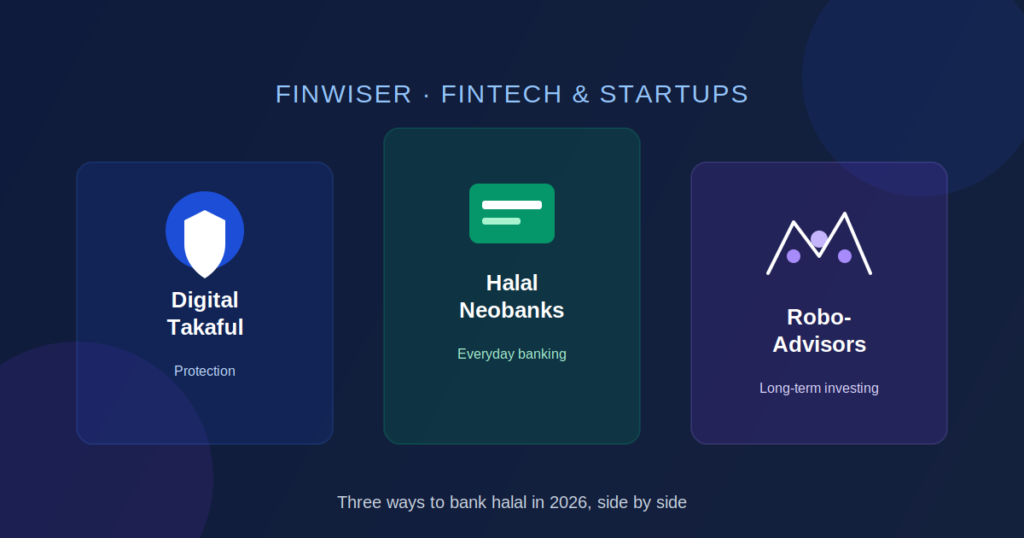
Three different jobs — insurance, everyday banking, and long-term investing — done the halal way. Here’s how digital takaful, halal neobanks, and shariah-compliant robo-advisors actually differ, and which one solves your particular gap first.
Bias disclosure: none of the providers named in this piece paid for, sponsored, or reviewed this article, and I don’t hold an account with or work for any of them. My only real stake is that halal-aware comparisons like this one are the core of what FinWiser does.
If you’ve started paying attention to Islamic fintech, you’ve probably noticed three different kinds of apps competing for the same halal-conscious wallet: digital takaful platforms, halal neobanks, and shariah-compliant robo-advisors. They get lumped together constantly, but they’re built to solve three completely different problems — protection, everyday banking, and long-term investing. This halal fintech comparison isn’t about crowning one universal winner, because for most people the honest answer is “it depends on which of those three jobs you’re trying to get done.”
A takaful platform replaces your insurance policy. A halal neobank replaces your checking account. A shariah-compliant robo-advisor replaces your brokerage account. Confusing the three is how people end up disappointed — expecting a neobank app to grow their retirement savings, or a robo-advisor to cover a hospital bill. Below, we break down what each one actually does, what “riba-free” really means in each case, and which combination makes sense depending on where you’re starting from.
Good News: You Don’t Have to Choose
These three categories aren’t rivals competing for the same account — they’re complementary layers of a halal financial stack. A lot of financially organized Muslims end up running all three at once: takaful for protection, a halal neobank for day-to-day spending, and a robo-advisor for long-term investing.
Think of it less like choosing a favorite and more like assembling a toolkit. The real decision isn’t “which one wins” — it’s “which one do I need first, given my current gaps.” Someone with no health coverage has a different starting point than someone fully insured but still investing through a conventional, interest-bearing brokerage.
At a Glance: The Halal Fintech Comparison Table
Here’s the side-by-side breakdown before we dig into specifics:
| Criterion | Digital Takaful | Halal Neobank | Shariah-Compliant Robo-Advisor |
|---|---|---|---|
| What it replaces | Conventional insurance | A conventional checking/savings account | A conventional brokerage or wealth manager |
| Riba-free mechanism | Tabarru’ (mutual donation pooling), not premium-for-profit | No interest paid or charged; revenue from fees/memberships | Shariah-screened equities, sukuk, and gold — no interest-bearing bonds |
| Typical cost | Contribution varies by coverage, like a premium | Flat membership fee or fee-free with conditions | Flat annual management fee, roughly 0.49%–0.99% |
| Typical minimum | No fixed minimum; contribution-based | Usually $0 to open | Often $100–$500 to start investing |
| Regulatory oversight | National insurance regulator (e.g. SECP, Bank Negara Malaysia) | Banking regulator via a licensed sponsor bank (e.g. FDIC-insured partner) | Securities regulator (e.g. SEC, FCA) as a registered investment adviser |
| Compliance standard | AAOIFI takaful standards + Shariah board | AAOIFI certification via a named Shariah board | Shariah screening ratios (e.g. non-compliant income under 5%) + purification |
| Best for | Replacing insurance and protection needs | Everyday spending, saving, and transfers | Long-term halal wealth building |
| Example providers | First Digital Takaful | Fair, Insha, Manzil | Wahed Invest |
11.5% projected CAGR, 2024/25–2029.
Criteria-by-Criteria Breakdown
Now let’s go deeper. Each part of this halal fintech comparison hinges on details that don’t show up in a glance-table — how riba is actually avoided, who regulates the product, and what it costs you in practice.
Riba-Free Mechanism
This is the single biggest technical difference between the three. Digital takaful platforms avoid riba by replacing the insurer–policyholder relationship with tabarru’ — participants donate into a shared pool, and the operator manages it for a fee rather than pocketing underwriting profit as an interest-bearing reserve. Halal neobanks avoid riba on the deposit side simply by not paying or charging interest at all; revenue instead comes from membership fees, card interchange, or optional Shariah-compliant investment add-ons.
Shariah-compliant robo-advisors avoid riba by screening out interest-bearing bonds and heavily leveraged companies, building portfolios instead from halal-screened equities, sukuk (asset-backed Islamic bonds), and gold. Each mechanism is meant to be verified by a Shariah supervisory board, and reputable providers publish that board’s names rather than just displaying a “halal-certified” logo. That distinction — mutual pooling, fee-based revenue, or portfolio screening — is the real backbone of any halal fintech comparison worth taking seriously.
Cost & Fees
Takaful contributions vary by coverage and provider, much like conventional premiums — there’s no single industry-wide number. Halal neobanks typically charge a membership fee instead of hidden charges; Fair, for example, has run pricing around $69 a year in place of overdraft and minimum-balance fees. Robo-advisors usually charge a flat annual management fee, commonly 0.49%–0.99%, plus fund-level costs baked into the underlying sukuk or equity funds. None of the three charge interest, but “no interest” doesn’t mean “no fees” — read the schedule closely.
Regulation & Licensing
Digital takaful operators are licensed as insurance businesses by their national regulator — SECP in Pakistan, Bank Negara Malaysia, or the equivalent elsewhere — on top of Shariah board sign-off. Halal neobanks are usually not banks themselves; most partner with a licensed, deposit-insured sponsor bank behind the scenes while the app layer handles the halal screening and user experience.
Shariah-compliant robo-advisors register as investment advisers with securities regulators, separate from any Shariah certification. Regulation and religious compliance are two different checks — a product can be fully licensed and still have a weak Shariah board, or the reverse. That gap is exactly why a careful halal fintech comparison checks licensing and Shariah sign-off as two separate boxes, not one.
Digital Experience
All three categories are mobile-first by design, which is part of why they’re often confused with each other. Takaful platforms focus their app experience on fast onboarding and digital claims. Halal neobanks lean into everyday tools — spending trackers, zakat calculators, prayer-time notifications. Robo-advisors focus on goal-based investing dashboards: risk questionnaires, automatic rebalancing, and portfolio breakdowns by asset class.
Availability
Coverage still varies a lot by country. Takaful has the deepest bench in Pakistan, Malaysia, Indonesia, and the Gulf. Halal neobanks are strongest in the US, Canada, the UK, and parts of Europe, with newer entrants launching across Africa. Robo-advisors are the most globally distributed of the three — Wahed alone operates across more than 100 countries — but account minimums, tax-wrapper options, and even basic app availability still depend heavily on where you live. Before assuming a provider serves you, check its supported-countries list directly rather than the marketing homepage — availability is the detail most halal fintech comparison articles skip.
Understanding Riba, Gharar, and Maysir
Every product here is built around avoiding the same three things. Riba is interest — a guaranteed return on money itself, rather than on a real asset or shared risk. Gharar is excessive uncertainty, part of why conventional insurance is contested among scholars. Maysir is gambling — profit from pure chance rather than productive activity.
Takaful solves for gharar through mutual risk-sharing instead of a wagered contract. Neobanks solve for riba by removing interest from the deposit relationship. Robo-advisors solve for all three through portfolio screening — excluding interest-bearing debt, speculative instruments, and off-limits industries. Knowing these three filters makes it easier to judge any new Islamic fintech product on its own terms, instead of taking a “halal-certified” badge at face value.
The Numbers Behind This Halal Fintech Comparison
The category is growing quickly enough that the numbers are worth sitting with. According to the Global Islamic Fintech (GIFT) Report 2025/26, produced by DinarStandard and Elipses, the global Islamic fintech market reached an estimated USD 198 billion in transaction volume in 2024/25 and is projected to grow to USD 341 billion by 2029 — an 11.5% compound annual growth rate.
The same report counts 484 Islamic fintech companies operating across 41 countries, with roughly 80% of that activity concentrated in just ten markets, including Saudi Arabia, Malaysia, Indonesia, and the UAE. That concentration matters practically: if you’re outside those core markets, expect fewer choices and slower feature rollouts than someone based in Kuala Lumpur or Riyadh, even as the underlying technology keeps improving.
How to Check Shariah Compliance Yourself
Every provider mentioned in this halal fintech comparison publishes — or should publish — a Shariah board or Shariah advisor of record, not just a logo. Before trusting any app with your money, look for three things: the names of the Shariah board members, a published compliance certificate rather than marketing copy, and a purification policy for any accidental non-compliant income.
Reputable robo-advisors disclose their screening ratios — for instance, capping non-compliant income at under 5% of total revenue, in line with AAOIFI standards. If a provider can’t answer “who certified this, and against what standard,” that’s a real gap, not a technicality — treat it the way you’d treat a bank that couldn’t tell you who insures your deposits.
Where Each Option Wins
No part of this halal fintech comparison is complete without being honest about trade-offs. Here’s where each category genuinely outperforms the other two.
Where Digital Takaful Wins
- Actual risk protection. Only takaful replaces insurance — a neobank or robo-advisor simply can’t pay a hospital bill.
- Mutual-pool structure. Surplus in the fund can sometimes be returned to participants, unlike a conventional insurer’s retained profit.
- Growing regulatory backing. Regulators like Pakistan’s SECP are now issuing dedicated digital takaful licenses, not just retrofitting old insurance rules.
Where Halal Neobanks Win
- Everyday convenience. Built for spending, saving, and daily transfers — the account you actually use every day.
- Transparent fee structure. Membership pricing instead of hidden overdraft and minimum-balance charges.
- Built-in halal tools. Zakat calculators and spending trackers save you from stitching together separate apps.
Where Robo-Advisors Win
- Long-term wealth building. The only category of the three actually designed to grow money over decades.
- Low entry barrier. Automated rebalancing and low minimums make halal investing accessible without a dedicated financial advisor.
- Global reach. The most internationally available category, with providers like Wahed operating across 100+ countries.
Which One Is Right for You? Wrapping Up the Halal Fintech Comparison
If you have no protection in place — no health, life, or home coverage — start with digital takaful. It’s solving the most urgent gap, and delaying protection to chase investment returns is a bad trade no matter which framework you use.
If your day-to-day banking still runs through an interest-based conventional account, a halal neobank (or at minimum, an account where you actively decline the interest) is next. It’s the account you touch most, so it’s worth getting right early.
If your protection and banking are already sorted and you’re sitting on savings in a low-yield or conventional account, a shariah-compliant robo-advisor is where the real long-term upside lives. Waiting to “get everything else perfect” first usually just means losing years of compounding.
Most people reading this will eventually run all three — just not all in the same month.
Key Takeaways
- Three different jobs. Digital takaful, halal neobanks, and shariah-compliant robo-advisors solve protection, banking, and investing — not the same problem in different branding.
- Riba-free doesn’t mean fee-free. Every provider still charges something; read the fee schedule.
- The category is scaling fast. Islamic fintech transaction volume is projected to nearly double, from USD 198 billion to USD 341 billion by 2029.
- Verify the Shariah board, not just the badge. A named board and a published certificate matter more than a logo.
- This isn’t about picking a winner. It’s about sequencing which gap you close first — protection, then banking, then investing.
5 Islamic Fintech Startups to Watch
To make this halal fintech comparison concrete, here are five real providers worth knowing by name — for research purposes only, not as an endorsement or paid placement.
- Wahed Invest — the largest global shariah-compliant robo-advisor, live in over 100 countries with portfolios of halal equities, sukuk, and gold.
- First Digital Takaful — Pakistan’s first fully digital, Shariah-compliant general takaful operator, licensed by the SECP.
- Manzil — a Canadian Islamic fintech building “the halal version of Wealthsimple,” spanning halal mortgages and investing, now expanding into the US.
- Fair — a US halal-certified neobank built around membership pricing instead of hidden fees.
- Insha — a Berlin-based Islamic digital bank, spun out of Al Baraka Türk, serving Muslim communities across Europe.
This halal fintech comparison will keep shifting as new providers launch and existing ones expand into new countries — treat it as a starting framework, not a permanent ranking. For more comparisons like this one, browse the rest of the Fintech & Startups pillar at FinWiser. For a deeper technical explanation of how takaful itself works, Investopedia’s overview is a solid next read: Investopedia: Takaful Insurance.