
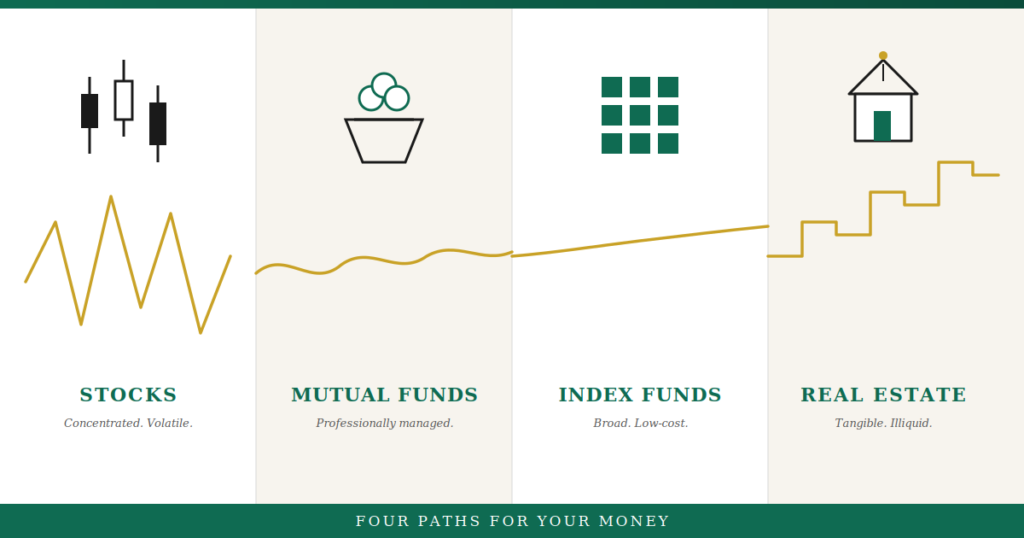
Stocks vs. Mutual Funds vs. Index Funds vs. Real Estate Compared
If you’ve got money to put to work and you’re staring at four different directions to send it, you’re not alone. Stocks, mutual funds, index funds, and real estate all show up on every “how to invest” list, and each one gets recommended like it’s the obvious answer. It isn’t. When you put stocks vs mutual funds vs index funds vs real estate side by side, what you actually find are four tools built for different jobs, different time horizons, and different amounts of hands-on effort.
When it comes to stocks vs mutual funds vs index funds vs real estate, this article isn’t here to crown a winner. By the end, you’ll know what each option actually asks of you — money, time, attention, and risk tolerance — and which one (or combination) fits where you are right now.
Stocks vs Mutual Funds vs Index Funds vs Real Estate: At a Glance
| Criteria | Stocks | Mutual Funds | Index Funds | Real Estate |
|---|---|---|---|---|
| Setup Effort | Low to open an account; high if picking individual companies well | Low — pick a fund, fund manager does the rest | Very low — pick an index, done | High — financing, inspections, paperwork, closing |
| Best For | Investors who want to research and pick individual companies | Investors who want professional management and are okay paying for it | Investors who want broad market exposure at the lowest cost | Investors who want a tangible asset and are comfortable with debt and upkeep |
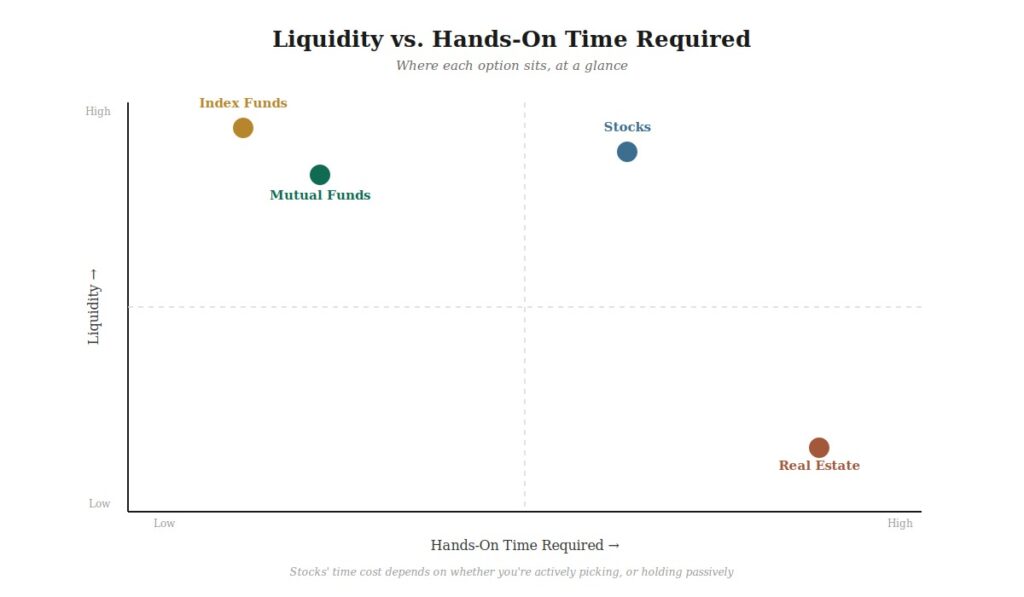
| Flexibility | High — buy, sell, or reallocate any trading day | Moderate — trade daily, but some funds carry redemption fees | High — same liquidity as stocks, low cost to adjust | Low — hard to sell part of a property or exit quickly |
| Time Commitment | High if actively researching and monitoring positions | Low — the fund manager handles day-to-day decisions | Very low — set an allocation and rebalance occasionally | High — tenants, maintenance, and management take ongoing time |
| Risk Level | High — concentrated in individual company performance | Moderate — diversified, but management decisions add variability | Moderate — diversified, moves with the broader market | Moderate to high — leverage and local market swings cut both ways |
| Liquidity | High — sell within seconds during market hours | High — sell within a day or two | High — sell within a day or two | Low — selling a property takes weeks to months |
| Halal Considerations | Depends on the company — screening needed for debt levels and sector | Depends on the fund — few are pre-screened for riba-free holdings | Depends on the index — Shariah-compliant index funds exist and screen automatically | Generally favorable if purchased without an interest-based mortgage |
Breaking Down Each Criterion
Setup Effort
Opening a brokerage account takes minutes for any of the first three options. The real difference in setup effort shows up after that. Picking individual stocks well means reading financial statements, understanding an industry, and tracking a company over time — that’s a standing commitment, not a one-time task.
A mutual fund shifts that research burden onto a professional manager, and an index fund removes it almost entirely by simply tracking a benchmark. Real estate sits at the opposite end: financing applications, property inspections, title work, and closing costs make it the slowest and most paperwork-heavy option to get into — a good reminder that stocks vs mutual funds vs index funds vs real estate isn’t just a returns comparison, it’s an effort comparison too.
Best For
Each of these four suits a different kind of investor. Someone who enjoys digging into a company’s earnings calls and competitive position might genuinely enjoy picking individual stocks. Someone who wants a professional making the calls, and is willing to pay a management fee for it, leans toward a mutual fund. Someone who wants to match the market’s long-term average with the lowest possible cost — which is most people, according to long-run performance data — fits an index fund. And someone who wants a physical asset they can improve, finance with leverage, and hold for rental income fits real estate. That’s the core split when you compare stocks vs mutual funds vs index funds vs real estate for personal fit.
Flexibility
Flexibility is one of the clearest differences in the stocks vs mutual funds vs index funds vs real estate conversation. Stocks and index funds can be bought or sold any day the market is open, which makes them the most flexible of the four. Mutual funds are close behind, though some charge a fee if you sell before a minimum holding period. Real estate is the outlier here — you can’t sell a bedroom to raise cash for an emergency. Once your money is in a property, it’s committed until you go through a full sale process.
Time Commitment
Time commitment might be the single biggest lifestyle factor in choosing between stocks vs mutual funds vs index funds vs real estate. Active stock picking can eat hours a week if done properly. Mutual funds and index funds ask almost nothing of your time day-to-day — you choose an allocation and revisit it occasionally. Real estate is the most time-intensive of the four once you own the property: tenant screening, maintenance calls, and lease renewals don’t pause because you’re busy with something else, unless you pay a property manager to absorb that work for you.
Risk Level
Concentrating money in a handful of individual stocks means your returns depend heavily on how those specific companies perform, which raises both the upside and the downside. Mutual funds and index funds spread that risk across dozens or hundreds of holdings, which smooths out the ride, though a mutual fund’s manager can still make calls that underperform the broader market. Real estate carries a different kind of risk — it’s tied to a single property in a single location, and if you’ve used a mortgage, that leverage magnifies both gains and losses. That contrast is central to any stocks vs mutual funds vs index funds vs real estate risk conversation.
Liquidity
Stocks, mutual funds, and index funds can all typically be converted to cash within a day or two. Real estate can take months, and selling in a hurry usually means accepting a lower price. If you expect to need the money on short notice, that liquidity gap matters more than almost any other factor once you map out stocks vs mutual funds vs index funds vs real estate side by side.
Halal Considerations
For a reader building a halal money system, the screening burden is different across all four. Individual stocks require checking a company’s debt-to-asset ratio and the nature of its business, since interest-bearing debt and prohibited industries (like conventional banking or alcohol) rule a stock out regardless of how well it performs. Mutual funds rarely disclose this screening upfront, so you’d need to dig into the fund’s holdings yourself. Index funds solve this cleanly if you choose one built specifically to track a Shariah-compliant index — the screening is baked into the index itself, so you’re not doing manual due diligence on every holding. Real estate is generally the most straightforward of the four from a halal standpoint, provided the purchase avoids an interest-based mortgage — cash purchases, rent-to-own structures, or Islamic financing products like Murabaha or Ijarah are the common workarounds. This is where stocks vs mutual funds vs index funds vs real estate diverge the most for halal-conscious investors.
Which One Is Right for You
Weighing stocks vs mutual funds vs index funds vs real estate ultimately comes down to your own time, risk tolerance, and liquidity needs:
If you’re just starting out: an index fund is usually the lowest-friction way to get market exposure without needing to become a part-time analyst.
If you enjoy research and want more control: individual stocks let you build a portfolio around specific companies you understand well, at the cost of more time and more concentrated risk.
If you want a professional making allocation calls: a mutual fund trades a management fee for someone else doing the picking, though it’s worth comparing that fee against index fund returns before committing.
If you have irregular income and want flexibility: stocks and index funds are easier to scale up or down, and easier to convert back to cash, than a property you can’t partially sell.
If you want a tangible asset and don’t mind hands-on work: real estate offers rental income and leverage that the other three can’t replicate, provided you’re prepared for the time commitment and lower liquidity that comes with it.
However you land on stocks vs mutual funds vs index funds vs real estate, matching the option to your own time and risk tolerance matters more than chasing whichever performed best last year. For another perspective on the stocks-versus-property side of that question, NerdWallet’s breakdown of real estate vs. stocks is worth a read.
Key Takeaways
A few things stand out when you compare stocks vs mutual funds vs index funds vs real estate side by side:
- Index funds generally offer the lowest cost and lowest time commitment of the four options, which is why they’re the default recommendation for most long-term investors.
- Individual stocks carry the highest potential for both gains and losses because returns depend on a small number of specific companies rather than a diversified basket.
- Real estate is the least liquid of the four — converting a property back into cash can take months, unlike stocks, mutual funds, and index funds which typically settle within days.
- Mutual funds add a management fee in exchange for professional decision-making, so it’s worth comparing that fee against index fund performance before choosing one over the other.
- Halal screening works differently across all four: individual stocks and mutual funds need manual due diligence, Shariah-compliant index funds build the screening in automatically, and real estate is straightforward mainly when purchased without interest-based financing.
Once you’ve weighed stocks vs mutual funds vs index funds vs real estate, the next question is how each choice actually plays out over time — and that comes down to matching it against your own timeline and risk tolerance.